You’ve got a happy customer.
They’ve said yes to a case study.
And now you’re sat staring at a blank doc trying to work out what on earth you’re going to write.
There are two stages to a great case study.
Stage 1: a case study interview that gets you the story and the detail you need.
Stage 2: a structure for telling that story, in a way that’s clear and enables prospects evaluating you to find themselves in the story.
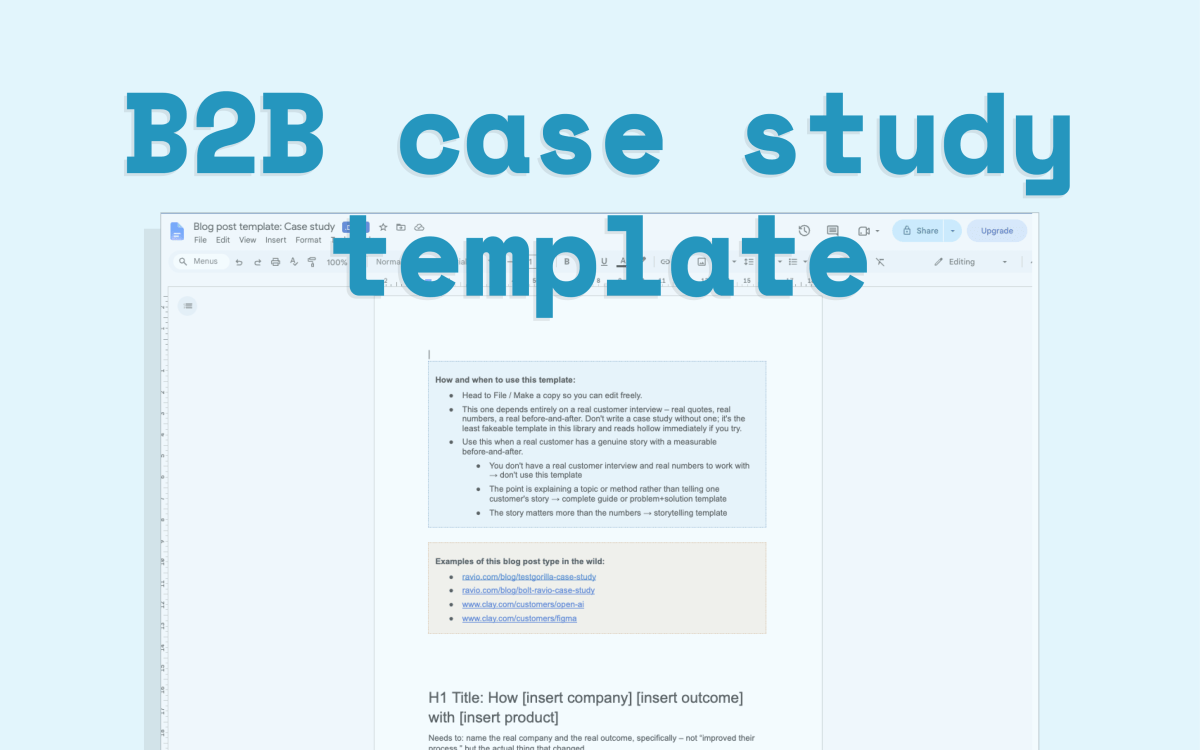
This guide covers both, and we’ve put together a case study template for you too, to give a foundation for that structural stage 2.
Skip straight to the case study template →
Case study template vs case study design template
One quick note before we get into it.
If you’re after a case study design template – something pre-designed to drop your logo and a stock photo into – this isn’t that. Canva and your PPT slide library have you covered.
And if you’ve landed here looking for how to write an academic case study for a dissertation, also not this. Sorry.
This is for B2B marketers writing a customer story: how to run the interview, and how to structure the case study.
What makes a B2B case study worth reading
Specificity, and a use case that matches the reader’s experience.
A named person, with their job title, and leaning on their words rather than your marketing team’s.
The second you anonymise it – “a leading financial services provider saw significant improvements” – you’ve told your reader this might not be entirely true.
Same goes for vague outcomes.
“Improved efficiency” means nothing, whereas “cut benchmark prep from four hours to thirty minutes” means something, because it’s specific enough to be checkable.
And while we’re here: don’t gate your case studies. It’s madness that anyone does. A case study exists to be read by someone deciding whether to trust you, and putting a form in front of it means the only people who see it are people who’ve already decided – and these days, also prevents LLMs from understanding your value and your happy customers.
How to approach case study interview questions
A bad case study is almost always a bad interview, not bad writing.
If you come out of that call with “yeah, it’s been really good, the team love it”, there is no amount of clever structuring that’ll save you.
You need the detail, and you only get the detail by asking for it.
Pick the right person
The person who uses the thing daily and felt the pain before it existed. They remember what was annoying. That’s what your reader will recognise themselves in.
Sort permission before the call, not after
Agree upfront that you’ll name the company, name them, and include numbers.
Finding out at the approval stage that legal wants everything anonymised is surprisingly common, and where case studies meet their death.
Ask about the before-state in concrete terms
Not “what challenges were you facing?”, which gets you a sentence of corporate nothing.
Ask: what did a Tuesday look like? What were you doing manually? How long did it take? What did you try first that didn’t work? What was giving you the worries on a Sunday? What was the thing that finally made you go looking for something else?
That last one is gold, by the way.
The trigger moment is the most relatable part of any case study, because your reader is probably sat in it right now – I’d recommend building a case study library around all the different buying triggers and use cases that you see amongst your customer base.
Ask for numbers directly
People don’t volunteer metrics. You have to ask, specifically, and give them a format to answer in: “before, roughly how many hours a week? And now?”
If they can’t share commercial figures, ask for something they can: time saved, number of people involved, how many days a process takes, a confidence rating out of ten.
Make it easy for them
Send three or four questions in advance so they can think (including prepping those all-important numbers), but don’t send the whole list – you want a conversation, not a form filled in out loud.
And if they say something brilliant mid-ramble, tell them, and whatever you do, don’t stop them. The questions are your guide, the tangents are your case study gold.
How to structure a B2B case study
Once you’ve got the interview, the structure is the easy part.
There are various ways you can tell the story, but the beats you always want to hit are:
The facts box
Company, industry, headcount, location, what they use – right at the top, scannable in five seconds.
Your reader is working out whether this company looks anything like theirs, and they’re deciding that before they commit.
Nobody wants to get 800 words into a story about a 2,000-person enterprise with a dedicated ops team when they’re a team of four.
The introduction
Who the company is, who you spoke to and their role, and what was going on around them at the time.
“They were mid-restructure” or “they’d just opened in three new markets” stops the problem from sounding like it could belong to anyone.
If you’ve got a strong pull-quote from the interview, stick it here – not everyone will read the whole thing, so frontload it with the best bits.
The problem with how things were
The before-state, in their words wherever you can manage it.
All that detail you dug for about what a Tuesday looked like, what they were doing manually, what they tried first that didn’t work – this is where it goes.
Say what the problem cost them, with specifics. “It was taking four hours a week, so it only ever got done properly once a quarter”.
What changed
What they did, why they chose this route, and what else they looked at.
Someone walking through the options they weighed up is far more useful than a clean story where the right answer was obvious from the start, and real decisions are messy enough that pretending otherwise shows.
One use case in depth (optional)
If there’s a distinctive way this customer uses the thing – something other customers wouldn’t have thought of – give it its own section. Only include it if it really is interesting and a use case you see with prospects often. If the story’s fully told without it, leave it out.
The impact
Before and after, with real numbers, ideally in a simple table.
People scroll straight to this section, so put it where they can find it and resist the urge to pad it out with adjectives.
And if the number is modest, say it anyway. “Significant improvement” just sounds like a number nobody wanted to share.
B2B case study examples
Clay: the systematic version
There are two things going on at Clay worth pulling apart: how the library is organised, and how the individual pages are built.
The customer library itself is filterable by use case – CRM enrichment, outbound, ABM, account research, and so on.
So a prospect who cares about one specific job can find the customer who did that job, rather than scrolling a chronological list hoping to spot themselves.
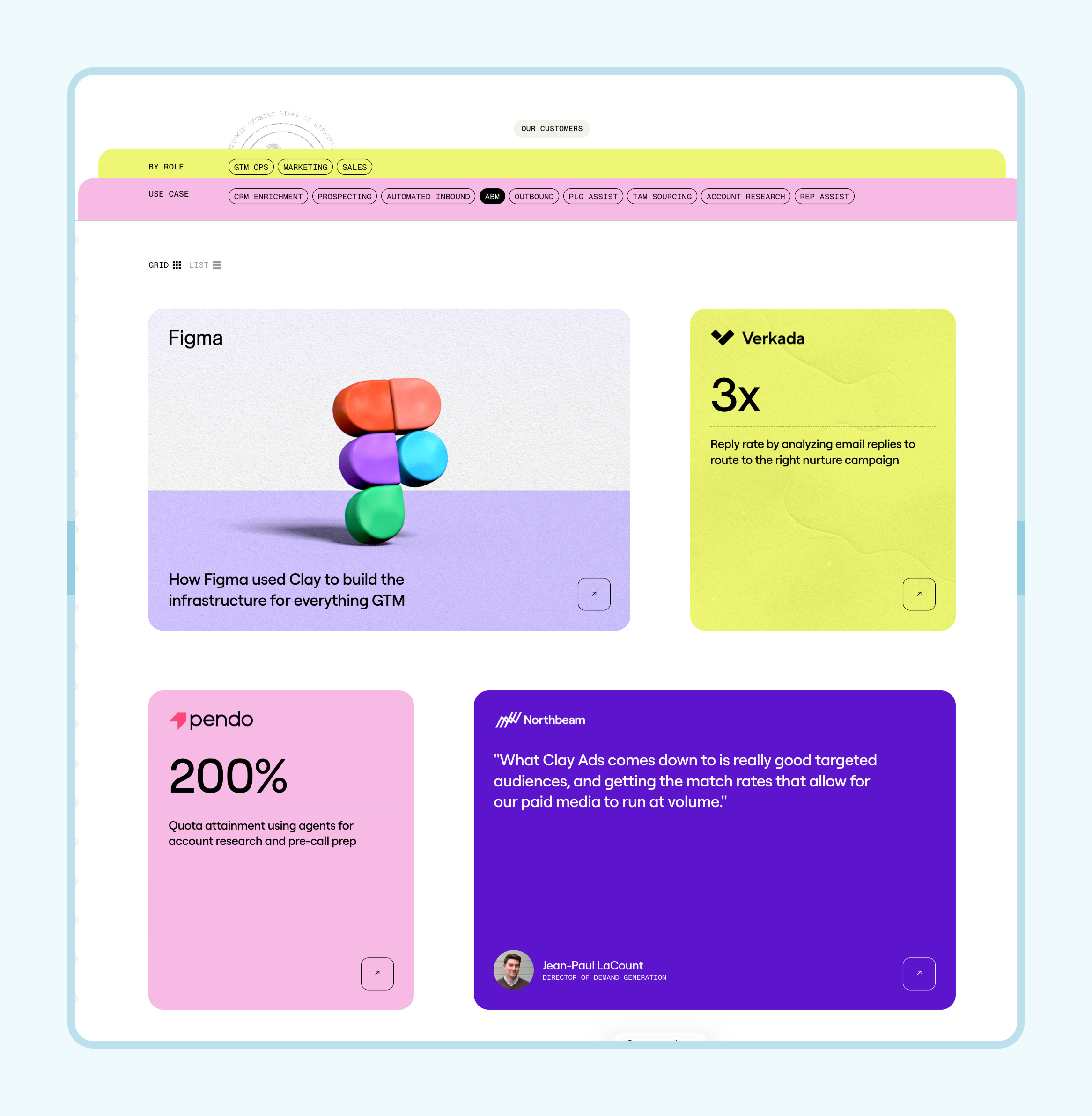
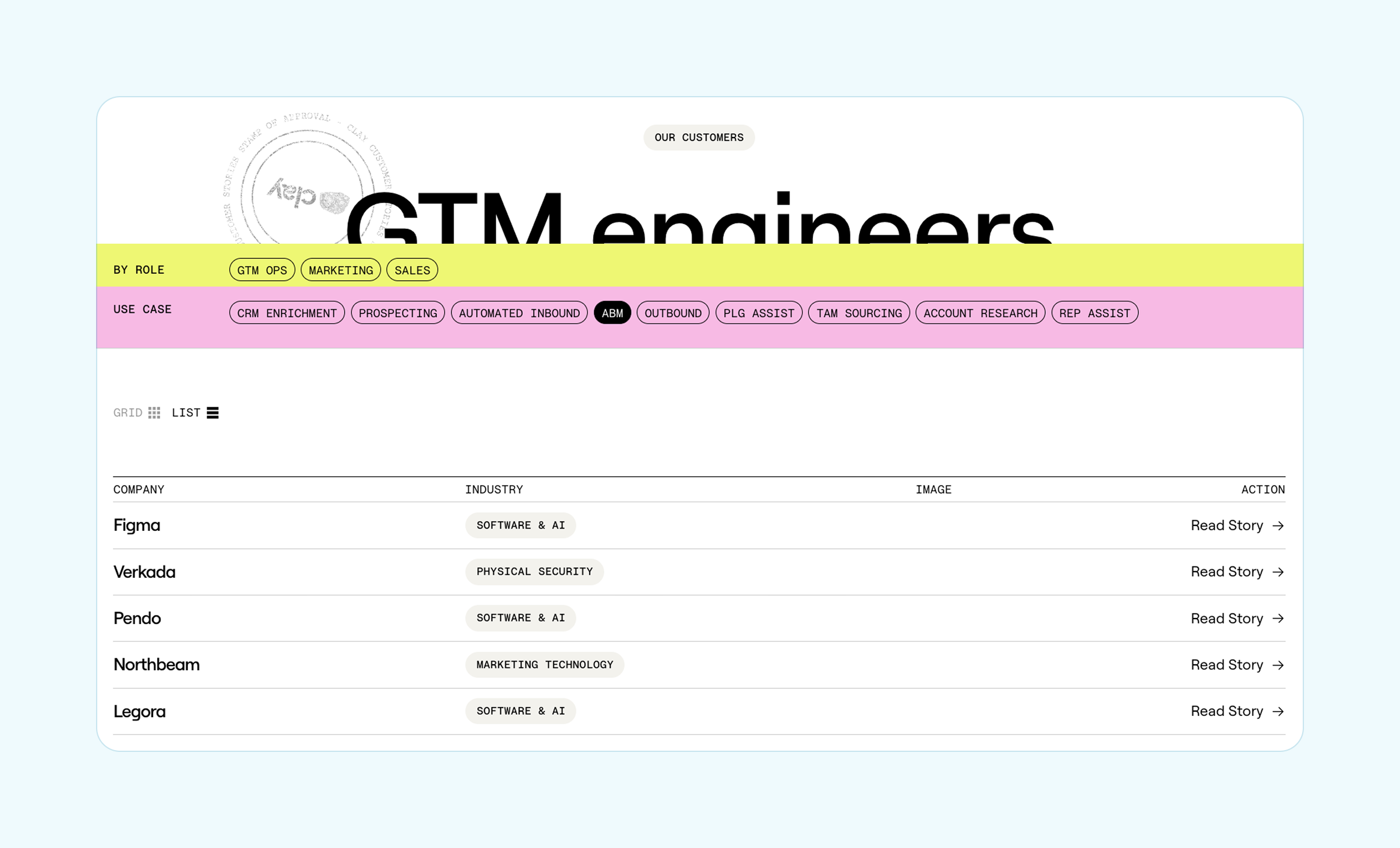
And you can add filters for job titles and industry too, helping users to find a case study that matches their exact situation. Case studies are there to show what you can do, so anything that helps users find what they’re looking for is smart smart smart.
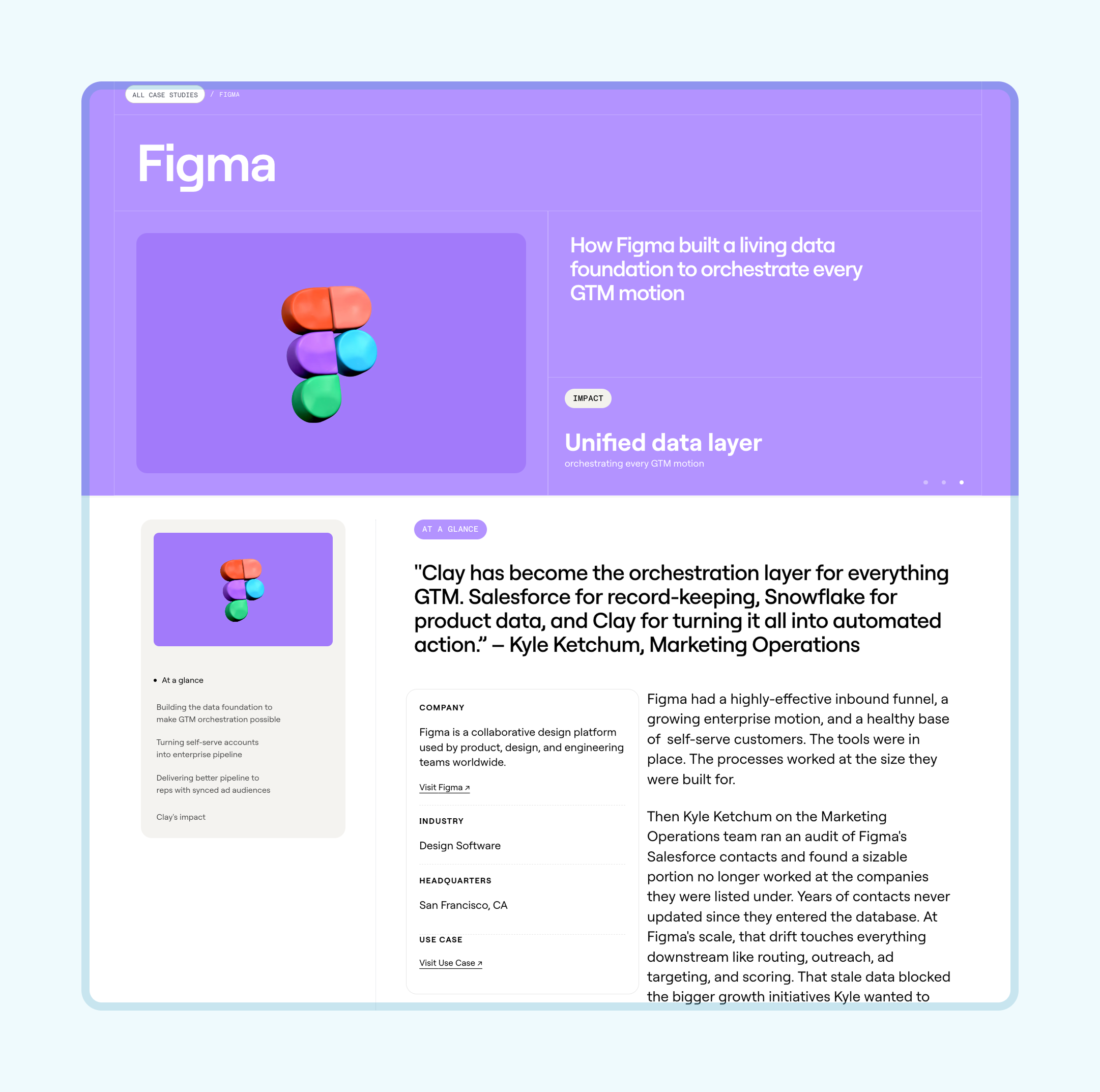
Then each individual case study follows a consistent shape:
- Title: “How [Company] used Clay to [specific outcome]” – the result is in the title every time
- A stat block directly underneath – one or two big numbers with a short label (“140% / Growth in outbound-sourced pipeline”)
- Company context – a paragraph on who they are and what the team does, before any problem gets described
- A results summary as bullets, up top rather than saved for the end
- The before – “Before using Clay, Sendoso’s outbound team faced several challenges”
- Repeated ‘use case’ sections, each covering a distinct job the customer uses the product for
- Pull quotes threaded throughout, attributed to named people with job titles (Alexander DeMoulin, GTM Ops at Intercom)
- “Clay’s impact” to close, then related case studies, so a reader who didn’t quite see themselves can find someone closer
Gong: the narrative version
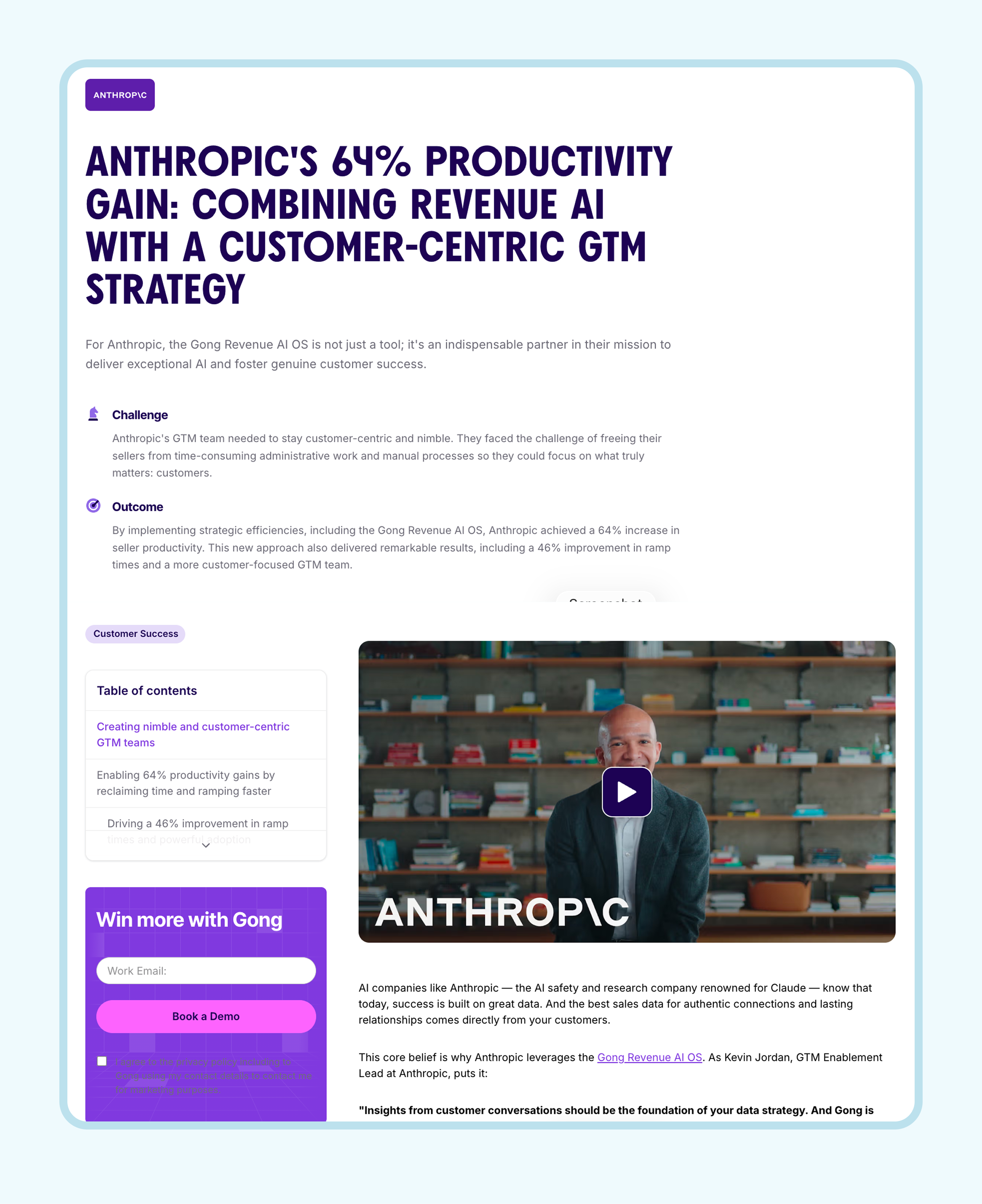
Where Clay’s pages are modular and repeatable, Gong’s read like actual stories, with bespoke sub-headings for each one and a proper editorial voice running through them.
Start with the titles, which put the result front and centre every time and usually pair it with a bit of character: “A Refined Pipeline: Edgepetrol Boosts Their Pipe Feed by 300% with Gong”, “ComplyAdvantage uses Gong to decrease ramp time by 50%”, “Plate IQ shrinks ramp-up time from a year to a few weeks”.
Which means the value is sat there in search results and in a nav list before anyone has to click – lead with those best bits.
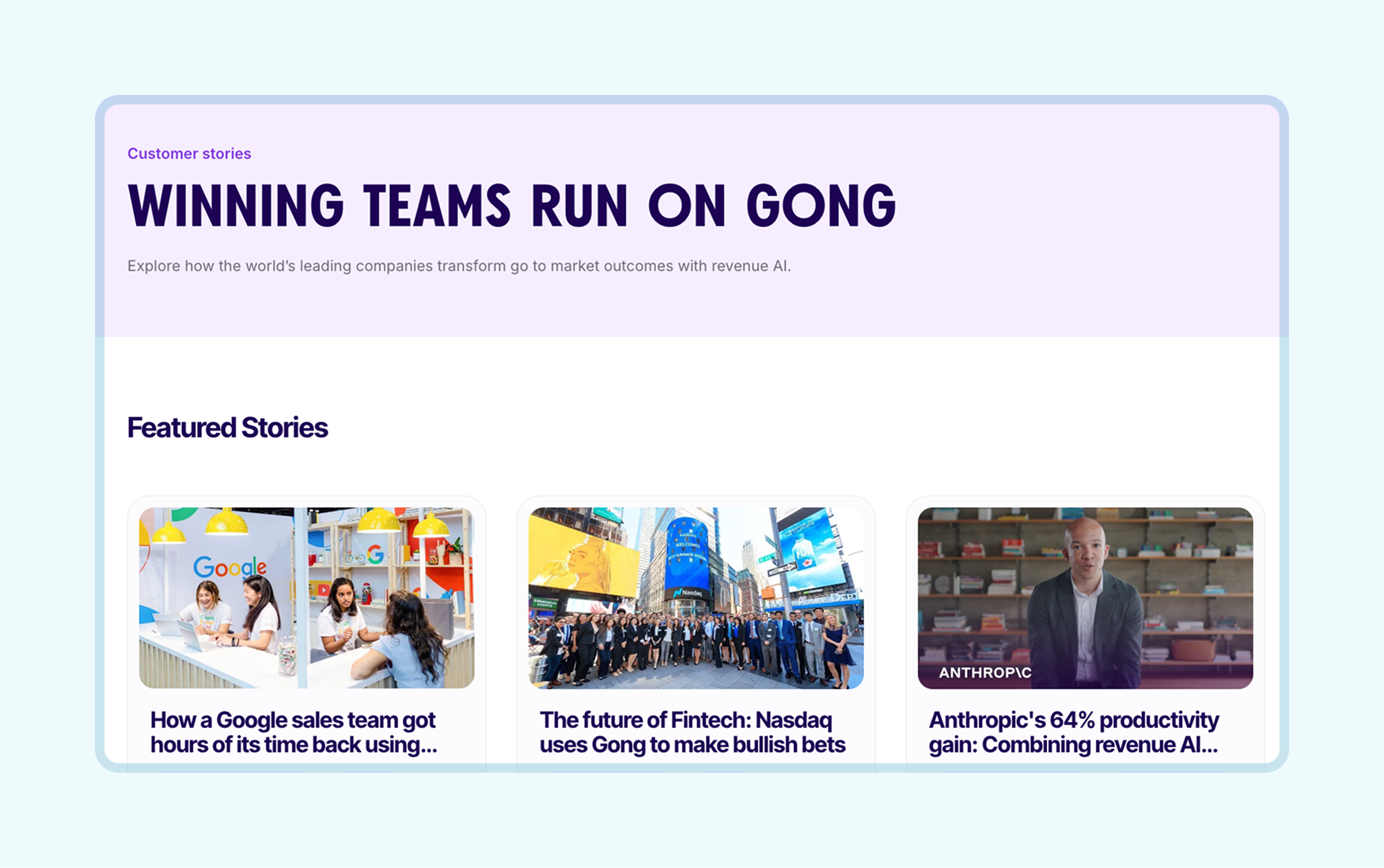
Inside, the shape is:
- A one-line summary under the title – “Learn how ComplyAdvantage cut their ramp-up time in half and improved sales productivity”
- The headline stat, pulled out large (“50% decrease in ramp time”)
- “The challenge” as an explicit heading, stated in one or two sentences
- A short results list – not just the headline number, but the secondary ones too (“increased Gong adoption by 20% across the company, used by 6+ different teams”)
- Then the story itself, under sub-headings written for that specific customer – “From recording tool to Revenue Intelligence solution”, “Not just for sales: Gong also helps product team”.
Free B2B case study template
If you’ve landed here looking for a case study template specifically, here’s what’s in it.
The template gives you the full structure – facts box, introduction, the before-state, what changed, the optional use case section, and the impact table – with prompts under each heading telling you what belongs there and what doesn’t. It’s a working doc rather than a design file, so you write straight into it and it tells you where everything goes.
The interview questions are in there too, and you’ll want those first.
Take them into the call, treat them as a guide rather than a script, and you’ll come out with the raw material everything else is built to hold.
FAQs
What is a B2B case study?
A B2B case study is a customer story showing how one business used a product or service to solve a specific problem, with real, measurable results. It typically names the company and the person interviewed, describes their situation beforehand, explains what changed, and quantifies the outcome.
It differs from an academic case study, which analyses a situation against theory rather than demonstrating a product’s value.
How long should a case study be?
Long enough to tell the story properly, usually somewhere between 600 and 1,200 words. Long enough to include real detail about the before-state and the numbers; short enough that a busy reader gets to the results.
A facts box at the top helps here, because it lets people who only want the headline get it without reading the whole thing.
What questions should you ask in a case study interview?
Ask what their day-to-day looked like before, what they tried first that didn’t work, what finally triggered the search for something else, and what’s different now. Ask for numbers directly and give them a format to answer in – hours per week before versus after, for instance.
Avoid broad questions like “what challenges were you facing?”, which tend to produce generic answers you can’t use.
What if the customer won’t share numbers?
Ask for a different kind of number rather than giving up entirely. Time saved per week, number of people involved in a process, how many days something takes now versus before, or a confidence score out of ten.
These are rarely commercially sensitive, and a specific small number is more persuasive than a vague claim about significant improvement.
Should case studies be gated?
No. A case study exists to build trust with someone who’s still deciding, and a form in front of it means only people who’ve already decided will see it.
Ungated case studies can also rank in search for queries like “[company] case study” or “how [company] did X”, and can be read by LLMs when someone asks about your product – neither of which works from behind a form.
Can you write a case study without naming the customer?
You can, but it will be significantly less persuasive. Anonymised case studies – “a leading financial services provider” – signal to readers that something is being hidden, because companies rarely conceal good results.
If naming isn’t possible, be as specific as you can about everything else: industry, company size, region, and the actual numbers.
What’s the difference between a case study and a customer story?
Mostly branding. Some companies use “customer story” to signal a more narrative, less formal piece, and “case study” for something more structured and results-focused.
The useful distinction is depth: a customer story might be a few paragraphs and a quote, while a case study typically includes the full before-and-after with quantified outcomes.

