Climate tech marketing: What 12 experts wish every founder knew

In the course of my career I’ve built content marketing from the ground up at B2B startups with very different social purposes: HR tech focused on fair pay (Ravio) and climate tech working on emissions reduction (Lune, Kamma). 

All build towards positive change, but the marketing contexts have felt very different.

Ravio tackles pay equity. It’s a mission that matters deeply to the team, but it’s not the primary problem our buyers are trying to solve. HR leaders come to us because they have an urgent need to pay fairly and competitively to attract and retain employees. The social impact is valuable, but it’s the cherry on top.

In climate tech, I found the opposite. The mission was front and centre, and the path from ‘this will save the planet’ to ‘this solves my business problem’ was much less clear.

I reached out to 11 expert marketers who operate in the climate tech space – from positioning consultants to in-house marketing leads to freelance writers – to find out the unique challenges and opportunities that resonate across the sector. 


Tomorrow’s problems don’t motivate today’s buyers

Climate change is an undeniably urgent problem. The science is clear, the impacts are accelerating, and we’re running out of time to act. But this hasn’t yet translated into the corporate world – most businesses aren’t feeling the urgency in their day-to-day operations. 

In traditional B2B SaaS marketing, you find your ICP’s deep pain points and create positioning and content that shows exactly how your product overcomes them, with the aim of generating demand – finding those who know they have a problem, and showing them the solution.

In climate tech, you’re a step behind doing demand creation instead: convincing prospects that climate change is a business problem worth spending time and money on now, when they have more pressing issues on their plate. You’re selling the problem before you can sell the solution – and that’s not a position any startup wants to be in.

Rebecca Cooke
Climate content writer
Linkedin | Website

MK McGowan
Climate tech communications consultant
Linkedin | Website

Greg McEwan
Communications Lead at Kaluza
Linkedin

Tabitha Whiting
Content writer and strategist
Linkedin | Website

What this means for your climate tech marketing

Stop trying to convince buyers that climate change is an urgent problem for their day-to-day work. It either is, or it isn’t. 

Instead, reverse your approach: start with speaking with your ICP buyers to find out the pain points that are keeping them up at night and the frustrating problems they’re actively trying to solve. Then work backwards to see how your climate solution addresses those pain points.

Back to the top ↑
Onto lesson two ↓


Regulations make terrible foundations for positioning

When you’re struggling to create urgency around climate solutions, regulations seem like the obvious answer. “You’ll need to comply with this new climate regulation next year” feels much more immediate than “climate change will impact your business eventually so start acting now.”

The problem is that climate regulations are frustratingly unstable. 

They get announced, delayed, watered down, or scrapped entirely. What looks like a strong compliance driver one quarter can disappear the next, leaving your entire positioning strategy in ruins.

Kamma, for instance, is a property data business originally focused on property licensing. When the Labour UK government introduced strict new Minimum Energy Efficiency Standards (MEES) proposals in 2021, Kamma built a climate tech arm focused around the environmental property dataset they’d already been building – thinking that these new regulations would bring new urgency. The proposal was scrapped two years later, and the company learned the hard way that positioning based on future climate compliance is incredibly risky, even now.

Plus, as Jacob Dowling, Product Marketing Manager at NatureMetrics, pointed out when I spoke to him about climate tech marketing, even when regulations do stick around, the guidance for meeting them is often vague enough that companies can comply with minimal effort. And competing on “good enough for compliance” in that context, is shaky ground.

Jacob Dowling
Product Marketing Manager at NatureMetrics
Linkedin

Andrew Copeland
Freelance content strategist and writer
Linkedin | Website

What this means for your climate tech marketing

Use regulations as supporting evidence, not primary positioning. Build your case around business problems that exist regardless of what politicians decide – operational efficiency, risk management, competitive pressure, cost savings.

But, do monitor regulatory changes. There may come a time where the regulatory environment is much more stable, and will become an important input for positioning and content production.

Back to the top ↑
Onto lesson three ↓


Sustainability is too broad to be your market

“We help companies with sustainability” might sound comprehensive, but it’s actually a positioning nightmare. Sustainability means completely different things to different people. The procurement manager worried about supply chain emissions, the facilities director implementing renewable energy, and the CSO building an ESG strategy have almost nothing in common except a vague shared label.

Climate tech founders often fall into this trap because they understand the interconnected nature of climate solutions. Your carbon accounting platform could theoretically help with scope 1, 2, and 3 emissions across any industry. Your energy management software could work for manufacturing, offices, retail, or even homes. But trying to be everything to everyone makes your messaging generic and your sales efforts unfocused.

At Lune, for instance, we started with broad messaging for any company that wanted to buy quality carbon offsets. The positioning was all about the climate benefits and scale of impact. In reality, this was far too broad and the climate impact didn’t resonate as strongly as we’d hoped.

What actually worked was niching down to speak specifically to supplier businesses (logistics, procurement, payments) who were under pressure from their customers to provide emissions information for their supplier scope 3 reporting. Same product, same API, but suddenly our content and positioning could speak directly to the specific pain points that logistics companies face. We could create case studies about delivery companies, write content about last-mile emissions, and build partnerships with logistics platforms. The focused approach made our solution feel purpose-built rather than generic.

The temptation to cast a wide net is there for any startup, but it feels particularly strong in climate tech because you’re often desperate to find any customer who cares about climate impact. But a spray-and-pray approach rarely works, and you end up with messaging that doesn’t strongly resonate with anyone.

Matthew Klassen
Content Marketing Lead at Patch
Linkedin

Lena Andican
Positioning and Messaging Consultant
Linkedin | Website

What this means for your climate tech marketing

Resist the urge to cast a wide net, and instead focus on niching down first. 

Pick one vertical, one use case, one type of buyer. Write positioning that speaks directly to their specific challenges, not general sustainability concerns. Create content, case studies, and partnerships that establish you as the obvious choice for that specific problem.

Look at which deals are actually being won, and who’s getting the most value from your solution right now, and find out what specific problem you’re solving for them. That’s your starting point.

Once you dominate that niche, you can carefully expand to adjacent ones using your proven positioning framework. But start narrow and go deep.

Back to the top ↑
Onto lesson four ↓


The people who care aren’t the people who buy

Climate tech sales rarely involve just one decision-maker: you’re navigating a web of stakeholders with completely different priorities, knowledge levels, and budget authority.

The sustainability manager who discovered your solution is excited about the climate impact and understands exactly why your technology matters. 

But the CFO who controls the budget cares about cost savings and ROI, the technical team who’ll implement it wants to know about integration complexity, and the CEO who gives final approval is thinking about risk and competitive advantage.

Whilst your sustainability lead champion might be won over by the climate impact, they often aren’t the person who can actually buy it.

Different messages are needed for different stakeholders. Anything you can do to help your champion sell internally to people who speak entirely different languages and evaluate success by completely different metrics, is going to help increase win rate.

During my time at Lune, for instance, we connected with a Product Marketing Manager at Payhawk who wanted to embed emissions calculations into their payments platform. She was sold on the impact and knew it was something end customers were asking for, but still struggled to get buy-in from leadership. We worked with her to build a business case for introducing a ‘Payhawk Green’ feature (which now exists), including a survey of real Payhawk customers about whether they would pay for the ability to calculate and offset emissions associated with their payments. This data-driven approach to demonstrating business value was what ultimately helped win the deal.

At Kamma, I saw the same theme: ESG Leads who wanted to introduce a green mortgage proposition, but weren’t able to demonstrate commercial success. We needed to coach them with resources like a retrofit messaging toolkit that would help them tap into the actual needs of homeowners and get clear on the market opportunity.

MK McGowan
Climate tech communications consultant
Linkedin | Website

Tabitha Whiting
Content writer and strategist
Linkedin | Website

What this means for your climate tech marketing

Your sustainability champion is excited about your solution, but they need ammunition to convince budget holders who care about completely different metrics. Create bridge materials that arm your champion with what they need to sell internally using business language, not climate language.

That might mean ROI calculators, customer surveys, competitive analysis, or business case slide templates that your champion can use to build internal support and translate climate benefits into business benefits for their colleagues.

Back to the top ↑
Onto lesson five ↓


Climate founders have a tendency to default to mission-first messaging

The climate tech community comes with a shared sense of purpose that attracts like-minded brilliant colleagues who are genuinely excited about their work.

That mission alignment can bring clarity to strategic conversations, making it easier to find alignment – which tends to be a blocker in any startup environment. This is something that Kait Payne has found in her role as Marketing Lead at Overstory: “alignment on strategy and development comes so much easier when you’re in agreement on the problems you’re trying to solve… we’re asking one question of ourselves ‘what can we do to help the most’”. 

However, that mission-above-all focus can also become a major downfall for climate tech marketing and positioning.

Founders and leaders naturally want to lead with the mission, the climate impact, the world-changing potential of their solution, because that’s what drives them and what feels the most important to convey. 

But, as we saw in Lesson 1, buyers aren’t feeling that urgency and need to act on climate change in their day-to-day roles in the same way that your team is. And even when the buyer does feel the urgency, their budget-holder often isn’t. We saw that time and time again at Lune – the Sustainability Leads we connected with were keen to introduce climate initiatives, but the CEO they reported to cared only about the ROI vs other projects.

Leading with the mission in your positioning, messaging, content, then, almost always falls on deaf ears. 

Plus, as Lena Andican observed of climate tech LinkedIn when I spoke with her, when the majority are positioning themselves in this way, the climate community quickly becomes an echo chamber: “Climate tech marketing right now is interesting only to those working in the space. We’re cheering on climate solutions and impact stories as feel-good content, but there’s no discussion on the commercial success of those solutions – which is what LinkedIn is full of for every other part of the tech industry.”

Your buyers aren’t scrolling LinkedIn celebrating every new climate milestone – they’re worried about quarterly targets, operational efficiency, and keeping their jobs.

Kait Payne
Marketing Lead at Overstory
Linkedin

Lena Andican
Positioning and Messaging Consultant
Linkedin | Website

Rebekah Mays
Executive ghostwriter
Linkedin | Website

MK McGowan
Climate tech communications consultant
Linkedin | Website

What this means for your climate tech marketing

The company’s climate mission absolutely matters, but to find product-market fit and grow as a company, you need to find the real business problems your product solves for your target buyers.

If you’re working with founders who are less commercially minded, it may well be up to marketing and commercial teams to coach on this shift. Audit existing messaging, and survey or interview your ICP audience to find out the real problems they’re facing. Then build new positioning and test it with those real ICP buyers. Use the findings to build the case to your founder of why positioning is key, and why the current mission-focused messaging isn’t cutting it.

The goal isn’t to hide the mission – it’s to lead with value.

Back to the top ↑
Onto lesson six ↓


Language matters in climate tech marketing

Unlike other tech sectors where you’re mainly competing on features and benefits, in climate tech you might be fighting scepticism, greenwashing accusations, and outright distrust before you even get to your value proposition – which means the language that you use matters.

This is compounded by the multi-stakeholder problem we explored in lesson 2.

Your sustainability lead champion might respond well to language about “carbon reduction” and “net zero goals”. But, at the same time, they’re also hyper-aware of greenwashing and will scrutinise every ‘net zero’ claim – as Karen McCandless, a freelance copywriter specialising in climate tech put it when I spoke to her about the challenges of climate tech marketing: “it’s always good to avoid jargon such as ‘carbon neutral’ or ‘net zero’ used without nuance”.

Meanwhile, the CFO approving the budget could see those same terms as vague buzzwords, virtue signalling – and any sense of urgency or disaster framing around climate action can make these business stakeholders feel like they’re being preached to rather than presented with a compelling business case. 

As Karen explains, “I’ve been told to not mention the words ‘sustainability’ and ‘climate change’ in marketing comms before, and to instead focus on how the tech can cut costs, boost efficiency, and improve performance, metrics which everyone cares about.”

Karen McCandless
Freelance copywriter
Linkedin | Website

Tabitha Whiting
Content writer and strategist
Linkedin | Website

What this means for your climate tech marketing

Firstly, be specific about what your technology actually does and how it plays a role in the wider world of climate solutions, avoiding broad terms that might feel like exaggerated claims and greenwashing red flags.

Secondly, we saw in lessons 1 and 2 that leading with business benefits tends to be more effective, and that’s true here too – avoid language that will alienate stakeholders who switch off when they hear more ‘preaching’ about the urgency of climate change. 

As with any messaging or marketing, be led by the voice of your specific buyer profiles. Speak to them regularly, understand what they’re struggling with, use language that reflects their own, and keep testing and improving your messaging and positioning over time to align with what truly resonates.

Back to the top ↑
Onto lesson seven ↓


Climate tech demands content for both PhDs and beginners

Marketing climate tech means becoming a subject matter expert fast. 

Whether you’re explaining carbon markets, direct air capture, or biodiversity credits, you need deep technical knowledge to create credible content and have meaningful conversations with sophisticated buyers who really know what they’re talking about.

Plus, with sustainability marketing being full of greenwashing, dubious claims, and solutions that sound too good to be true, the need for credible content to build brand authority in the space is even more important.

This also follows through to your company as well as your solutions – if you’re asking customers to invest in sustainability projects, you need to practice what you preach and show how you’re building a genuinely sustainable company. At Lune, for instance, we publicly shared our own carbon footprint calculations and offset them with high-quality carbon removals, demonstrating commitment to their own solution. Other climate tech startups like Climatiq have pursued B Corp certification to validate their sustainability commitments beyond just their core product.

But, as we’ve seen in earlier lessons, the people who understand the technology also aren’t always the people who approve the budget. So whilst your point of contact might be a Sustainability Lead who wants detailed methodology and peer-reviewed research, but your budget holder might be a CFO who needs to grasp the basics.

All of this means building two levels of content: expert-level materials that prove your credibility to technical buyers, and accessible explanations that help decision-makers understand why they should care. As a content marketer, that means levelling up your subject matter expertise fast, and having the skills to translate those complexities into clear language that’s accessible for any level of understanding – which can be demanding.

Tegan Tallulah
Sustainability copywriter
Linkedin | Website

Jason Dela Cruz
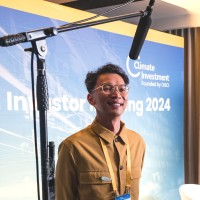
Marketing & Comms at Climate Investment
Linkedin

Matthew Klassen
Content Marketing Lead at Patch
Linkedin

Rebecca Cooke
Climate content writer
Linkedin | Website

MK McGowan
Climate tech communications consultant
Linkedin | Website


Expert library: The responses in full

The insights throughout this piece are drawn from conversations with 11 expert marketers who operate in the climate tech space. 

Each was asked the same question: “What makes marketing in climate tech uniquely different from other industries you’ve worked in, and how has this shaped your approach with the companies you’ve worked with?”

Below are their full, unedited responses. If you’re interested in connecting with any of these contributors or learning more about their work, their LinkedIn profiles and websites are included too.

Andrew Copeland | Freelance content strategist and writer

Linkedin | Website

Some of the biggest challenges I’ve encountered are:

  • Inconsistent budgets (a lot of stopping and starting) due to changes in policies and funding
  • Simplifying complex topics for a nontechnical audience
  • Avoiding blanket statements and making transparent claims backed by real evidence
  • Keeping up with changing policies and regulations.
Greg McEwan | Communications Lead at Kaluza

Linkedin

In climate tech, you’re not just marketing a product. You’re marketing a version of the future.

The challenge is to help customers see themselves in that future, to make it feel both inspiring and achievable. That means cutting through complexity, building trust and showing how today’s actions lead to tomorrow’s impact.

And you have to do all of that while staying laser-focused on your customers – solving real, urgent problems they’re facing right now. It’s not enough to be right. You have to be relevant.

Jacob Dowling | Product Marketing Manager at NatureMetrics

Linkedin

IMO, the biggest challenge is that climate (and especially biodiversity, where I focus) is an emergent-regulatory environment. This makes positioning incredibly difficult.

Positioning against regulations is dangerous because, even when regulations exist, guidance for how to meet them is loose. And it’s often possible for companies to tick box these regulations using quite basic tools.

So, the positioning has to be about going beyond the regulations to future-proof, avoid reputational risk, be a market leader, etc. You need to convince them that it’s worth spending 10x more on your solution than is strictly needed to be compliant, because your data is more robust and reliable and credible. (But do they really care?) This is a much harder sell.

A couple years ago, many companies built commercial strategies around the concept of ‘Purpose’ (there’s a lot of literature on this from Deloitte, in MarketingWeek etc). Brands like Unilever and Pepsico etc. really pushed having an environmental/social purpose to their products in the belief that this would generate growth.

They’ve since discovered this was a false hypothesis and many brands are now rolling back on their social and environmental commitments in favour of a renewed, traditional focus on P&L, efficiency, etc. This has impacted marketing climate/esg/biodiversity solutions, because these no longer automatically align with company strategies and culture. Many of these companies are also scaling down their sustainability teams as a result, who are the main point of contact and heroes for our solutions; smaller, more stressed sustainability teams with less weight in the boardroom has a knock-on effect on our ability to sell.

As I said, I believe these are true of climate in general but especially true of biodiversity / nature impact reporting, which many commentators believe is tracking about a decade or more behind climate in terms of its maturity. So for biodiversity, you have the additional challenge of not just selling product or building brand, but also building the category and educating your target customer.

Jason Dela Cruz | Marketing and Communications Manager at Climate Investment

Linkedin

Marketing in climate tech is unique because you’re not just promoting a product—you’re communicating a mission. 

At Climate Investment, I focus on translating complex science into clear, credible stories. It’s essential to incorporate factual, data-driven content – especially for audiences who may pilot or deploy the technologies. But I also strive to keep it accessible for those simply looking to understand. This balance has made me more strategic and mission-driven in how I craft narratives that inspire action.

Kait Payne | Marketing Lead at Overstory

Linkedin

Working in climate tech is uniquely exciting because alignment on strategy and development comes so much easier when you’re in agreement on the problems you’re trying to solve. At Overstory, when we’re considering challenges like powering hospitals during catastrophic storms or protecting communities from devastating wildfire, we’re ultimately asking one question of ourselves: “what can we do to help the most?”.

That question is behind every product decision and customer conversation. It guides the decisions we make about how we grow our business and the story we tell in the market. It makes the wins feel even better when we can see real impact on real people.

Compared to other industries, climate tech feels much more community-based. It’s about bringing people and stories together to solve pressing global issues, which is the dream from a marketer’s perspective. It’s simpler to convince people that what we’re doing matters when we’re literally saving lives.

In a moment when people around the world are suffering so much, it feels meaningful to get to spend my time working on something important alongside a wonderful community of mission-driven folks.

Karen McCandless | Freelance copywriter specialising in climate tech

Linkedin | Website

Climate tech is still a controversial topic. Climate tech companies are worried about greenwashing and being seen as jumping on the bandwagon. The target audience sometimes isn’t fully on board with the idea of climate change. I’ve been told to not mention the words “sustainability” and “climate change” in marketing comms and to instead focus on how the tech can cut costs, boost efficiency, and improve performance, metrics which everyone cares about. In some more traditional industries, the idea of “climate tech” gets push back from the people that are using it. And rightly so. Sometimes companies do implement climate tech just to appease shareholders or to tick regulatory boxes. There is a fair amount of distrust.

If you’re marketing climate tech to consumers, you have to be careful not to lecture or alarm them, or be sensationalist. In eco linguistics, we talk about something called the “Disaster Frame”. This is when you say things like, “We’re running out of time”, or “The ice caps are melting”, or even “It’s too late”. It can make people feel powerless but it also plays into the idea that many people feel such a sense of fatigue. They’ve heard it all before and they don’t want to hear this scaremongering again.

Linguistics really does matter when marketing climate tech. This is one area more than any other I’ve worked in (maybe other than healthcare) where you need to be specific when you’re talking about the tech. In healthcare, companies generally stay away from talking about a “cure”. Climate tech is a similarly specific and technical industry. It’s always good to avoid jargon such as “carbon neutral” or “net zero” used without nuance. Those words over promise on what is usually not something climate tech can deliver without other internal shifts. It’s also important to avoid talking about a “solution” as this implies there is one neat little thing you can do to “solve” emissions. “Eliminate emissions” is another over promise as that’s often something climate tech can’t do.

If talking to consumers, avoid anything too over the top like, “save the planet. Instead use gain-framed language (“live better,” “save money,” “protect what you love”), activate agency (“you can help,” “we are building solutions”), and localise and personalise (“in your neighbourhood,” “your children’s future”).

Lena Andican | Positioning and messaging expert

Linkedin | Website

Key insights discussed in a video call – full transcript available upon request.

“Intellectual arrogance” and lack of marketing appreciation: Climate tech founders often exhibit what one VC calls “intellectual arrogance” – believing scientific expertise is superior to commercial understanding. Unlike B2B SaaS founders who value marketing as a strategic function, climate tech founders see marketing as a “colouring in department” and often ask about channels without understanding basic buyer personas.

Extreme marketing fundamentals gap: When asked “who is your buyer?”, climate tech founders often have no answer. They lack awareness of needing marketing fundamentals in place before pursuing sales, instead taking a “spray and pray” approach. The sector is years behind B2B SaaS in marketing sophistication and playbook awareness.

Mission vs. commercial messaging challenges: Working with founders on messaging often requires “dialling down the impact side and dialling up the commercial side.” Example: ocean restoration funeral business founders wanted every slide focused on social impact, but investors need to see ROI potential first. Climate tech’s political sensitivity means leading with climate benefits rarely works commercially.

Problem awareness is low: It’s difficult convincing founders they have a marketing problem, which makes consulting challenging. Many resist considering messaging changes, preferring to focus on tactics or saying they’ll address fundamentals “once sales get going” – backwards thinking that perpetuates the problem.

Content quality and community issues: Climate tech LinkedIn content is mostly Instagram-style feel-good posts about impact rather than strategic business discussions. Unlike B2B SaaS feeds full of growth tactics and strategic advice, climate tech content adds little commercial value and represents a missed opportunity for meaningful professional discourse.

Market timing and funding reality: The climate tech funding boom allowed companies to avoid commercial fundamentals, but with declining investment and questions about second rounds, startups must mature their approach. Many founders still expect 10+ year R&D periods before commercialization, showing disconnect from current market realities.

Matthew Klassen | Content Marketing Lead at Patch

Linkedin

I’d say I had a couple key takeaways as I got to know our audience (largely corporate sustainability leaders, as well as some on the supply side, and the larger carbon market ecosystem).

‘Climate’ is a huge, variegated, fragmented space. It’s truly global, and there are SO MANY disciplines and personas and focus areas – some of them never intersect with each other, really. I went to a conference and met a person working in regulatory compliance for a regenerative agriculture company. I met a VC for reforestation projects. I met an economics student. There’s science, business, tech, academia, etc. The digital channels you associate with ‘climate’ or ‘sustainability’ are WAY too broad for almost every company working in this space. If you buy a list associated with climate keywords, it’s probably a lot of people who buy ‘eco-friendly’ consumer goods, maybe job seekers; it’s tough to get at the right audience. You have to build/curate the right people over time.

On a similar note, there are so many layers of messages to consider. Before I started at Patch, I thought I was well-read on climate change, but there was another level of sophistication (emissions scopes, trading systems, claims policy, marginal abatement costs, etc.). And within that there are levels of expertise – new CSOs from a marketing or legal background, longtime climate experts with an academic background, etc. You HAVE to speak the language at a level that meets your audience where they are. You don’t have to convince anyone that climate change is actually happening.

Because of those 2 things, I’ve found that some ‘old-school’ B2B tactics really work. Email-gated research, webinars, in-person events. People appreciate thoughtful, in-depth, well-researched analysis and are willing to ‘give-to-get’ that. Brand really helps.

MK McGowan | Climate comms consultant

Linkedin | Website

I think climate tech marketing sits at this complex intersection of technical complexity, urgent global need, and business pragmatism.

Here are my thoughts on what makes climate tech marketing uniquely challenging:

The translation gap is massive. I’ve found that 87% of founders I’ve interviewed struggle to translate technical concepts for non-technical buyers. You’re explaining breakthrough science to procurement teams who just want to know ROI.

Many founders assume environmental impact sells itself, but I’ve found 62% had to pivot away from climate-first messaging to business-first approaches after market feedback. I’m not saying to green-hush your message, but lead with user benefits and ROI.

Multiple stakeholder complexity is challenging. You’re selling to sustainability teams (who care about impact) AND finance teams (who care about cost) AND technical teams (who care about implementation) simultaneously.

The curse of knowledge is extreme. When you’ve spent years developing carbon capture technology, it becomes incredibly difficult to remember what it’s like to not understand molecular processes.

The uphill battle with skeptics can be tiring. It can feel like you’re constantly converting non-believers who view climate solutions as “nice to have” rather than essential. But I’ve learned that focusing on ROI, tangible benefits, and crystal-clear value propositions cuts through that resistance better than any climate argument.

My biggest takeaway is that people don’t buy the best climate solutions. They buy the ones they can understand fastest. Superior technology fails because customers don’t ‘get’ it, not because it doesn’t work.

Rebecca Cooke | Freelance climate copywriter

Linkedin | Website

What makes marketing and communications for climate tech uniquely different from other industries is that, oftentimes, you’re marketing a solution to an audience who aren’t yet affected by the problem. It defies the traditional marketing playbook: identify the pain point, pitch the solution. With climate tech it’s more complicated. We know the climate crisis is here. We know massive disruption to life, the ecosystem and the economy is inevitable if we don’t act. But, as of today it hasn’t quite hit the pockets of those holding the purse strings yet, so it’s more difficult to attract buy-in.

There are other issues around the technical language, complexity and interconnected nature of climate solutions which are difficult to translate into punchy copy. But having a solid grasp of the landscape of climate threats and solutions, and communicating their necessity in a direct and human way goes a long way to solve this.

Essentially, in the future, all products and services will have to consider climate effects and limitations by necessity. So those that incorporate this now are leading by default.

Rebekah Mays | Executive ghostwriter

Linkedin | Website

Climate tech marketing is unique in that brands sometimes act like “the environment” is the customer.

Especially now — with both the US and the EU pulling back on corporate sustainability compliance — climate tech marketers have to think hard about their value proposition and make sure it’s resonating with their customers.

In other words, the value proposition has to be more than just “sustainability.” It needs to address day-to-day pain points the customer is facing in their industry — whether that’s related to ROI, convenience, or performance.

Basically we want to make sure that aside from climate benefits, there’s a clear value prop & messaging that resonates with their target audience and solves real problems.

Tegan Tallulah | Sustainability copywriter

Linkedin | Website

The biggest thing that comes to mind is I think climate tech is very technically complex and the founders and subject matter experts are often very technical and committed to detail and precision, which is great but it can make it challenging to step back and tell an engaging story. In most content and copywriting, being able to simplify complexity into accessible, human terms is really important. I guess this isn’t unique to climate tech but I think it’s particularly challenging as leaders/clients can be very wedded to the technical detail.

My approach is generally to relentlessly ask/remind about the target audience and what they are looking for. Because in some cases it does make sense to go into the weeds for niche audiences, but other times it really doesn’t, and they need to see that.

All the content marketing insights I’ve bookmarked this year so far

The world of B2B content marketing moves fast – new tactics, frameworks, channels, tools, and strategies emerge constantly. 

Keeping on top of it and sifting through the noise to find genuinely useful content marketing insights and advice from truly knowledgeable content thought leaderes can feel overwhelming when you’re trying to build or refine your own content strategy.

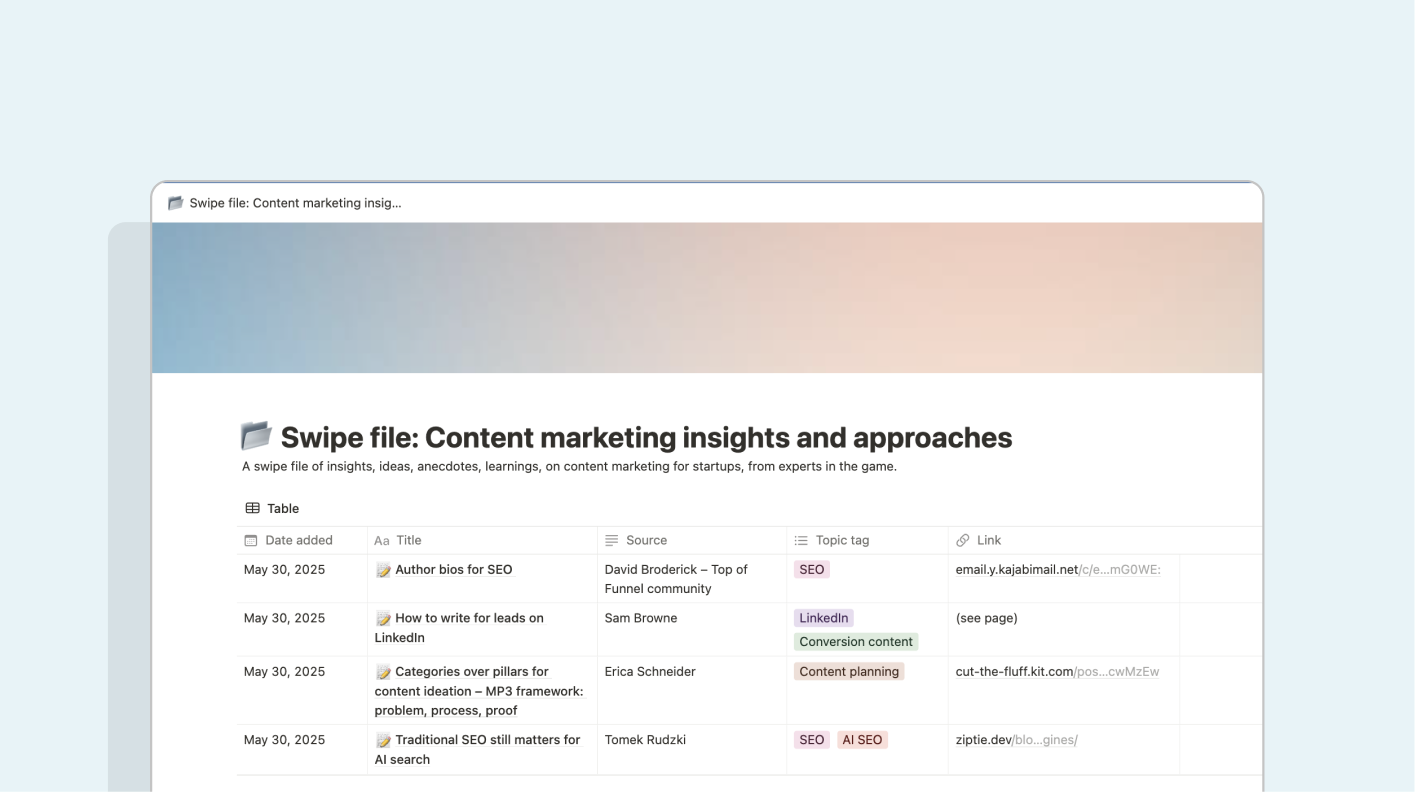
To help, I keep a Notion swipe file of the most interesting content marketing advice and insights I come across – and I share the latest additions in each edition of my ‘This Month in Content’ newsletter too.

In this blog, I’ll walk you through the content marketing insights from industry experts I’ve bookmarked in my swipe file this year so far, with my thoughts on how each one could inform your own content plans. 

Swipe file: content marketing insights and advice

17 content marketing insights from true industry experts in 2025

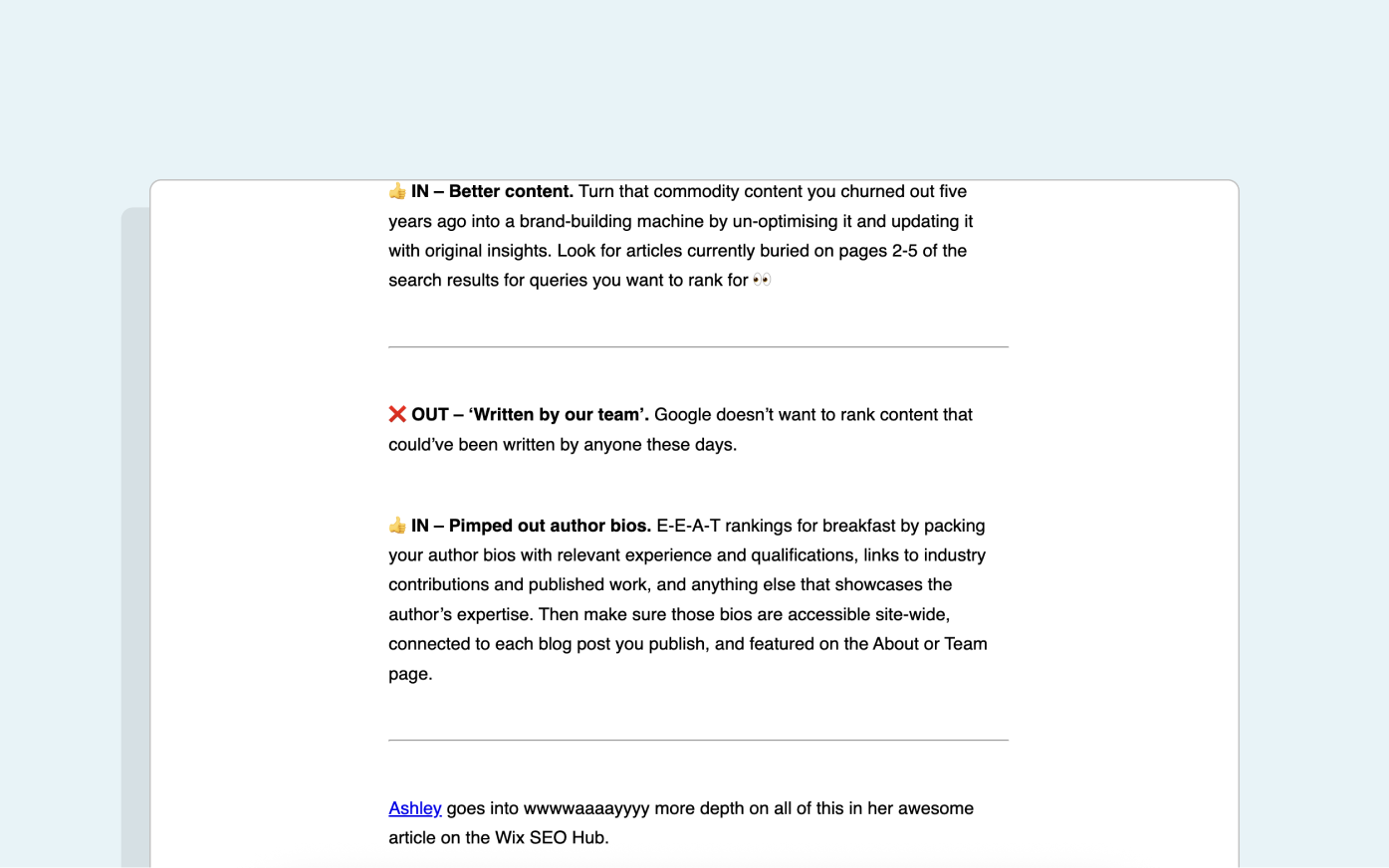
Insight 1: Ashley Segura’s take on author bios as your secret SEO weapon

Gone are the days when you could slap “Written by our team” on a blog post and expect Google to take notice.

In a recent the Top of Funnel community newsletter, David Broderick shared Ashley Segura’s deep-dive on the recent shifts in how Google evaluates content credibility – including the role of author bios.

With Google’s increasing focus on E-E-A-T (Experience, Expertise, Authoritativeness, Trustworthiness), the quality of your author bios has become a genuine ranking factor. 

This isn’t just about ticking Google’s boxes – detailed author bios also build trust with readers who are increasingly sceptical of generic company content in an AI-saturated landscape.

The suggested solution? Think about author bios as an opportunity to demonstrate expertise and credibility, which could include:

  • Pack them with relevant credentials. Include specific qualifications, years of experience, notable achievements, and industry certifications that directly relate to the content topics your authors cover.
  • Link to external validation. Reference published work, speaking engagements, industry contributions, and media mentions that showcase your authors’ (or contributor’s) expertise beyond your own website.
  • Make them accessible site-wide. Don’t bury author bios at the bottom of blog posts. Feature them prominently on your About page, link to full bio pages from every piece of content, and ensure they’re easily discoverable across your site.
  • Keep them current. Regularly update bios with new achievements, publications, and credentials to maintain their SEO value and accuracy.
Insight 1: Ashley Segura’s take on author bios as your secret SEO weapon

Insight 2: Sam Browne’s strategy for generating real leads on LinkedIn over vanity metrics

LinkedIn engagement feels addictive. The dopamine hit of likes, comments, and shares makes it tempting to optimise every post for maximum visibility.

But as Sam Browne revealed in a recent edition of his ‘Nice Work’ newsletter, this approach misses the point if your goal is business growth rather than vanity metrics.

Sam’s research into his own LinkedIn performance showed that his most viral posts generated thousands of followers but zero leads. Your most profitable LinkedIn content won’t get the most engagement. Instead, it connects with a small fraction of your audience who happen to be in-market for your solution to address their pain point at exactly the right moment.

The key to his success was focusing first on building a foundation of personal brand through that engagement-focused content, and only then start weaving in targeted lead generation content:

  1. Build familiarity through consistent, valuable content that helps your audience get to know your personality and approach
  2. Establish authority by sharing insights, frameworks, and expertise that position you as a credible expert in your field
  3. Develop trust through personal stories, behind-the-scenes content, and authentic vulnerability that humanise your brand
  4. Only then aim to convert by sharing case studies, testimonials, and social proof that demonstrate your track record of results on the problems you’ve been consistently discussing.
Insight 2: Sam Browne's strategy for generating real leads on LinkedIn over vanity metrics

Insight 3: Erica Schneider’s MP3 framework that gets away from building content pillars for the sake of content pillars

Content pillars have become a default approach to content planning, but, approached wrong, they often create more confusion than clarity.

In her ‘Cut the Fluff’ newsletter, content strategist Erica Schneider recently introduced the MP3 framework as a much more strategic alternative that focuses on the purpose of each piece of content rather than arbitrary topics:

  • Market the Problem: Content that articulates your buyers’ struggles better than they can themselves. This includes pain point identification, industry challenges, and problem-focused research that helps prospects understand what they’re dealing with.
  • Market the Process: Content that shares your experience, frameworks, and methodologies. This demonstrates your expertise whilst providing genuine value through actionable insights and strategic guidance.
  • Market the Proof: Content that validates your insights with tangible results. Case studies, testimonials, data-driven outcomes, and transformation stories that prove your approach works.

As Erica explains, “When you stop seeing content as one homogenous blob and start seeing it as three distinct categories with different strategic functions, everything changes.”

Before creating any piece of content, you choose which category it serves – eliminating the decision fatigue that can come with vague content pillars.

Even better, one topic can generate content across all three categories. Take “email marketing strategy” as an example:

  • MP1: “Why 73% of B2B email campaigns fail to drive pipeline”
  • MP2: “The 5-step framework we use to build high-converting email sequences”
  • MP3: “How this email strategy generated 47% more qualified leads in 90 days”
Insight 3: Erica Schneider's MP3 framework that gets away from building content pillars for the sake of content pillars

Insight 4: Tomek Rudzki’s research on why traditional SEO is still crucial for AI search

The narrative that “SEO is dead” because of AI search tools like ChatGPT and Perplexity is everywhere right now – a prime example of how difficult it is to cut through the noise to find genuine insights on effective content marketing.

Recently, SEO expert Tomek Rudzki decided to test this assumption with hard data. 

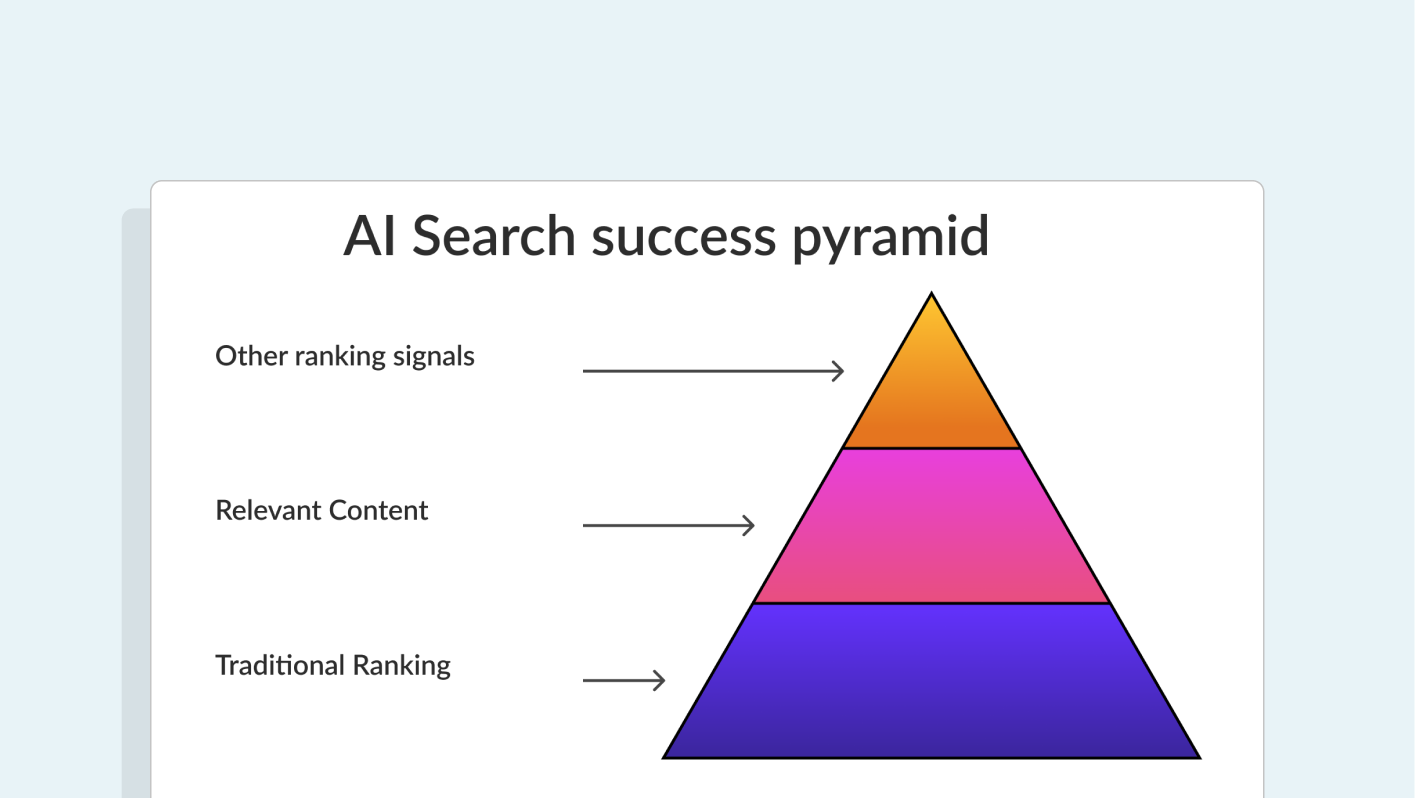
His analysis of 25,000 AI search queries revealed that if your content ranks #1 in Google’s traditional search results, you have a 25% chance of being cited in AI overviews and responses – so traditional SEO tactics are still important. 

However, he did find one important difference which is key for any content marketer wanting to optimise for AI search too.

Whereas traditional SEO optimised for the “best page” with comprehensive content that covered everything someone might want to know about a topic, AI search optimises for the “best answer” i.e. precise, relevant responses to specific questions.

As Tomek puts it, this means a shift in focus: “Instead of asking ‘How do I rank for this keyword?’ start asking ‘How do I provide the best possible answer to this specific question?'”

Insight 4: Tomek Rudzki's research on why traditional SEO is still crucial for AI search

Insight 5: Eli Schwartz’s take on GEO being the new SEO 

The hot topic of the moment is, of course, AI search optimisation (or whatever term we end up landing on) – it’s all over my LinkedIn feed and in basically every content newsletter I subscribe too. Including Eli Schwartz’s ‘Future of SEO’ newsletter.

His take is that with AI engines answering basic informational queries directly, top-of-funnel content for SEO purposes is becoming less and less effective. Instead, the new battleground is mid-funnel content – those users who know what category of solution they need but haven’t chosen specifics. Think comparison guides, case studies, and solution-focused content that could get your brand mentioned in AI responses.

Insight 6: James Allen’s data on how to get cited by AI 

Another AI search optimisation one: James Allen’s research for Search Engine Land explored the top sources that AI search engines are pulling from. 

It turns out there’s quite a lot of difference – ChatGPT loves Wikipedia and authority sources, Google’s AI embraces Reddit and community content, whilst Perplexity favours expert review sites. 

But, the main theme is that being present in community forums, industry publications, and third-party review content might matter more than your own company blog for AI citations.

Insight 7: Beam Content’s approach to product-led content without the sales pitch 

This month Beam Content published an article on ‘How to create product-led content without sounding like sales’. It’s packed full of interesting insights from product marketers, but the most interesting point to me was the importance of continuing to centre the customer and their problems even in bottom-of-funnel, product-led content. 

As Growth and Product Marketing Advisor Nicole Silver puts it: “I’ve always taken the perspective that the customer is the hero, not the product.” Instead of creating content that aims to show what your product can do, start with the pains that your audience are feeling, and weave the product naturally into that.

I also thought that Sam Brenner’s observation that “Your audience’s eyes glaze over when they see CTAs. They’re thinking, ‘Oh, this company is always putting their trash in the CTA box, but the advice is good. Just ignore the product.'” was an astute one. When we do talk about the problems our product solves, we’re tempted to add a ‘book a demo to see how we’ve fixed this’ style CTA. But we should just be showing there and then exactly how our product addresses that particular problem, in a way that showcases the real value of the product – interactive demos or sandbox environments, rather than hiding everything behind “book a demo” walls that create barriers instead of building trust.

Insight 8: Emily Kramer’s ‘shows vs feeds’ framework for company blogs

Recently Emily Kramer’s MKT1 newsletter explored the question of ‘is the company blog dead’. It’s an interesting question that very much depends on the context of the company and their content aims. 

One idea I thought was worth bookmarking was switching from creating “feeds” (random streams of forgettable blogs), to “shows” – intentional, episodic content where each piece builds on the last to create a full series. These recurring themes and formats could be a great way to build deeper audience connections with the content being produced.

Insight 9: The new T-shaped marketer is independent and autonomous

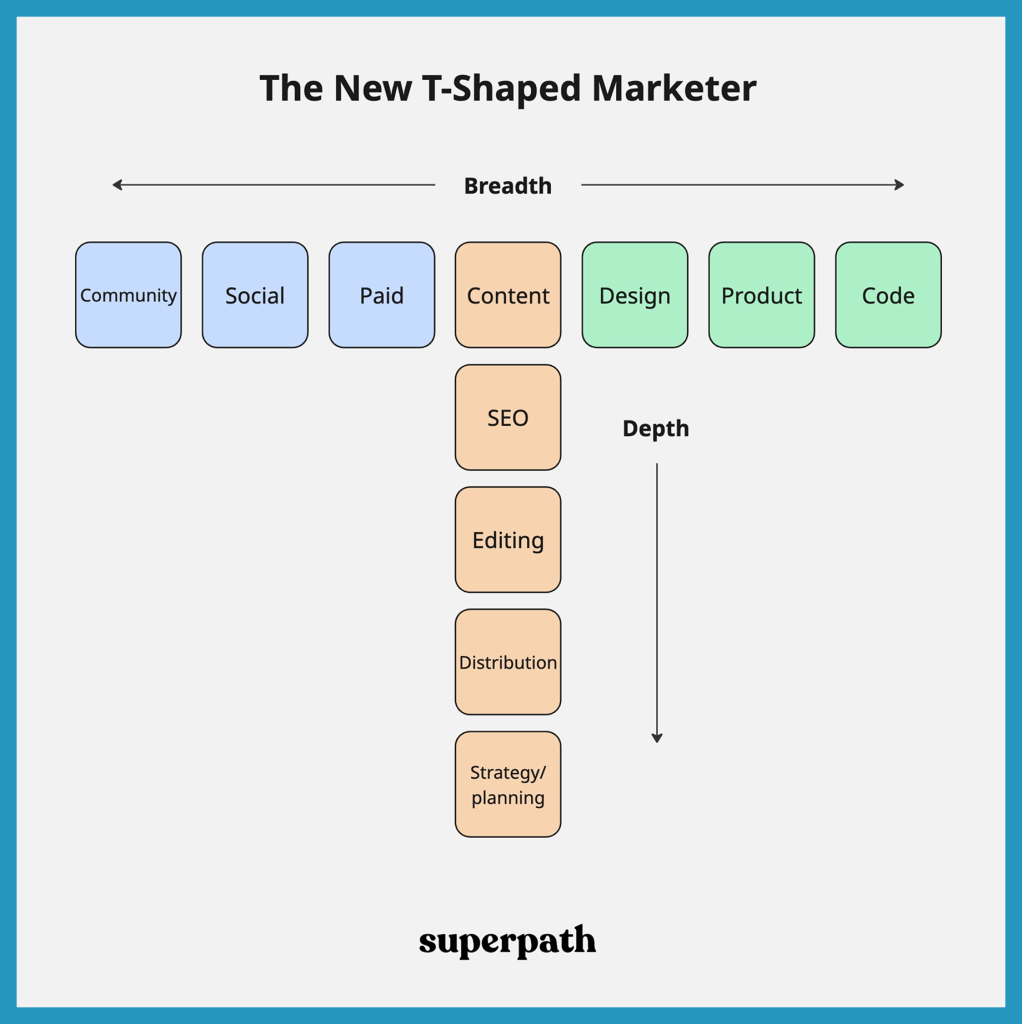
Superpath’s recent piece on how AI is evolving the T-shaped marketer highlights how marketers are about to become weirdly self-sufficient. 

“Just a few years ago, getting time from a developer to make a small website change was a hassle. Now we each have a shop full of power tools.” 

The breadth axis now includes skills we were never expected to have – basic coding, design, data analysis. That doesn’t mean we all need to ditch content specialisms and become generalist marketers, but it does mean that we have the chance to finally be able to bring those half-formed creative ideas to life without waiting for other teams to make them a priority.

Read the full article →

Insight 10: Building content for wildly different expertise levels

I wrote a piece on climate tech marketing this month, and one frustration that kept coming up was the need to create content for both technical buyers with PhD-level knowledge on climate science, and stakeholders who don’t know the difference between ‘carbon neutral’ and ‘net zero’ and just want the business impact explained in two minutes.

This isn’t just true in climate tech – any product that has a sales cycle that includes multiple stakeholders has likely felt this pain of varying levels of subject knowledge. 

Do you create the 101 content? Or head straight for the expert-level?

It’s tempting to go for “Goldilocks content” that’s detailed enough for experts but simple enough for executives. But that satisfies nobody. 

What actually works is accepting you need completely separate content streams – in climate tech that might look like technical deep-dives that build trust in your methodologies for Sustainability Leads, and executive summaries in a handy slide deck for CEO budget holders. 

Read the full article →

Insight 11: HubSpot’s creator podcast partnership strategy: co-creation and exclusive, long-term sponsorships

I finally cleared my podcast backlog this month and caught up on an April episode of Content Briefly featuring Carly Baker on Hubspot’s podcast and YouTube network

HubSpot’s Media Network does something clever – instead of fighting for ad slots, they partner with creators for exclusive, long-term podcast sponsorships on topics the creator actually cares about.

The bit that made me think “why isn’t everyone doing this?” – instead of fighting for ad slots, they find creators who have a relevant audience, co-create a podcast with them that fits their niche, and have Hubspot as the exclusive, long-term sponsor (purely for positive brand association, the product is barely mentioned). 

Creators get reliable income without losing creative control, whilst HubSpot gets airtime with no other brands mentioned. Rather than competing in crowded ad spaces, they’re building their own creator ecosystem.

Listen to the full episode →

Insight 12: Elena Verna’s framework for starting new roles: protect, optimise, bet, strategise

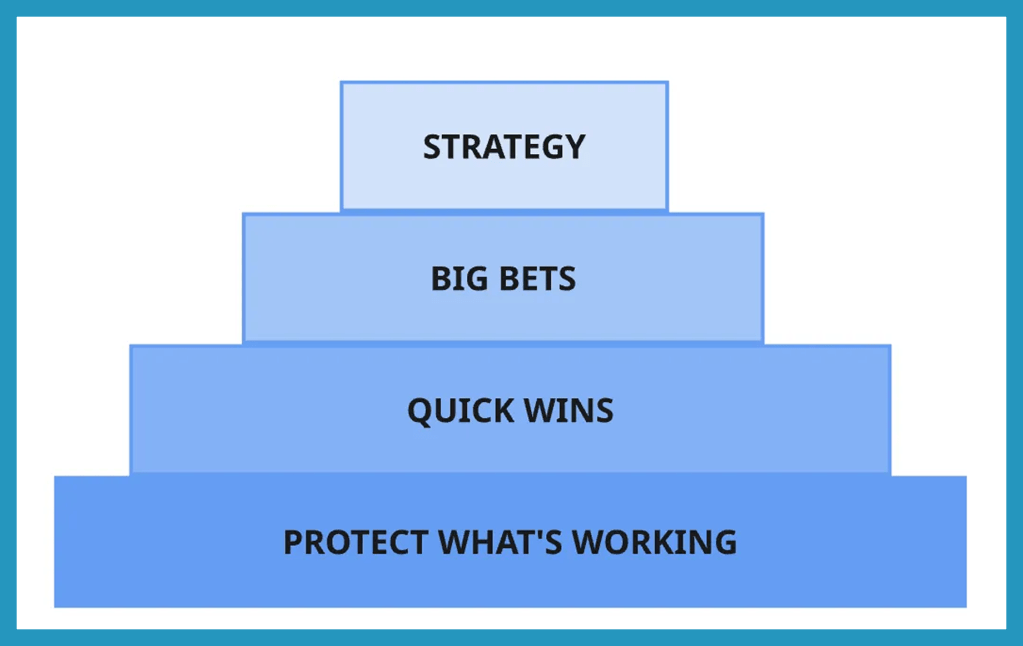
Elena Verna’s recent newsletter on her first 90 days as Growth Lead at Lovable is a masterclass in balancing learning with delivering from day one. She breaks it down into four phases: protect what’s working, find quick wins, tackle one big bet, then shape strategy.

At Lovable, this meant first figuring out why they were growing organically and protecting that, then fixing obvious issues with key pages and flows, (like making collaboration free so users could invite teammates without hitting paywalls) and finally planning bigger strategic moves (like building community or building a founder ecosystem).

Read the full post →

Insight 13: The AI writing structure that’s now completely ruined: “It’s not just X, it’s Y”

Content strategist Bani Kaur wrote something that made me go “oh god, YES” – AI tools have completely killed the “it’s not just X, it’s Y” structure for her. 

I’ve started noticing this everywhere. Those opening hooks that used to feel punchy now scream ChatGPT. 

If your writing sounds like it could’ve come from an AI tool, it probably won’t cut through anymore – so it’s time to reflect on those go-to structures we all lean on, use them sparingly, and find fresher ways to make our points.

Read the original LinkedIn post →

Insight 14: Exit Five’s virtual event production insights: make it feel like an experience, not a meeting

I’ve sat through enough terrible virtual events in my time, so when Exit Five wrote about their approach to running virtual events this month, I clicked instantly. 

Their philosophy: “Most meetings aren’t special. And your event needs to be.”

They treat virtual events like an experience, not another meeting – branded intros, smooth transitions, coffee break codes for the first 50 people, strategic giveaways tied to specific content rather than random swag.

Read the full article →

Insight 15: Contentoo’s State of Content Teams 2025 report – the shift from more content to better content

Contentoo surveyed 150 content professionals about what’s working for them right now. 

There’s a ton of interesting findings in the full report, but the ones that resonated most with me are: 

  • Leading teams are measuring activation, not creation. Instead of tracking how much content gets published, they’re looking at how deeply it integrates into sales processes and looking for success in how much it supports their sales team. One respondent nailed it: “Content doesn’t scale if you’re just feeding the beast. It scales if it creates leverage – across sales, onboarding, and product.”
  • The human backlash is building. Despite 86% of teams using AI, respondents predict a “flight back to humanity” – teams focusing on “more FUN B2B content” that AI simply can’t create. After months of AI-generated sameness flooding our feeds, the appetite for genuine human perspective is only growing stronger, and I absolutely love to see it – let’s get creative y’all.
  • The strategic power of saying NO. Several teams found their breakthrough came from what they stopped doing. No more trying to be across every platform or saying yes to every ad hoc request that comes through to us. Doing fewer things, but doing them exceptionally well, is the new strategy. I know this resonates with our team at Ravio – we’re dead set on finding our focus, and then protecting it at all costs.

Read the full report →

Insight 16: Exit Five’s newsletter philosophy is ‘write letters to one member of your audience’

I loved Grizzle’s breakdown of how Exit Five built their newsletter – partly because I’m a fan of Exit Five’s newsletter myself, but mostly because I love content that reveals the process behind successful strategies, it’s always a winner in my eyes. 

One takeaway is that Head of Content Danielle Messler writes each Exit Five newsletter as if she’s writing a letter to one specific reader from their subscriber base. “Today I’m writing for Chelsea. Tomorrow, it’s for Amruta, who just started managing an 80-person marketing org.”

They get 30-40 replies per email (basically unheard of in B2B), and Danielle reads and responds to every reply. So when she writes for Chelsea, she’s not imagining her struggles, she knows them from their actual conversations.

When you write for “B2B marketers” you can easily end up with generic advice that could apply to anyone. 

When you write for Chelsea who you interviewed last week and you know is struggling with attribution at her Series B startup, you naturally include the specific details and nuanced perspectives that make content actually useful.

Read the full breakdown →

Insight 17: Why “let’s get all our employees to post on LinkedIn” rarely works

In a recent edition of the Superpath newsletter, Eric Doty shared learnings from an episode of their podcast about employee enablement. 

“Let’s get our employees to create content!” is what Eric calls the ‘white whale of B2B content marketing’ – sounds so simple in theory, yet anyone who’s tried it knows it’s a nightmare in practice.

The reality is that not every person on your team is going to want to be visible on LinkedIn – or make a great content creator.

Eric breaks down the models that actually work, with the learning of seeking those who are already natural creators:

  • Founders – telling the company story and building in public.
  • Practitioner evangelists – subject matter experts whose expertise naturally overlaps with the product (like our Chief People Officer at Ravio, where our audience is HR and Rewards teams)
  • Operational thought leaders – those existing content creators, who are already sharing their expertise in their space for their own personal brand, not with promoting the company or product in mind.
  • Marketer/product evangelists – marketers are great at speaking to the company’s positioning, so can be a great conduit for company messages and content because they naturally know how to talk about it in the right way. 

Subscribe to the newsletter →


Stay ahead of the content marketing curve

Want to stay updated as I add more content marketing insights and advice to my swipe file?

Subscribe to This Month in Content, a monthly newsletter where I share the best content marketing insights I’ve come across each month – as well as a standout example of great B2B content marketing too.

Every new insight also gets added to my full Notion swipe file, so bookmark that too for whenever you need strategic inspiration for your content planning.

5 (research-backed) climate communication principles for messages that actually work

Scientific reports filled with inaccessible jargon. Greenwashing from fossil fuel giants. Media headlines that swing between “glorious sunny weather” and “fiery apocalypse.”

This is the climate communication that most people receive day to day.

We’re told climate change isn’t real, or isn’t that bad. We’re told it’s all our fault. We’re told it’s just about polar bears and melting ice caps. We’re told it’s too late to act, or that someone else will sort it out.

The result? A murky narrative where understanding what climate change actually means for us and what actions we should be taking feels utterly impossible.

Climate change communication has been, on the whole, pretty abysmal.

But effective climate communication is vital to influence change, because we need a mass of hyper-engaged citizens with clear demands for a different future. 

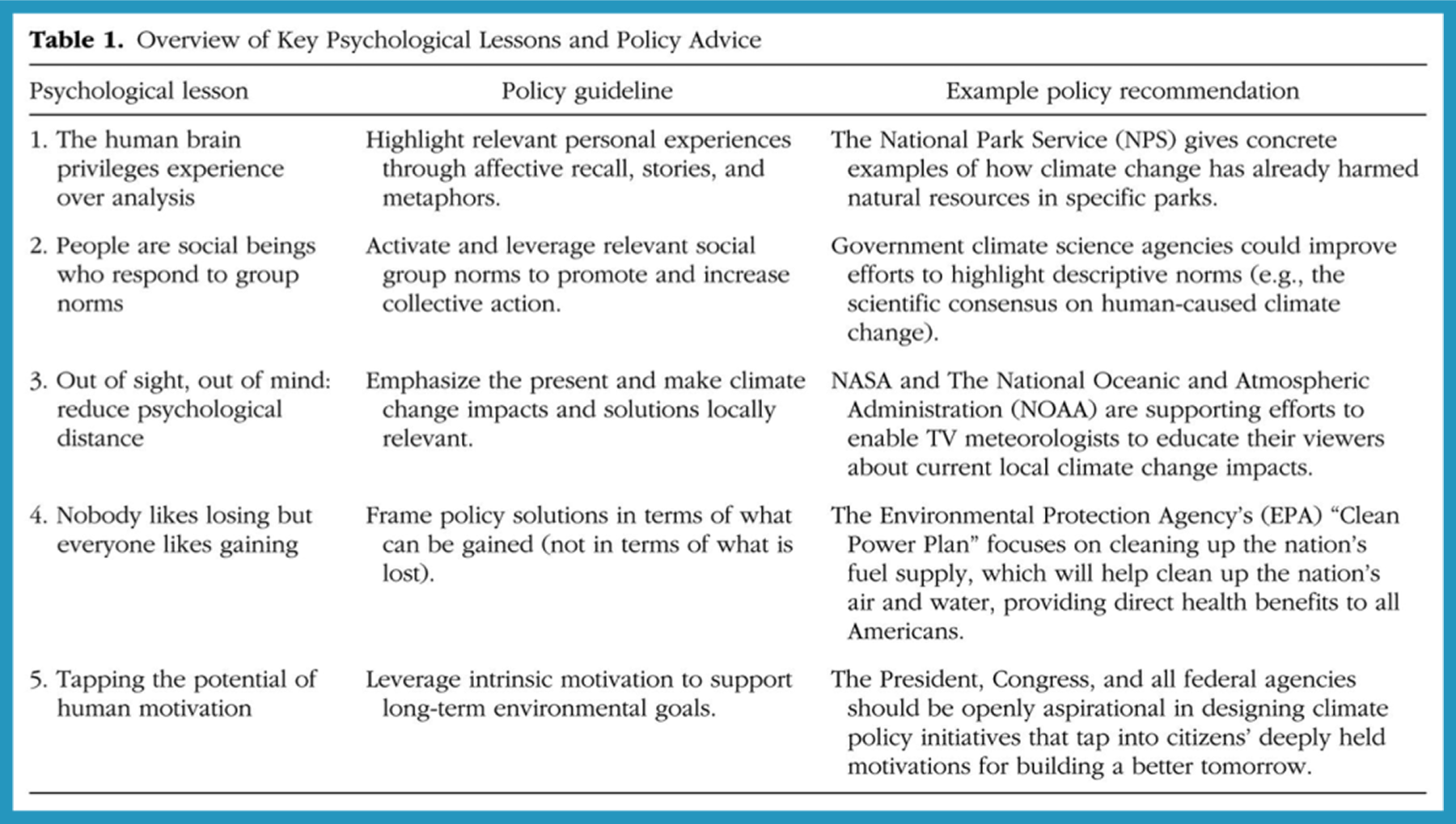
If we want people to care about climate change and act on it (including climate tech buyers), we need to completely rethink how we talk about it.

The climate crisis desperately needs the best communications team we can muster.

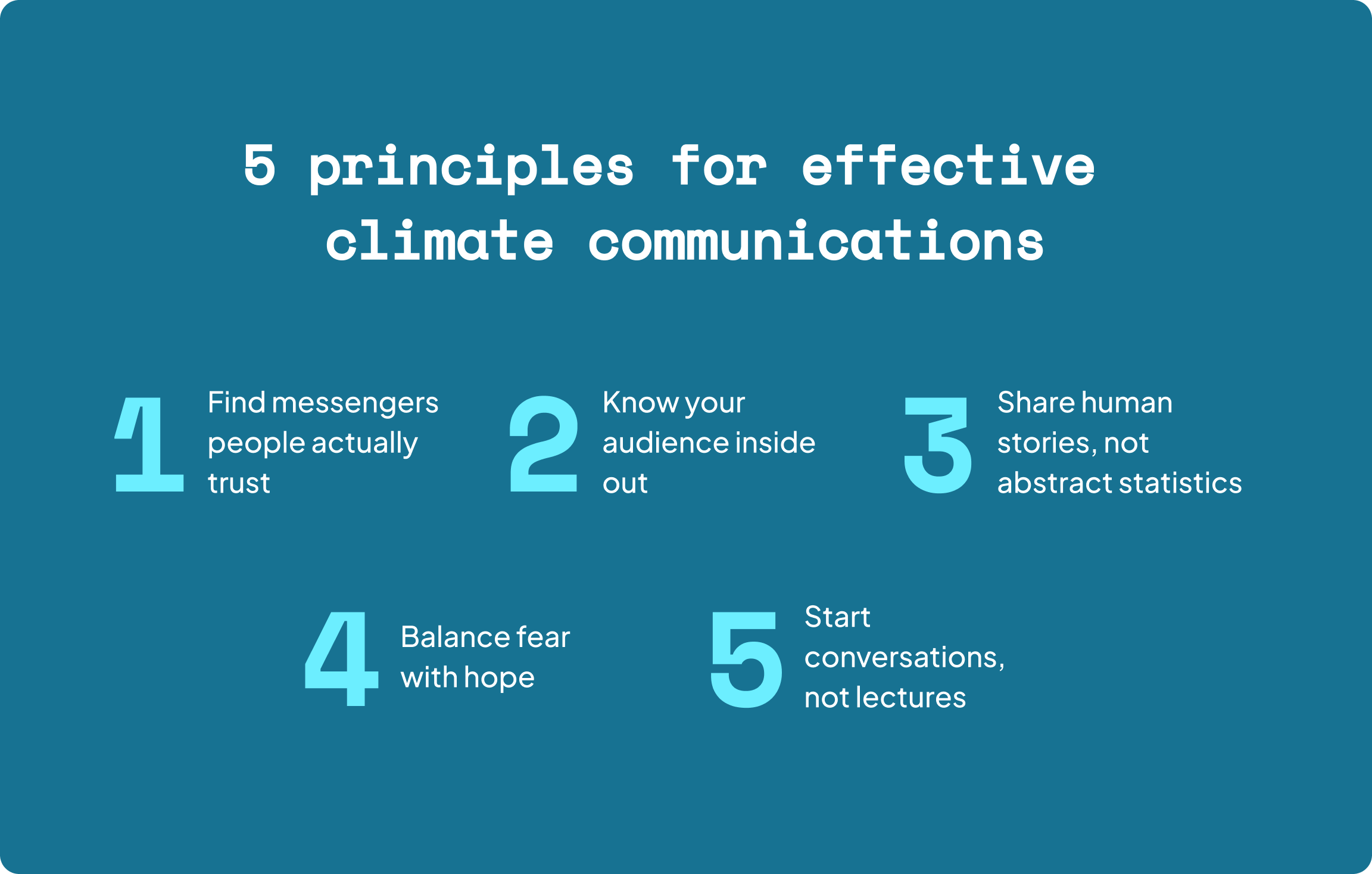
So I’ve dived into all the research on climate and science communication, and come up with 5 essential principles for climate communication that actually works:

  1. Find messengers people actually trust
  2. Know your audience inside out (and tailor the message to that understanding)
  3. Share human stories, not abstract statistics
  4. Balance fear with hope
  5. Start conversations, not lectures.

When you apply these principles together, you create climate communication that cuts through the noise, builds genuine trust, and inspires people to act.

Let’s take a closer look at each.

The 5 principles for effective climate communication

Principle 1: Find messengers people actually trust

When it comes to climate campaigns, who delivers the message matters just as much as what’s being said.

For decades, the climate crisis narrative has been dominated by voices that many people simply don’t trust – from politicians who make empty promises to economists with competing agendas. These messengers have muddied the waters, transforming what is truly accepted science into something that feels like an ongoing debate.

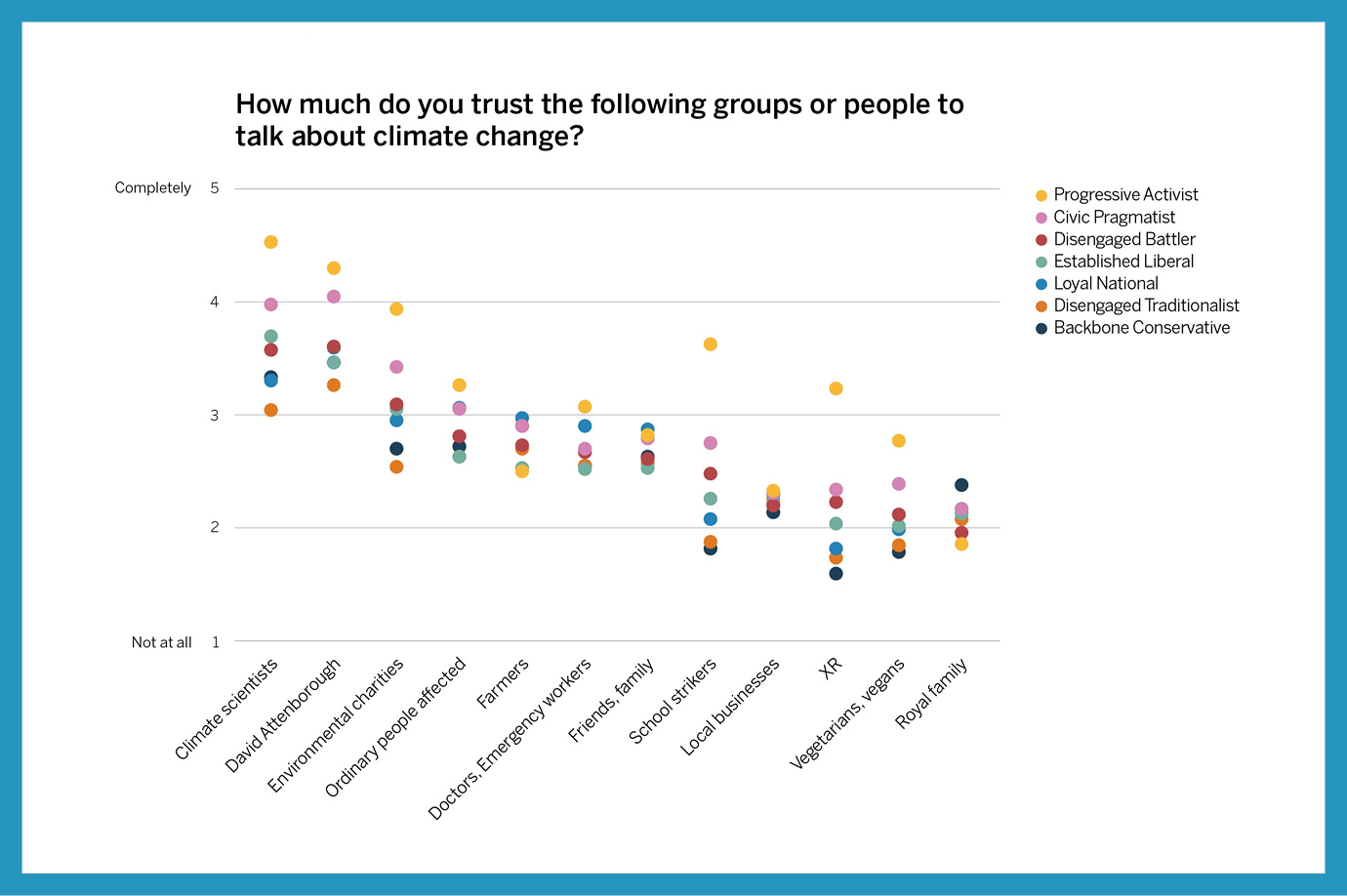
Climate scientists have also played a big role in sharing messages about climate impacts and action. But, interestingly, the public generally has lower trust in scientists than we might expect, often due to their use of technical jargon, unwillingness to speak in certain terms, and focus on statistics rather than storytelling.

Our receptiveness to climate messages often has less to do with the facts presented and more to do with who’s presenting them.

A trusted messenger is someone the audience already trusts – and who that is varies dramatically depending on your target audience. It might be local community leaders, religious figures, respected professionals, friends and family members, or social media influencers relevant to specific communities.

Read more about finding trusted messengers for climate campaigns →

The key takeaway: Identify who your specific audience already trusts, and ensure your climate message comes from those voices rather than defaulting to experts or authority figures.

Principle 2: Know your audience inside out (and tailor the message to that understanding)

Climate change means completely different things to different people – and I mean completely different.

A conservative farmer in rural America will interpret the exact same climate message in a totally different way than a progressive student in London. That’s not because one is right and one is wrong – it’s because humans filter everything through their existing beliefs and values.

It’s easy to assume that everyone should care about climate change for the same reasons we do. But people have different priorities, different fears, different dreams for the future.

The magic happens when you take the time to truly understand what your specific audience already cares about, then show them how climate change connects to those things. 

Want to reach conservatives? Talk about energy independence and economic opportunity. Speaking to parents? Focus on protecting their children’s future. Addressing a business audience? Highlight the financial risks of inaction.

It’s not about changing your message to tell people what they want to hear – it’s about finding the authentic connection between climate action and what they already value most deeply.

Read more about tailoring climate communications to your target audience →

The key takeaway: Stop broadcasting generic climate messages. Start with deep audience research, then frame your message around what they already care about.

Principle 3: Tell human stories, not abstract statistics

Most people think climate change is happening to someone else, somewhere else, sometime else. Not to them, not here, not now.

We’ve spent decades showing people melting ice caps and polar bears on shrinking ice floes. We’ve bombarded them with statistics about parts per million and global temperature averages. And it hasn’t worked.

Why? Because these messages have made climate change feel abstract and distant. 

In reality, we care most about protecting the places we’re emotionally connected to – our hometown, our local park, the beach where we had our first kiss. And we prioritise immediate concerns over future consequences.

The moment you put a human story (tailored to your audience) within climate communications – when you share the story of a local farmer whose crops are failing, a coastal community dealing with flooding, a family struggling with extreme heat – everything changes. Suddenly it’s not about polar bears or statistics. It’s about people just like us facing real challenges.

Read more about the power of climate change stories →

The key takeaway: Use the graphs and statistics sparingly. In their place, find the human stories that make climate change feel personal, local, and solvable.

Principle 4: Balance fear with hope

Most climate communication is absolutely miserable.

We get a constant stream of disasters, extinctions, and corporate greed. Heat domes, wildfires, floods. “We have 12 years to save the planet” headlines that make you want to crawl back into bed and hide.

The problem with that approach is that fear only motivates people when they believe they can actually do something about the threat. When all you hear is doom and gloom, you don’t think “I must act immediately” – you think “this is hopeless, what’s the point?”

People get so overwhelmed by the scale of the climate crisis that they shut down completely. They stop engaging. They turn away.

Yes, it’s important to be honest about the severity of what we’re facing. But then show people the solutions that are already working. The communities that are adapting and thriving. The technologies that are scaling. The policies that are making a difference.

People need to feel both the urgency of the crisis AND their own power to be part of the solution.

Read more about the importance of climate hope in communications →

The key takeaway: Stop with the doom and gloom and despair narratives. Balance honest portrayals of climate impacts with concrete examples of progress and pathways forward.

Principle 5: Start conversations, not lectures

You know that feeling when someone talks at you rather than with you? That’s exactly how most climate communication feels.

We get scientists lecturing us with technical jargon. We get activists shaming us for our every wrong move. We get politicians making grand speeches about what needs to happen. Everyone’s talking, but nobody’s listening.

We treat climate communication like it’s about transferring information from expert brains into empty public heads. As if people are just waiting around to be educated about climate change, and once they know the facts, they’ll obviously start caring.

That’s not how humans work.

Real persuasion happens in conversation. It happens when you genuinely listen to someone’s concerns, acknowledge their perspective, and find common ground. It happens when people feel heard and respected, not lectured and judged.

The most powerful climate communications I’ve seen aren’t presentations – they’re discussions. They’re spaces where people can ask questions, share their own experiences, and explore how climate change connects to their own lives.

When you create genuine dialogue, people don’t just receive your message, they help shape it. And messages that people help create are the ones they actually care about and act on.
Read more about building climate conversations not lectures →

The key takeaway: Stop broadcasting at people. Start genuine conversations where you listen as much as you speak.

Climate change discussions: Why two-way dialogue beats lectures every time

Much of our existing communication about climate change can feel like you’re being lectured at – whether by scientists, climate activists, and fossil fuel executives, they’re always trying to tell you how you should think and what you should be doing better.

But if we’re trying to get a message across and inspire action on climate, one-sided lectures will never work.

We need to be engaging in meaningful climate conversations that recognise diverse perspectives and create space for genuine dialogue.

The problem with one-way climate communications

Climate messaging often falls into the trap of one-sided arguments that fail to engage audiences effectively:

  • Scientists using technical jargon and relying on the information deficit model
  • Industry narratives that lecture us on individual guilt while deflecting corporate responsibility
  • Activist messaging that can appear preachy and media coverage that enforces impossible standards
  • Polarisation that deepens divides rather than building bridges for collaborative action.

Let’s examine each of these challenges in more detail.

Scientists and the information deficit model

Climate scientists, whilst being an absolutely vital piece of the puzzle in combating the climate crisis, aren’t always the best communicators.

Whilst statistics and scientific jargon make sense in the context of an academic paper or conference, when this is translated into public engagement campaigns it doesn’t always come across in the best light – often feeling like a literal lecture.

In fact, research has shown that using scientific jargon can significantly reduce the effectiveness of climate communications.

For instance, a 2019 study published in the journal Public Understanding of Science found that “using jargon significantly disrupts processing fluency” and increases resistance to persuasion, heightens risk perceptions, and reduces overall support for technological solutions – even when the jargon is explained. The researchers concluded that “initial messaging should strive to facilitate an easy processing experience and eliminate jargon where possible.”

Susan Joy Hassol, Director of Climate Communication, has identified numerous terms that climate scientists use regularly but that mean something completely different to the general public – terms like “theory,” “aerosols,” “enhance,” and “positive feedback”.

She calls this gap the need to “translate science into English”.

When we’re aiming to engage the public, win their trust, and persuade them of our way of thinking or an action that’s needed, a jargon-filled lecture isn’t the way to go.

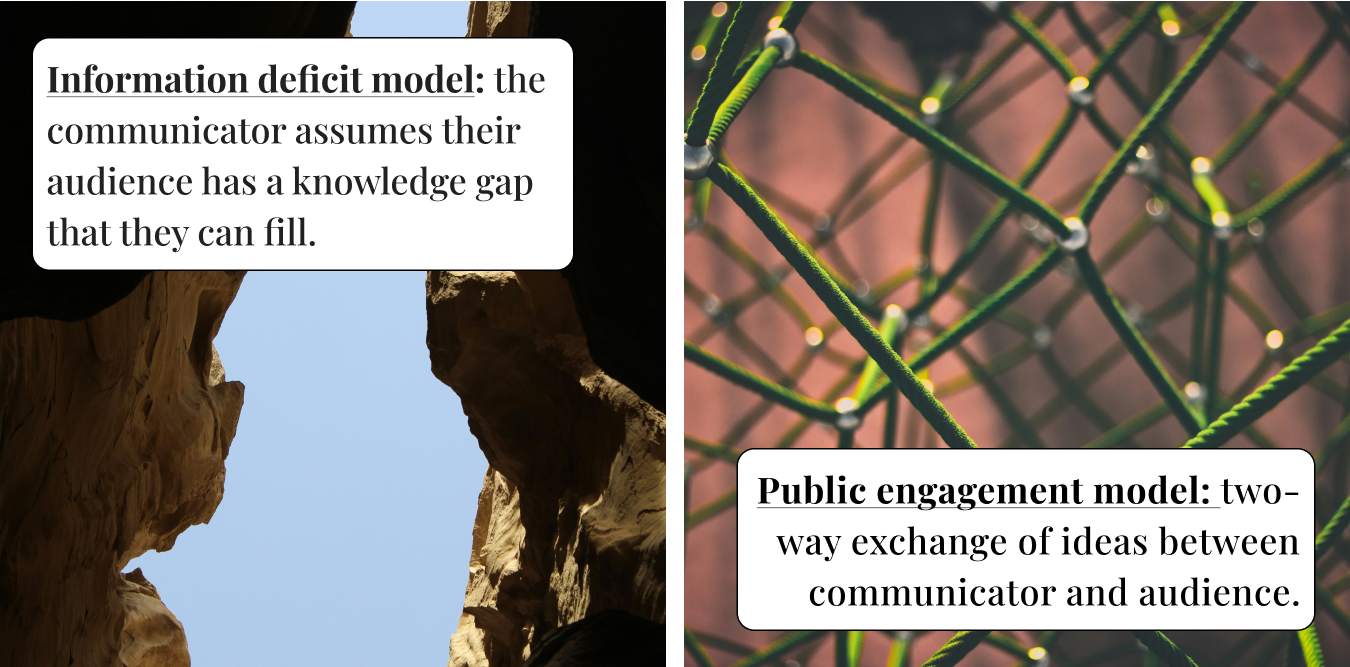
Key concept: What is the information deficit model?

The “information deficit model” in science communication assumes that the public lacks scientific knowledge, and simply providing more information will lead to understanding and behaviour change. 

Research shows this approach is largely ineffective, as people interpret information through their existing worldviews, values, and social contexts. Effective climate communication requires more than just facts – it needs dialogue, storytelling, and connection to people’s lived experiences.

Information deficit model: the communicator assumes their audience has a knowledge gap that they can fill. Public engagement model: two-way exchange of ideas between communicator and audience.

Industry narratives and climate guilt

The fossil fuel industry has dominated the narrative on climate change since it first came to light in the 1960s.

Back then it was largely attempts to deny climate science through advertorials and funding researchers to downplay its findings and promote climate scepticism in the mainstream media.

Today, they’ve shifted to placing blame on individuals in their greenwashing ads, another way that climate communications often feels like a lecture.

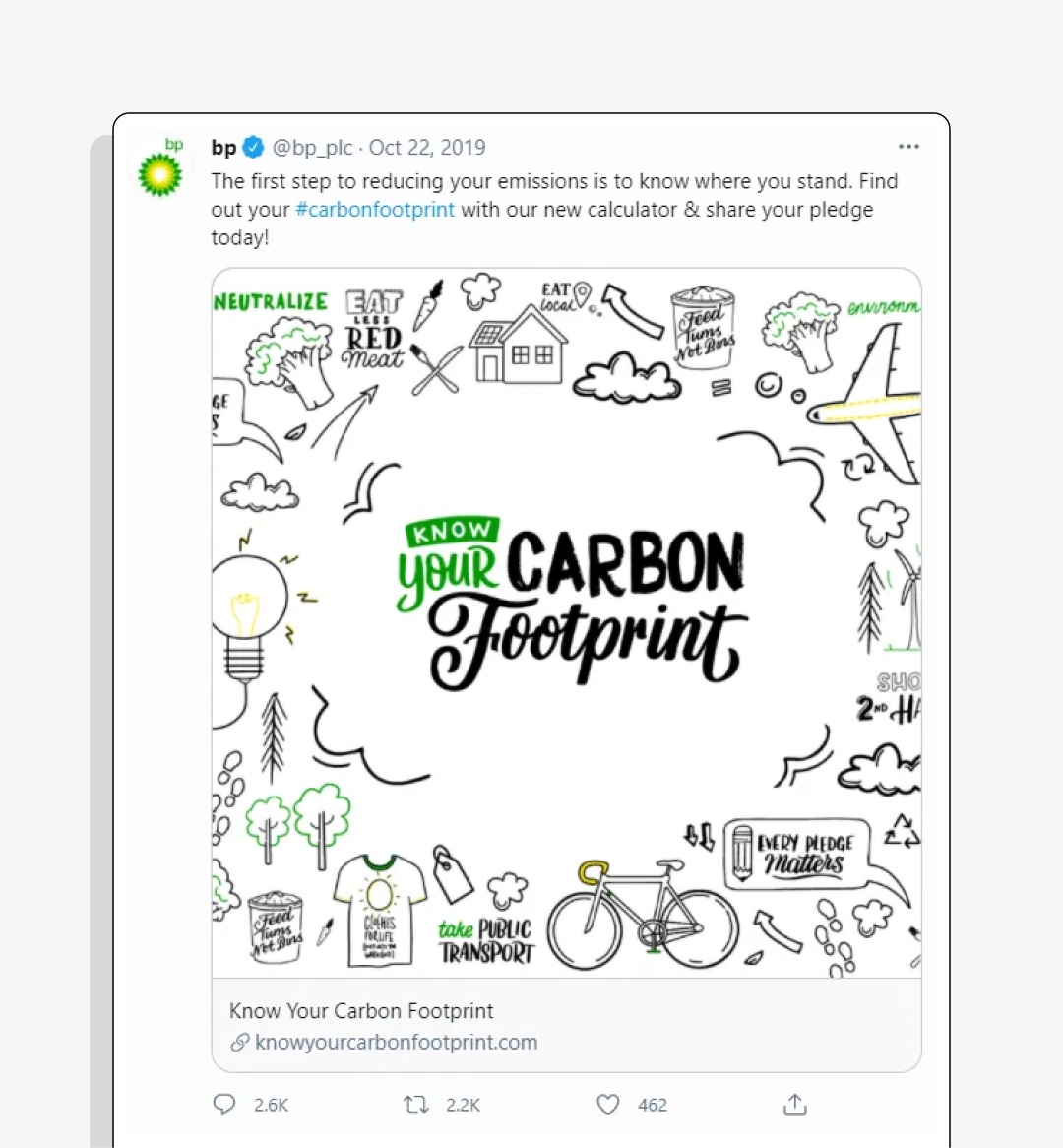
Infamously, BP created the notion of a ‘carbon footprint’ to guilt-trip people on the carbon emissions resulting from everyday activities – without accounting for their role in extracting and burning fossil fuels, and building a society reliant on them.

Screenshot of a Twitter post from BP in 2019, sharing their carbon footprint tool

More recently, E.On’s advertising campaign ‘It’s Time’ depicts people going about their lives blissfully aware of raging fires, floods, and melting ice caps, with the message that it’s time for us all to do our part – as if individuals hold the key to fixing this mess.

Screenshot showing E.on's website for their 'It's time' campaign

Research consistently shows that guilt and shame-based approaches in climate communication often backfire rather than inspire action. 

For instance, a study published in the Journal of Agricultural and Environmental Ethics found that climate shame responses often lead to “anger, mocking, denial, and other defensive behaviours” rather than productive engagement with climate solutions. 

This aligns with public health communication research by Yale physician Dr. Kristen Panthagani, who demonstrated that shame-based messaging about vaccines entrenched people further in their resistance, with corrections using negative language making recipients more defensive about their beliefs. 

Both studies emphasise that approaches focused on connection, empathy, and shared values are more effective than those that provoke shame and guilt.

Key concept: What is climate guilt?

Climate guilt is the feeling of responsibility and shame about one’s contribution to climate change through everyday activities. 

While personal actions matter, research shows that excessive focus on individual guilt can be counterproductive, leading to defensiveness or helplessness rather than constructive engagement. 

Corporate messaging often leverages climate guilt to shift responsibility away from industry and systemic change onto individuals.

Activism and media polarisation

Climate activists are another key communicator, and whilst their personal style can be highly effective, they can also sometimes come across as morally superior or preachy.

Again it’s the climate guilt and shame that becomes an issue – making people feel they’re being lectured at for everyday choices like eating meat or taking flights, especially when many activists are perceived as coming from privileged backgrounds.

The media often exacerbates this problem by holding anyone who mentions climate action to impossibly high environmental standards. 

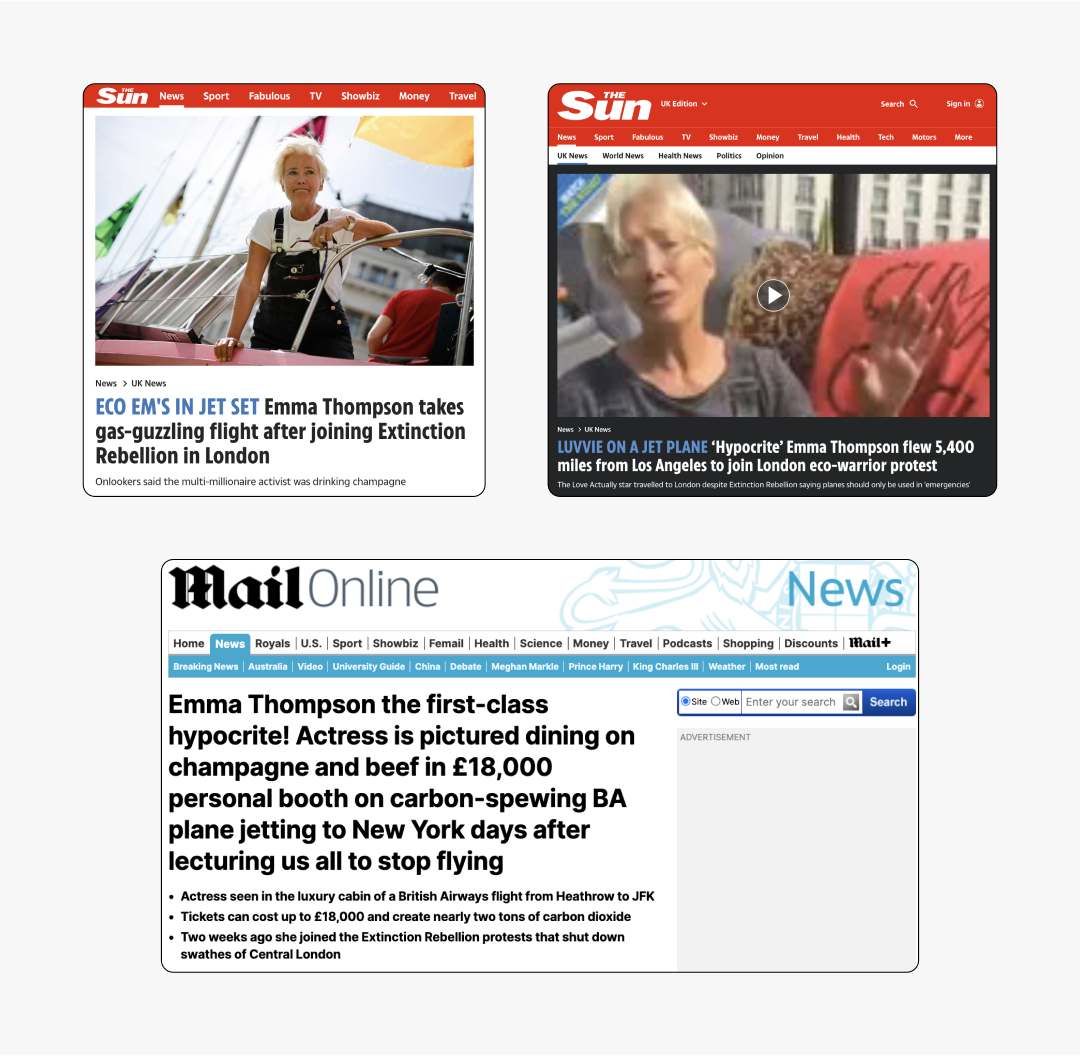
Like when Emma Thompson attended an Extinction Rebellion protest in London and climate-denying media outlets rushed to point out that she flew from LA to attend:

Screenshot of headlines about Emma Thompson flying after attending a Extinction Rebellion protest

As we’ve seen, shame and guilt aren’t productive emotions when it comes to climate action. In fact, they’re often debilitating – people either get defensive or feel helpless to fix what seems like an overwhelming problem.

‘Us vs you’ lectures about what we, as individuals, should or should not be doing to save the planet only deepen the already existing divides in our increasingly polarised society.

Why two-way climate discussions are more effective

Research consistently shows that dialogue-based approaches to climate communication produce better results than one-way information transfer.

The science behind two-way dialogues for communicating climate change

Multiple studies support the effectiveness of two-way dialogue for science communication:

  • A comprehensive review study by Cathelijine Reincke et al found that the deficit model of science communication is largely ineffective, and that enabling two-way dialogue and engagement is hugely beneficial for both parties involved.
  • According to research published in the Journal of Science Communication, public engagement with climate science improves significantly when communication moves from a one-way “telling” approach to a two-way dialogue that acknowledges diverse values and perspectives.
  • A 2021 study in Environmental Communication found that participatory approaches to climate communication led to greater knowledge retention, higher levels of trust in the information, and increased motivation to take action compared to traditional lecture-style presentations.

As climate scientist Katherine Hayhoe notes in her book “Saving Us”:

“Think of every conversation as being three conversations at once: about facts, feelings, and identity.”

Katherine Hayhoe

Two-way dialogue creates space for all three of those conversations to happen simultaneously – and, importantly, also allows the messenger to gain a better understanding of the worldview and personal factors that go into the audience’s perception of climate change.

“On climate change and other issues with moral implications, we tend to believe that everyone should care for the same self-evident reasons we do. If they don’t, we all too often assume they lack morals. But most people do have morals and are acting according to them; they’re just different from ours. And if we are aware of these differences, we can speak to them.”

Katherine hayhoe

So, with two-way dialogue and conversation-focused climate communications, we can achieve:

  • Higher information retention: People remember information better when they’ve actively engaged with it through discussion
  • Greater trust in climate science: When people can ask questions and receive clear answers, their trust in the information increases
  • More motivation to act: Dialogue that connects climate issues to people’s existing values leads to greater motivation for action
  • Community building: Two-way discussions create connections between people concerned about climate change, reducing the sense of isolation.

Key concept: What is ‘public engagement’ in climate change communications?

Public engagement refers to meaningful interaction between scientists, communicators, or policymakers and the general public on climate issues. 

Research shows that effective public engagement goes beyond passive information delivery to include active dialogue, collaboration, and co-creation of solutions. 

The most successful engagement approaches connect climate issues to community values, provide space for diverse perspectives, and enable participants to see themselves as part of the solution.

Example: How Curious Climate Tasmania use two-way dialogue for effective climate change discussions

The Curious Climate Tasmania group provides an excellent example of effective climate change discussions in action. 

This ‘public-powered scientific engagement’ initiative aimed to increase public engagement on climate by flipping traditional one-way science communications on its head.

The group conducted an experimental travelling roadshow, complete with radio show, where members of the public were encouraged to ask questions and open discussions with scientists about their work.

Screenshot of article by the Curious Climate Tasmania group, about their roadshow experiment

The results demonstrated the power of two-way climate dialogue:

  • Hundreds of attendees aged 10-89 turned up to the roadshow events, with 80% saying they were there specifically to talk to scientists
  • Attendees left with a high level of trust in the information and research findings discussed at the events
  • 93% of attendees said they would like to attend more events.

As the organisers noted: 

“People are crying out for relevant and practical climate dialogue with others they can relate to and trust.”

The study also revealed how local context shapes climate conversations. 

Attendees from Tasmania’s west coast were interested in extreme climate events due to their history of strong seasonal weather patterns. Meanwhile, discussions started by attendees from the east coast, where many older retirees live in seaside towns, focused on sea-level rise, farming practices, and alternative energy sources.

This highlights the importance of tailoring climate conversations to learn about and lean into the existing worldview and context of a specific audience.

The organisers concluded: 

“Such high levels of interest would indicate that our project – engaging with communities on climate change, listening to their concerns and ideas, and working together to identify and develop action options – is one that people desire and need to empower community-level action.”

Sticking with the scientific researcher vs member of public example, for instance, not only will the member of public be more engaged and likely to understand and contextualise the information within their own worldview and identity, but the researcher can actually gain a huge amount of insight from understanding how their research is received and interpreted, and the questions that arise from this. 

Curious Climate Roadshow infographic

How to bring two-way climate conversations into your climate campaigns

It can sometimes feel unnerving to put dialogue-based communication into practice. 

Some interactions might open your work or your brand up to challenging questions or criticism, but we shouldn’t see this as a negative, only an opportunity to learn and discuss.

For brands engaging in sustainability marketing, open dialogue is especially important. 

Climate-engaged audiences face an ongoing battle against greenwashing in the corporate world, as brands like H&M and E.on use large-scale marketing campaigns to state their climate credentials, while shutting down any semblance of conversation or debate about the accuracy of those claims.

Instead, being transparent about your own role or knowledge gaps and enabling dialogue establishes trust – the perfect foundation for effective climate discussions.

Practical steps for better climate discussions

Here are a few practical ways to implement two-way climate dialogue in your communications work:

1. Create space for genuine conversation

  • Host interactive events where climate scientists or experts can engage directly with community members
  • Use social media for two-way engagement, not just broadcasting information
  • Incorporate Q&A sessions into presentations, webinars, and published content
  • Create feedback mechanisms like surveys, discussion forums, or comment sections that allow for meaningful exchange.

2. Listen and adapt to your audience

  • Conduct audience research to understand existing knowledge, concerns, and values
  • Adjust your messaging based on what you learn from your audience
  • Acknowledge diverse perspectives and validate different entry points to climate concern
  • Follow up on questions and provide additional resources when requested.

3. Make information accessible and relatable

  • Use clear, jargon-free language that everyone can understand
  • Connect climate issues to local impacts that people can see in their own communities
  • Share personal stories about climate experiences and solutions
  • Provide practical, actionable steps that feel achievable to your audience.
How to have climate conversations, not lectures: Identify ways to enable two-way dialogue, Listen closely and learn from your audience, Use clear language and cut the jargon.

The evidence is clear: two-way climate conversations are more effective than one-way lectures. By creating space for dialogue, we build trust, deepen understanding, and empower more people to take part in climate action.

Ultimately, climate change impacts us all in different ways, and we all deserve to hold space in the conversation – especially those who have historically lacked a voice in climate discussions.

That means opening up climate communications to enable connections, discussions, debates, criticisms, concerns, questions, and suggestions – we can’t just keep shouting climate messages out into the ether and expecting them to resonate.

When we approach climate communication as a conversation rather than a lecture, we create the conditions for genuine engagement, shared understanding, and collective action.


This article is part of our series on effective climate communication strategies. Read our previous articles on the importance of trusted messengers, reflecting audience worldviews, telling human stories, and incorporating climate hope and positivity.

Climate storytelling: Why personal accounts matter more than facts alone

One major challenge in communicating climate change is that people are prone to interpret climate change as a faraway, abstract problem. 

It’s often seen as an “environmental issue” – something to care about only if you’re an eco-warrior or nature-lover who wants to save the animals.

For those who do see the human impacts, it’s still easy to feel like climate change is something that’s causing problems for people in distant countries or future generations, not something that will impact our lives directly.

With this framing, it’s very difficult to get a message across and persuade an audience to act. 

So, for climate communication to be effective, it’s vital that we emphasise the personal stories behind climate change, and ideally stories of those that feel close to home.

Why climate change feels distant

When we do think about the human impacts of climate change, it often feels like it will only affect other people, in another place, at another time. 

It’s impacting people elsewhere, not those in our local vicinity

In reality, the human effects of climate change are already being felt across the globe with changing weather patterns and extreme weather events increasing in regularity. 

However, as someone living in the UK, the general narrative here is that the hotter summers are great, whilst elsewhere the impacts are already deadly – like the heatwaves of 50 degrees in India or the wildfires of LA, or the severe flooding of monsoon seasons in South East Asia.  

It’s easy to feel like climate change isn’t going to reach us in our local area.

And it’s that local area that we care about the most.

It’s a psychological fact (via a concept known as place attachment theory) that we all become emotionally attached to the places we live in and visit regularly, like our hometown, holiday destinations, or the local park we visit each week. 

What is place attachment theory?

Place attachment theory refers to the emotional bonds that people form with specific geographic locations.

These bonds develop through experiences, memories, and meanings associated with places where we live, grow up, or have meaningful experiences.

When it comes to climate change, place attachment helps explain why people may care deeply about protecting their local environments while feeling less concerned about distant climate impacts.

This localised focus makes climate change feel less urgent because it’s perceived as happening “elsewhere” – unless those distant places also hold personal significance.

Most of these places are physically close to us, which means we naturally care more about protecting our local area than distant parts of the world.

So, even as extreme weather becomes more common globally, until climate change directly affects places we care about, it feels too distant to demand urgent action.

Research published in the journal Global Environmental Change confirms this psychological pattern, finding that people tend to perceive climate impacts as “more severe in developing countries and in more geographically distant zones” than in their own communities. The study found that “self-closeness to an event appears to be related to a greater concern [about that event]”. (Devine-Wright, 2013).

This means that:

  • A farmer experiencing changing rainfall patterns first hand feels greater concern than someone reading about rainfall patterns in another country
  • Someone whose hometown experienced flooding will likely feel more concerned about climate-induced flooding than someone who’s never lived in a flood zone
  • A person with family in a climate-vulnerable region will typically feel more concerned about those specific impacts than someone with no personal connection.

And so on.

Further, a second study published in the Journal of Environmental Psychology found that this concept has a direct impact on the likelihood to act on climate change – “individuals who believe climate change impacts are unlikely to happen or will primarily affect other people in other places are less likely to be concerned about climate change impacts and less likely to support climate adaptation” (Singh et al., 2017).

It’s a future problem, not one for right now

Another reason that climate change feels like a distant issue is that humans struggle to act on things that feel like a long-term problem, not an urgent one that will impact us in the short-term.

Again, this is just part of our psychology – with the concept of ‘temporal discounting’ the term used to describe how we place heavier weight on the present than the future.

What is temporal discounting?

Temporal discounting is a psychological concept that describes how humans tend to place greater value on rewards or consequences that are closer to the present, while discounting those that are further in the future.

When it comes to climate change, temporal discounting explains why we often struggle to take urgent action now to prevent disasters that might happen years or decades from now.

Even though the future consequences are severe (like coastal flooding or extreme heat), our brains are wired to prioritise immediate concerns (like economic convenience or lifestyle comfort).

We typically think about this in terms of delayed gratification — like the famous marshmallow test – but it applies to how we prioritise social issues too. 

This undervaluing of distant risks has proven to play a significant role in how we perceive climate change risks.

This undervaluing of distant risks has proven to play a significant role in how we perceive climate change risks.

Research into temporal discounting and climate change has yielded compelling evidence that humans consistently prioritise immediate benefits over future consequences. 

For instance, a 2009 paper titled “Judgmental Discounting and Environmental Risk Perception” found that people systematically undervalue environmental risks that are distant in time.”

This psychological tendency creates a significant barrier to climate action because the activities contributing to climate change provide immediate, tangible benefits –like the convenience of driving a car – while the costs seem distant and abstract.

It’s an abstract concept that feels intangible

We struggle to visualise what climate change actually is – we can’t see it or touch it, making it feel intangible.

Research published in the journal Nature Human Behaviour identifies this as a key challenge, noting that climate change is often perceived as “abstract, uncertain, and with consequences in distant places or times” (van Lange et al., 2018).

This abstract nature creates yet another psychological barrier to action.

Without tangible evidence that we can see and feel directly, climate change becomes another item on a long list of potential concerns rather than an immediate priority requiring action.

Given that people typically view climate change as a future problem affecting faraway places, it’s incredibly challenging to create climate communication that really breaks through and motivates action.

But there are effective approaches that can help shift this perspective.

Most communications frame climate change as a human issue, not an environmental issue

One of the biggest problems in climate communication is that we’ve made climate change seen primarily as an environmental problem, not a human one.

“They defined climate change as an environmental issue and therefore not a resource, an energy, an economic, a health, or a social rights issue.”

George Marshall, Don’t Even Think About It

This ‘framing’ matters immensely, as George Lakoff explains in his influential work on political communication. 

George Lakoff, Don't Think of the Elephant

Lakoff, a cognitive linguist, argues that the frames we use – the mental structures that shape how we see the world – determine our understanding of issues like climate change. 

What is George Lakoff’s ‘framing’ argument in ‘Don’t Think of an Elephant’?

George Lakoff  introduced the concept of framing in political discourse, most notably in his book “Don’t Think of an Elephant!”.

Framing refers to how we use language to shape perception and understanding of issues. Lakoff argues that the words, metaphors, and narratives we use activate certain neural circuits in our brains that influence how we interpret information.

For climate change, Lakoff points out that environmental framing (focusing on “saving the planet” or “polar bears”) disconnects humans from the narrative. This framing makes climate change seem like a special interest issue rather than a human survival issue.

He suggests reframing climate change to emphasise that “we are the polar bears” – highlighting that human existence itself is threatened.

Lakoff’s approach demonstrates why storytelling about real people affected by climate change is so powerful – it reframes climate change from an abstract environmental problem to an immediate human concern that requires action.

Media analysis shows this environmental framing is pervasive in current climate communications.

For instance, one study of climate change imagery found that the most common visuals used in climate communication are polar bears on melting ice, smokestacks, and barren landscapes – all reinforcing the idea that climate change is primarily about “nature” separate from humans (Rebich-Hespanha et al., 2015). 

In another study, children frequently mentioned “polar bears melting” as one of their primary associations with climate change (Lee et al., 2020) – suggesting it’s the impacts on animals and on earth’s geography that are most memorable in existing media and climate campaigns.

When climate change is continually framed as an “environmental issue,” it becomes mentally filed away as a special interest concern rather than a human survival issue.

As researcher Saffron O’Neill notes in her study of climate imagery, “The polar bear has become an iconic symbol of climate change… Yet this imagery may distance people from climate change, as polar bears are perceived to be remote from people’s everyday experiences” (O’Neill et al., 2013).

Polar bear on melting ice

The way we talk about things, the language and images we use, profoundly influences how people understand them. 

For decades, climate change has been presented as “saving the planet,” “protecting the environment,” or “fighting global warming” – always with images of melting glaciers and sad polar bears. 

The risk to human civilisation is rarely mentioned.

The framing of solutions has been just as problematic. 

Lakoff uses the example of carbon taxes. The term “carbon tax” activates images in our minds associated with financial burden, government overreach, and personal sacrifice. This framing makes it easy for opponents to characterise climate action as costly and threatening to economic prosperity.

“It [carbon tax] does not evoke in the minds of the public the real human horrors and economic costs of climate disasters.”

George Lakoff, Don’t Think of an Elephant!

The reality is that climate change is an inherently human issue.

“We are the polar bears. Human existence is threatened, as is the existence of most living beings on earth. When we see the polar bear struggling on the ice floe, that is us.”

George Lakoff, Don’t Think of an Elephant!

Without humans, we wouldn’t be facing climate change in the first place. It’s a problem caused by our industrialisation and use of fossil fuels. And it has very real human consequences too.

The planet has endured dramatic changes in climate in the past. But humans haven’t. 

So, what does this mean for how we communicate climate change?

It means that conveying why climate change actually matters for typical people can be hugely powerful – flipping the narrative from an environmental problem to a human one.

“The bottom line is this. To care about climate change, you only need to be one thing, and that’s a person living on planet Earth who wants a better future. Chances are, you’re already that person – and so is everyone else you know.”

Katherine Hayhoe, Saving Us

Framing climate change as the human issue that it is should be woven into any climate change campaign by demonstrating how it impacts things all humans care about: food security, water availability, public health, energy security, and protection of disadvantaged communities – with the specific topics focused on led by the target audience being addressed.

And instead of using scientific language and scare tactics, these topics are better introduced through climate change storytelling that illuminates the real, human stories behind this environmental challenge.

The power of climate change stories: connecting with an audience through human narratives

Research has long shown that stories are powerful as a form of communication.

Humans have a long tradition of storytelling as a way to share information, convey meaning, and connect with other people.

Neuroscience studies have shown that stories provoke real cognitive processes and emotions; even to the point where a listener’s brain waves start to sync with those of the storyteller.

We’re better at remembering stories too – much more effectively than remembering facts, which explains why the statistics which have dominated many climate conversations don’t have the desired impact: they simply don’t stick.

More recently, researchers have shown that storytelling is powerful specifically for communicating about climate change.

A 2020 study at Yale found that sharing personal and emotional stories from people already impacted by climate change had the power to engage even the most skeptical audiences across the political spectrum. 

In fact, a personal climate story from a North Carolina sportsman named Richard Mode describing how climate change affected the places he loved to fish was particularly effective at shifting beliefs and risk perceptions, especially among conservatives who are traditionally less receptive to climate messages.

In the study, participants listened to Mode describe in heartfelt tones how he’s seen the climate changing first-hand as ducks migrate later in the year and trout disappear from their old haunts. “Trout require cold, clear, clean water,” Mode explains. “Places that I’ve trout fished in the past that used to hold lots of fish are warming, and the fish just aren’t there like they used to be.” This simple, personal testimony proved remarkably effective at shifting perspectives across political divides.

Plus, stories help to bridge the feeling of distance that often plagues climate communications, as we saw earlier.

According to Yale’s Climate Connections research, “personal stories are particularly powerful because they bridge the psychological distance of climate impacts” and “help us recognize the immediacy of the climate crisis and its impacts” (Yale Program on Climate Change Communication, 2024). This emotional engagement creates the essential foundation for motivating action.

Successful examples of climate storytelling in action

So what do effective climate change stories look like? Let’s take a look at a few examples.

Yale Climate Connections: Everyday voices

Yale Climate Connections (YCC) produces daily 90-second radio stories that feature diverse people talking about how climate change affects their lives and what they’re doing about it. 

These stories reach hundreds of radio stations nationwide, including many in conservative areas.

The program connects the dots between climate change events happening to real, relatable people across America, framing climate change as a local as well as global issue. 

From pastors preparing their congregations for climate impacts to veterinarians advocating for greater heat protection for racehorses, these stories highlight how climate change affects the people, places, and things their audience already cares about.

Yale Climate Connections: Everyday voices

Climate Generation’s eyewitness stories

Climate Generation has built a powerful programme around the concept of climate stories. 

Founded by polar explorer Will Steger, who has witnessed climate impacts firsthand in Arctic regions, the organisation now collects and shares personal climate stories from people across the country. The organisation also hosts storytelling workshops, helping people discover and share their personal climate change stories – everyone has a story to tell.

Their approach emphasizes that while the climate stories represent individual perspectives, “it is our collective stories that have the power to shift the narrative.” 

Climate Generation's eyewitness stories

WaterAid’s climate stories

WaterAid’s series of ‘climate stories’ shows how climate change impacts communities through water-related challenges. 

One powerful example focuses on Lake Chilwa in Malawi, which has dried up significantly, affecting local livelihoods – like Samson the fisherman with no fish to sell, or Belita who makes an income selling rice porridge to fishermen but was unable to grow enough crops due to the lack of water.

These stories bring abstract climate impacts down to the human level, showing real consequences for real people trying to support their families.

WaterAid's climate stories

The “Barrio Fridge” movement

The “Barrio Fridge” started a grassroots movement of community fridges to prevent hunger and reduce food waste simultaneously. 

This story demonstrates how local climate solutions can address multiple community needs at once, and how ordinary people can create meaningful change through simple, practical actions.

By sharing these stories of community-led initiatives, climate communicators show that solutions don’t have to wait for top-down policy changes – they can start with neighbors helping neighbours.

How to use climate storytelling to strengthen communication campaigns

As we’ve seen, climate storytelling is perhaps a crucial tool for overcoming psychological distance, ensuring our audiences understand the true human impacts of climate change.

To craft impactful climate stories that motivate action:

  1. Make it local. Focus on climate stories in places your audience cares about and can relate to. Localised stories that show climate change happening “here, not just there” are more likely to overcome the psychological distance problem. 
  2. Feature diverse voices. Include stories from people your audience identifies with or respects – research shows that trusted messengers within communities are more effective than outside experts.
  3. Balance impacts with solutions. While it’s important to honestly portray climate impacts, stories that include practical solutions and actions avoid triggering despair. Per Espen Stoknes suggests using the “3:1 rule” — including three hopeful, solution-oriented framings for every one threat.
  4. Connect to existing values. Frame climate stories around values your audience already holds, whether that’s protecting family, creating jobs, strengthening community, or preserving traditions.
  5. Emphasise the present, not just the future: Stories should highlight climate impacts happening now, not just those predicted for distant decades, to overcome the psychological distance issue.

This article is part of a series on effective climate change communication. Check out the rest of the series:

Trusted messengers make all the difference in climate campaigns

When it comes to climate campaigns, who delivers the message matters just as much as what’s being said.

For decades, the climate crisis narrative has been dominated by voices that many people simply don’t trust. 

From politicians who make empty promises to economists with competing agendas, these messengers have muddied the waters, transforming what is truly accepted science into something that feels like an ongoing debate.

Our receptiveness to climate messages often has less to do with the facts presented and more to do with who’s presenting them.

So who are the trusted messengers that people will actually look up to on climate issues? 

And how can we leverage this understanding for more effective climate campaigns?

Table of contents

  1. Table of contents
  2. What is a trusted messenger?
  3. The trusted messenger paradox in climate campaigns
  4. Who qualifies as a ‘trusted messenger’ on climate change?
  5. How to find the right trusted messenger for your climate campaign
  6. Successful examples of trusted messengers in climate campaigns
  7. In summary

What is a trusted messenger?

Before we dive into the climate campaign side of it, let’s get clear on what we mean by a ‘trusted messenger’.

In communication theory, a trusted messenger is an individual or entity that audiences perceive as credible, authentic, and reliable—someone whose message they’re willing to hear and consider seriously. 

Research has consistently shown that when people evaluate information, they place greater weight on the trustworthiness of the messenger than on their expertise alone – it’s something that’s deeply rooted in the way that humans process information and make decisions.

The concept relates closely to the psychological principle of source credibility – wherein the trustworthiness and capability of a person or entity is directly related to how credible they are as a source, and therefore how likely individuals are to believe the information they impart. 

It’s a cornerstone of social influence and persuasion theory dating back to Aristotle’s focus on ‘ethos’ in rhetoric to explore the credibility or trustworthiness of a speaker or argument.

Here’s a couple examples of recent research on the topic of trusted messengers to illustrate the importance they hold.

Firstly, a 2022 paper by Loeb et al explored the relative effectiveness of different messengers in communicating public health information and encouraging vaccination during the Covid-19 pandemic. 

The key finding was that community-based organisations who already had an established relationship with vulnerable communities were the most effective for these campaigns because pre-existing trust increased their credibility around the highly-debated topic of vaccines.

Interestingly, the study also discovered that trust can be transferred by association – when a primary trusted messenger introduces or endorses a secondary messenger, some of that established trust transfers to the previously unknown entity. 

As a second example, a 2023 research paper by Chi-Horng Liao explored how mass media impacts altruistic behaviours. A key insight from the study was that audience trust in the media source is crucial for determining whether information will be perceived as useful and reliable – with trusted sources having far greater influence on attitudes and behaviors.

In the specific context of climate communication, trusted messengers function as individuals who can help “bridge the climate change communication gap” between scientific facts and public understanding. 

Communicators like these can transform abstract climate data into climate campaigns that resonate emotionally and culturally with their intended audiences.

The trusted messenger paradox in climate campaigns

When we consider who the most credible messenger for a climate campaign is, the instinct might be to think of climate scientists. 

These are the people who have the deepest knowledge of the subject matter, the experts on the matter who audiences will surely respect, right? 

Wrong. 

The evidence is clear: scientists may be the ones who conduct the research, but they aren’t necessarily the most effective at communicating it – in fact, the public generally has lower trust in scientists than we might expect. 

There are several reasons for this trust deficit, with three that research has found to be particularly damning:

  • Use of technical jargon
  • Unwillingness to speak in ‘certain’ terms
  • Too many statistics, a lack of storytelling.

Use of technical jargon forms a communication barrier

Scientific communication relies heavily on specialised terminology that creates significant barriers to public understanding. 

Research published in the Journal of Language and Social Psychology found that the mere presence of specialised terminology in science communications triggered negative reactions in audiences, even when definitions were provided (Shulman et al., 2020)

The study demonstrated that jargon doesn’t just make content harder to understand – it actively signals to non-experts that “this message isn’t for them,” creating psychological distance between scientists and public audiences.

Unwillingness to speak in ‘certain’ terms: when scientific caution backfires

Scientists are trained to express appropriate uncertainty and nuance in their findings – the argument being that there is always some level of uncertainty in science, some unknowns that haven’t been factored into a particular piece of research. 

It’s a methodological strength that unfortunately becomes a communication weakness in public discourse.

Research published in Nature concluded that uncertainty was found to erode trust in scientists and their research (Howe et al., 2019). 

The paper particularly highlighted how the subtle difference between scientific and everyday understandings of “uncertainty” leads to public misinterpretation of normal scientific caution as evidence of disagreement or lack of consensus.

“In scientific discourse, [‘uncertainty’] conveys the degree to which something is known. In the vernacular, the word conveys rather the sense of not knowing”.

The emotional storytelling gap – statistics aren’t enough to persuade

Perhaps most critically, scientific communication often lacks the emotional resonance and narrative structure that research shows is essential for motivating action on climate change.

Scientists typically focus on facts, statistics, and research findings.

In reality, it’s personal stories that make a successful climate campaign.

A study in the journal Climatic Change found that to trigger action on climate change, campaign messages needed to be structured as stories, rather than as analytical presentations of facts. Storytelling facilitates “experiential processing” that heightened emotional engagement and arousal – crucial factors for motivating pro-environmental behavior (Morris et al., 2019).

Research published in Communication Reports provides further evidence that personal stories about climate impacts can shift beliefs and risk perceptions even among political moderates and conservatives – with these effects mediated specifically by emotional reactions like worry and compassion (Gustafson et al., 2020).

Who qualifies as a ‘trusted messenger’ on climate change?

So, if not scientists, who should we be incorporating as trusted messengers for climate campaigns?

A trusted messenger is, quite simply, someone the audience already trusts. 

Research from Climate Outreach’s “Britain Talks Climate” study reveals that David Attenborough stands out as the UK’s most universally trusted voice on climate issues. 

Described as “a trusted messenger across all seven segments” of British society, Attenborough transcends political and social divides in a way few other public figures can.

Climate Outreach Britain Talks Climate findings on trusted messengers

His effectiveness stems not just from his knowledge, but from his authenticity, consistency, and ability to communicate complex ideas in accessible ways. 

He connects the scientific reality with the emotional impact in a way that resonates across demographic boundaries – getting that balance between fact and relatable storytelling right, which we’ve seen is vital for success.

But beyond celebrity figures like Attenborough, trusted messengers can come from many places – with different audiences trusting different messengers.

Social identity theory has an important role to play in this, because it’s typically people in our ‘in-group’ who we naturally perceive as trusted figures.

Social identity theory, first proposed by Henri Tajfel in 1979, explains how our sense of self is deeply intertwined with the social groups we belong to. We naturally divide the world into “us” and “them” – those who align with our identity and those who don’t.

With climate change having become an increasingly debated and politically polarising issue, it has, as George Marshall notes in his excellent book Don’t Even Think About It, become “polluted with social meaning.” 

It means that we need to be looking to the ‘insiders’ of our audience when we think about the right trusted messengers for climate campaigns, people like:

  • Local community leaders
  • Religious figures
  • Respected professionals (doctors, teachers, etc.)
  • Friends and family members
  • Social media influencers relevant to specific communities.

The right messenger varies dramatically depending on who you’re trying to reach, so the place to start is always with a deep understanding of your target audience and the people and organisations in their life that they have pre-existing trust with.

How to find the right trusted messenger for your climate campaign

It’s clear that, for those embarking on climate campaigns, getting the messenger and the voice of the campaign right is absolutely crucial for success. 

Without the right messenger, the campaign will fall on deaf ears.

With the right messenger, you’ll be able to leverage ‘trust transfer’ – gaining trust from an audience through your organisation’s new association with a voice that they already know and trust. This is especially important for climate campaigns trying to reach skeptical or disengaged audiences.

As we’ve seen, before selecting a messenger for your climate campaign, you need to understand the specific audience you’re trying to reach. 

Consider these questions:

  1. What social circles does your audience belong to? (Professional, religious, cultural, geographic)
  2. What values and beliefs define these social circles? (Conservative, progressive, traditional, innovation-focused, family-driven)
  3. Who do these groups typically trust for information? (Both within their immediate social circle and farther afield e.g. social media influencers, media outlets)
  4. Where do they consume information? (Social platforms, community spaces, traditional media)
  5. What existing views and knowledge does this audience have about climate issues?

The answers will guide you toward appropriate messengers who can genuinely connect with your target audience.

Successful examples of trusted messengers in climate campaigns

Celebrity messengers: Olivia Colman and Make My Money Matter

One successful example of a trusted messenger in recent climate campaigns is Academy Award-winning actress Olivia Colman’s work with Make My Money Matter.

In late 2023, Colman took on the role of “Oblivia Coalmine,” a villainous fossil fuel CEO in a campaign that exposed how UK pension funds are financing climate damage.

Oblivia Coalmine campaign by Make My Money Matter

The campaign generated more than 15 million organic YouTube views within just three weeks and led over 70,000 people to visit the organisation’s website to learn more about how their pensions were being invested. 

As a widely respected actress with broad appeal across different demographics in the UK, Olivia Colman brought credibility and attention to an issue many people had never considered before. 

Campaign director David Hayman noted that having “a well-known and popular spokesperson” helped the campaign go viral, particularly when they can “bring their own personality and humour” to the issue.

By personifying the fossil fuel industry in a darkly comedic way, Colman made a complex financial issue both accessible and emotionally engaging, with a clear story. 

Oblivia Coalmine campaign by Make My Money Matter

Reaching niche audiences through Social media influencers

An increasingly important category of trusted messengers for climate campaigns is social media influencers who have built dedicated followings around specific interests or identities.

Take, for example, Pattie Gonia, a drag queen environmentalist with over 770,000 Instagram followers, who combines LGBTQ+ advocacy with climate activism. By merging these identities, Pattie Gonia (the drag persona of Wyn Wiley) makes climate activism inclusive and accessible to LGBTQ+ communities.

Pattie Gonia has successfully collaborated with major environmental organisations on climate campaigns. 

For instance, in 2024, Pattie partnered with The Nature Conservancy on an educational campaign about forest management through controlled forest fires.

The video, which featured Pattie in a fire-inspired dress talking to a firefighter about how indigenous communities have used controlled fires as a forest management tactic for centuries – combatting misunderstanding and promoting greater understanding of environmental and social issues. 

Pattie Gonia x Nature Conservancy climate campaign

It quickly became The Nature Conservancy’s second-highest performing Instagram reel ever, generating over 210,000 likes and 14,000 shares.

Other campaigns have included a 2023 Pride Month collaboration with the Audubon Society on a YouTube music video ‘The Song of the Meadowlark’ which highlights how climate change is impacting birds – with a hopeful message of ‘let’s go birding together’ aiming to spark action amongst the audience.

Pattie Gonia x Audabon Society climate campaign

The effectiveness of influencers stems from their ability to connect with specific communities through shared identities, interests, and values. 

Unlike celebrity messengers who offer broad reach, these influencers provide deep engagement with particular demographic groups who might otherwise be overlooked by mainstream climate campaigns.

Faith leaders as climate messengers: The Islamic Declaration on Climate Change

Faith leaders have emerged as particularly powerful trusted messengers on climate issues, especially in communities where religious identity is central. 

Religious leaders shape the attitudes and beliefs of their congregations and are among the most trusted voices in many communities.

The effectiveness of faith leaders as climate messengers stems from their ability to frame climate action in terms of shared religious values.

For example, in 2015 Muslim leaders from 20 countries issued the “Islamic Declaration on Climate Change”, calling for action to phase out greenhouse gas emissions and framing climate protection as a religious duty. 

The Islamic Declaration on Climate Change

In summary

Finding those trusted messengers who can truly cut through is vital for effective climate campaigns. 

In a landscape clouded by denial, fossil fuel industry influence, and greenwashing, the right voices can transform how climate messages are received and acted upon.

The science of climate change is settled. Now, the challenge is ensuring that science is communicated by people your audience is ready to hear.


This article is part of a series on effective climate change communication. Check out the rest of the series:

Why your target audience matters in climate change communication

Know your audience, and understand what they value the most.

That’s step 1 in the start of any marketing campaign or piece of content – and it’s even more crucial when communicating about climate change.

Why does understanding the target audience matter in climate change comms?

There are two reasons that make understanding your climate change target audience absolutely essential:

  • Climate change can be interpreted in a multitude of different ways
  • Climate change is inherently polarising.

Climate change can be interpreted in a multitude of different ways

Climate change is inherently difficult to communicate about.

As George Marshall puts it, climate change is “exceptionally multivalent.” 

It’s simultaneously an urgent, life-threatening crisis and something intangible that we can’t see, touch, or feel day-to-day.

“Climate change is, I suggest, exceptionally multivalent. It lends itself to multiple interpretations of causality, timing, and impact. This leaves it extremely vulnerable to our innate disposition to select or adapt information so that it confirms our pre-existing assumptions. If climate change can be interpreted in any number of ways, it is therefore prone to being interpreted in the way that we choose.”

 – George Marshall, Don’t Even Think About It: Why Our Brains Are Wired To Ignore Climate Change

This ambiguity leaves climate change naturally open to wildly different interpretations by different audiences – depending on their existing worldview.

No piece of communication ever stands alone, because humans will always take new messages and immediately mould them to fit our existing opinions, beliefs, and worldviews – known as confirmation bias

When you combine this with a topic like climate change that’s already wide open to interpretation, you end up with vastly different existing connotations depending on your target audience.

So, having the context of those existing opinions, beliefs, and worldviews of the audience you’re trying to communicate with about climate change is incredibly important to understand how your messaging will be interpreted.

Climate change is inherently polarising.

Climate change as a concept has become increasingly polarised in society, over time becoming intrinsically linked with politics and identity

Generally speaking, liberals or left-leaning people will tend to see climate change as scientific fact which needs to be urgently addressed, whilst more conservative and right-wing people are skeptical and generally less concerned. 

The debate on climate change has evolved into a moral one socio-cultural one, with an ‘us vs them’ dynamic and strongly held beliefs on all sides of the equation.

If you don’t take the time to understand your specific climate change target audience’s existing knowledge and viewpoint, then you risk deepening the already enormous divide that exists on this topic, potentially generating heated contention rather than productive conversation.

There’s no one-size-fits-all in climate change comms – tailor to your target audience

The key takeaway is this: there is no universal approach when it comes to communicating about climate change – tailoring the message to the audience you’re targeting is a must.

As Katharine Hayhoe writes in her excellent book ‘Saving Us: A Climate Scientist’s Case for Hope and Healing in a Divided World‘:

“On climate change and other issues with moral implications, we tend to believe that everyone should care for the same self-evident reasons we do. If they don’t, we all too often assume they lack morals. But most people do have morals and are acting according to them; they’re just different from ours. And if we are aware of these differences, we can speak to them.” 

Katherine Hayhoe, Saving Us

So, messages and campaigns about climate change must always start with a nuanced understanding of the specific audience receiving the communication. 

Only then can your message be carefully tailored to resonate with who that audience is, how they already see the world (and climate change), and what they care deeply about.

Consider these drastically different climate change target audiences:

  • A right-wing leaning policy maker in America
  • A masters student studying sustainable tourism
  • A rural coffee farmer in Indonesia
  • A small business owner in a UK seaside town

These different people will all have drastically different reactions to the same climate change communication campaign.

So, depending on your goal, you would want to tailor your message to each specific audience to maximise impact.

Examples of tailoring messages to your climate change target audience

Let’s explore some real-world examples of how to effectively tailor climate communications to specific audiences.

Example 1: The Conservative Climate Leadership Council for politically conservative audiences

The Climate Leadership Council targets conservative Americans by framing climate action around economic opportunity, national security, and market-based solutions.

The campaign’s core pillars are:

  • Carbon advantage. By manufacturing goods with lower emissions, America can improve its economy whilst also lowering emissions.
  • Trade. By rewarding and encouraging lower carbon supply chains we can reduce the impact of the global trade system.
  • Carbon dividends. The ‘Baker-Shultz Carbon Dividends Plan’ is a proposal to charge fossil fuel companies a carbon fee, and put that fee back into the pockets of all American families – as well as doing the same at borders for global trade.
  • Measuring emissions. Supporting a clearer view of climate impact through a streamlined emission measurement and reporting approach.

All of these pillars focus on the economy, trade, wealth creation – topics which are typically associated with that more conservative audience. 

By building a campaign around market-based solutions, the Climate Leadership Council is able to push for change whilst not alienating its target audience.

Carbon leadership council's four areas of work

Example 2: The Laudato Si’ Movement for religious audiences

The Laudato Si’ Movement (formerly the Global Catholic Climate Movement) engages religious communities in climate change by framing climate action as a moral and spiritual imperative.

Their approach centres around:

  • Creation care theology. Climate action is presented as “caring for our common home” and protecting God’s creation, drawing directly from Pope Francis’s encyclical Laudato Si’.
  • Intergenerational justice. Their messaging emphasises our moral responsibility to future generations, framing climate inaction as a failure of stewardship.
  • Concern for the poor. They highlight how climate change disproportionately affects the world’s most vulnerable populations, connecting environmental action to core religious teachings about caring for the poor.
  • Parish-level engagement. The Laudato Si’ Action Platform provides practical tools for local religious communities to reduce their environmental impact through concrete actions.

By connecting climate action to deeply held religious values and existing moral frameworks, the Laudato Si’ Movement reaches an audience that might otherwise be disconnected from climate messaging.

Laudato Si' Movement's website

Example 3: Project Drawdown’s solutions framework for climate-aware audiences

Project Drawdown targets liberals and progressives who already accept climate science but need direction on specific solutions. 

Instead of focusing on the problem (which this audience already understands), they emphasise comprehensive, actionable paths forward.

Their approach includes:

  • Solutions rankings. Their research ranks climate solutions by effectiveness, costs, and benefits, appealing to the data-driven, evidence-based mindset of many progressives.
  • Sector-specific tools. They offer targeted resources for different sectors (food, transport, buildings, etc.), allowing people to focus on areas most relevant to their existing interests.
  • Co-benefits framework. Each solution is presented not just for its climate impact but also for its benefits to health, equity, and economic wellbeing, connecting climate action to broader progressive values.
  • “Climate solutions at your fingertips” messaging. Their communications emphasise agency, hope, and empowerment rather than doom-and-gloom scenarios that can lead to eco-anxiety among the already concerned.

By moving beyond problem statements to detailed solution pathways, Project Drawdown gives already-convinced audiences a constructive way to channel their existing climate concern into specific, effective action.

Project Drawdown's solutions library

How to tailor communications to different climate change target audiences

Here’s a few practical steps to follow to effectively communicate about climate change with your specific audience.

Step 1: Get clear on your target audience first

Before crafting any climate communication, define your audience as precisely as possible:

  1. What’s their context? Location, age, profession, interests, etc.
  2. What do they care most about? Health, family, financial security, community?
  3. What are their existing political beliefs, values, and worldviews? How does climate change fit into those frameworks?
  4. How concerned are they about climate change? How are they (or people in their circle) likely to be impacted?
  5. What communication channels do they use? What other climate change messaging might they be receiving there?

The more specific you can be, the better – “UK homeowners aged 35-55 with centre-right political views who are moderately concerned about climate change but prioritise financial security” is going to be much more useful than simply “homeowners.”

2. Research and listen to understand their worldview

To effectively tailor a message, you then need to gain a deep understanding of that audience’s values, beliefs, and communication preferences, through techniques such as:

  • Conduct formal research: Surveys, focus groups, or interviews with your target audience
  • Monitor relevant online communities: Forums, social media groups, comment sections
  • Review existing studies: The Yale Program on Climate Change Communication, for instance, segments audiences into “Six Americas” based on their climate beliefs, with a substantial amount of research on how these different audiences relate to climate change.

Look for:

  • What language and terminology they use when discussing climate issues
  • Which values they prioritise (e.g., family safety, economic security, community wellbeing)
  • What concerns or objections they commonly express
  • Which sources of information or messengers they trust – scientists, social media influencers, celebrities, friends and family, etc.

3. Clarify your core message and desired outcome

Be explicit about what you want your audience to think, feel, or do:

  • Knowledge outcome: What specific information do you want them to understand?
  • Attitude shift: How do you want their feelings or perspectives to change?
  • Behavioural change: What specific action do you want them to take?

4. Align your message with your findings

Based on your deep understanding of the audience, now it’s time to frame your message in a way that will resonate with them. 

For instance:

If your audience is already highly concerned about climate change: Focus your message around impacts, action, solutions, and hope. Avoid dwelling too much on doom-and-gloom scenarios, as this audience is already aware and might experience eco-anxiety. Project Drawdown’s solutions-focused approach works well here.

If your audience is religious: Focus on the moral imperative to protect people and the natural world. Frame climate action as stewardship of creation and emphasise the disproportionate impact on vulnerable communities, following the Laudato Si’ Movement’s approach.

If your audience is primarily concerned with economic issues: Highlight the economic opportunities in clean energy, the job creation potential, and the financial risks of inaction. Frame climate solutions as smart investments in the future, similar to the Climate Leadership Council’s market-based approach.

If your audience is highly influenced by their peers: Play into ideas of social norms and what others are doing in response to climate change – the Robert Cialdini “Don’t Throw In The Towel” study is a classic that demonstrates the power of social influence on behaviour change.

Climate Outreach recommends narrative workshops where climate messages are developed and tested directly with members of the target audience.

5. Choose appropriate messengers, channels, and formats

Research consistently shows that trusted messengers are critical in effective communication – for instance, a 2019 study published in Nature Climate Change found that messages from trusted in-group members were significantly more effective at changing climate beliefs than identical messages from outgroup sources.

So, it’s crucial to align this with your audience too:

  • Select credible voices: Identify who your audience already trusts (community leaders, industry experts, peers)
  • Use appropriate channels: Meet your audience where they are (social media platforms, community events, industry publications)
  • Consider collaborative approaches: Partner with organisations or individuals already respected by your target audience.

If we can find that sweet spot where our message truly resonates with what our climate change target audience cares most deeply about, that’s where real impact happens.

Understanding your climate change target audience isn’t just about making your message more palatable – it’s about making it more effective. It’s about ensuring that your communication actually leads to the change you want to see, whether that’s shifting perceptions, changing behaviors, or driving policy support.

By taking the time to truly understand your audience’s values, concerns, and worldview, you can craft climate change messages that don’t just get heard, but actually inspire action. 

And in a topic area as critical as climate change, that’s what really matters.


This article is part of a series on core principles for effectively communicating climate change, with other topics in the series including:

Climate hope and positivity are key to communicating climate change

Most communication on climate change focuses on the negatives.

There’s the devastating impacts – extreme weather events that are becoming more and more extreme, and more and more frequent, entire species going extinct, corrupt oil and gas executives making millions out of pretending they care. 

In ways, that makes sense – the impacts of the climate crisis are already devastating and will only continue to get worse, so there are a lot of negatives to talk about.

Plus, people are more likely to engage with negative headlines, so for media outlets and marketing campaigners who want to maximise engagement, it’s the natural way to go.

But what if this actually damages the effectiveness of the communications when it comes to persuading people to act on climate?

This could well be the case.

There’s a lot of evidence to suggest that instilling climate hope, positivity, and solutions-oriented narratives can be much more persuasive – and that’s what we’ll explore in this article.

Are ‘doom and gloom’ narratives ever effective when communicating climate change? 

Doom and gloom narratives do have their place.

The theory of emergency framing (otherwise known as disaster framing) dictates that when issues are shown to be both urgent and exceptional, the audience is more likely to be compelled to act to avoid catastrophe occurring. 

the guardian negative climate headlines

There are examples of this negative framing being impactful. 

For instance, the World Wildlife Fund has for decades largely centred its campaigns on showcasing animals which are very close to extinction – examples being their ‘love it or lose it’ campaign, removing the panda from their logo, or their ‘#lastselfie’ campaign, all with essentially the same message.

Let’s take a closer look at the #lastselfie campaign as an example.

The #lastselfie campaign aimed to make a viral social media moment on Snapchat, with several WWF accounts sharing images of well-known endangered species, with the message of ‘don’t let this be my last selfie’ – compelling users to act now and pledge a donation to prevent the extinction of the animal. 

By focusing on Snapchat as the channel, where the time-bound nature of the platform’s posts meant they disappeared after being viewed for 7 seconds, heightened the sense of urgency around the speed of extinction that we’re seeing today.

After a week of the campaign being live, screenshots of the disappearing snapchats had been shared on Twitter 40,000 times, and WWF had met their monthly donation target. The campaign was also widely recognised for its impact, even winning two awards at the 2015 Webby Awards.

WWF myselfie campaign twitter screenshots

It was clearly an impactful campaign, and there are many more examples of emergency framing being an effective technique when communicating climate change.

However, it isn’t always the case.

The problem with ‘doom and gloom’ narratives for climate communications 

Whilst emergency framing and doom and gloom narratives can in some instances drive an audience to act, in many cases they do the exact opposite – prevent action.

Importantly, the whole theory behind ‘emergency framing’ rests on the existence of an urgent and exceptional catastrophe. 

There’s no doubt that the climate emergency is this. However, it’s also very much a long-term umbrella catastrophe with lots of catastrophes (extreme weather events, extinctions, etc) happening along the way.

This means that, to be effective, we need to be able to sustain the urgency and exceptional nature of these doom and gloom climate narratives over decades to come. 

That’s very difficult to do, because when an issue is in the public eye for a long period, it inevitably loses some of that feeling of immediate urgency – this feeling that climate change will impact future people in other places is one of the huge barriers to action that we face.

Saffron O’Neill and Sophie Nicholson-Cole refer to this as a ‘law of diminishing returns’ in their study “Fear Won’t Do It” for the Tyndall Centre for Climate Change Research:

“It is possible that a law of diminishing returns may exist. If this exists, fear approaches need to be made more intense as time goes by because of repeated exposure to threatening information in order to produce the same impact on individuals.”

Screenshot of the research paper: Fear Won't Do It for the Tyndall Centre for Climate Research

Given that we know that so much existing climate change communication does use this emergency framing, it’s highly likely that its use has already been saturated and is no longer as effective as we’d like it to be.

In fact, a study by the Oxford Institute of Journalism found that “more than 80% of all climate news had employed the disaster frame.” 

Research paper: Climate change in the media by James Painter

The doom and gloom narrative is front and centre when communicating climate change. 

It’s overwhelming.

And it makes us feel hopeless – because fear is only motivating when we feel it is in our ability to influence change and support solutions to the emergency we’re being told about.

When doom and despair is all we hear, it makes us feel there’s nothing to be done, which is not conducive to persuading an audience to take a desired action.

O’Neill and Nicholson-Cole’s “Fear Won’t Do It” research paper also highlighted the role of control in our psychological functions. 

First we seek to control external causes of fear (i.e. take action) and if that is perceived to be impossible (as we see here with climate change) then we seek to control the internal causes instead – which results in “denial and apathy” towards climate change.

“If the external danger—in this case, the impacts of climate change—cannot be controlled (or is not perceived to be controllable), then individuals will attempt to control the internal fear. These internal fear controls, such as issue denial and apathy, can represent barriers to meaningful engagement.”

This suggests that if we persist in relying on disaster framing when communicating climate change, we could unintentionally make the problem worse – driving away engaged audience members who turn instead to denial in the face of hopelessness.

James Patterson et al. sum it up well in their 2021 study ‘The political effects of emergency frames in sustainability’, concluding that whilst emergency framing can be effective, it can als be detrimental to progress.

“Emergency frames can be energising, as witnessed by the diffusion of climate emergency declarations and school student strikes, which can imbue inspiration, hope and a sense of efficacy. But emergency frames can also be emotionally draining and create exhaustion, anxiety, guilt and fear. Fear can have ambiguous and sometimes counterproductive effects on motivation to act.”

So, what’s the alternative? 

Narratives of hope, positivity, and climate solutions can be more persuasive 

We need hope, because we need climate action.

Not only are hopeful people more likely to act themselves, but research from the Yale Program on Climate Change Communication found that people who are hopeful are significantly more likely to try and convince others in their lives to make changes, and to support policies that aim to mitigate climate impacts.

Yale Program on Climate Communication: linking hope to public engagement

Of course, when we communicate about climate change we should never sugar coat the seriousness of the situation we’re in – it’s simply about creating room within this for actions and solutions that can bring about change. 

In fact, a different research study on public engagement by the Yale Program on Climate Change Communication found that creating this balance between showing the negative impacts and leaving room for hope is key to persuading an audience to act.

Their findings on the psychological impact of communications suggests that if we want to motivate an audience to act on a problem, we need to highlight:

  • Negative: The impact in relation to ourselves and the social groups we identify with
  • Negative: The impact in relation to our present and our local area, not a distant future in a faraway place
  • Positive: The personal benefits (i.e. what can be gained) of solutions to that problem
  • Positive: The ability of the individual to build a better tomorrow through supporting those solutions.
Yale Program on Climate Communication: psychological factors in climate communications

So what can we learn from this to apply to our own climate communications?

Well, firstly, that when we communicate about climate change impacts (whether overall or a specific problem area) we should always emphasise how those impacts relate to the personal and the local for our specific audience

Secondly, that it’s crucial to then demonstrate potential solutions to those impacts, how those solutions would create a brighter future (greener, fairer, safer, healthier, happier, wealthier) for the things the audience already cares about, and how the audience can take action to support that brighter future.

In Per Espen Stoknes’ book ‘What We Think About When We Try Not To Think About Global Warming’ he suggests that one effective method is the ‘3:1 rule’ – every time we communicate about climate change, we should include three ‘supportive framings’ for every one ‘threat’ to highlight the wide-reaching benefits of adopting climate solutions, rather than the terrifying impacts of not doing so. 

Whatever the approach, the key is to balance out the hopelessness and leave room for action, with visions of climate hope, positivity, and solutions-oriented narratives.

One example of this approach is Grist.

Grist is a non-profit media outlet that is entirely dedicated to telling stories of climate solutions and justice – painting the picture of what that brighter future could look like if we embrace climate solutions.  

Climate hope, climate positivity, and climate solutions are woven through every article or campaign produced by their brand. 

There’s a whole ‘solutions’ section front and centre on their website, where they highlight all the different climate solutions being built and tested. 

Grist climate solutions section

There’s also the weekly ‘The Beacon’ newsletter – a literal beacon of hope where stories of climate progress are shared to counteract the myriad of negative headlines out there.

And there are bespoke series too, like ‘Imagine 2200’ from 2024, a collection of 1,000 short stories submitted to Grist as part of a competition to celebrate “vivid, hope-filled, diverse visions of climate progress”.

Grist Imagine 2200 short stories competition

Grist still covers the negative stories, but it’s balanced by the positive. 

That balance is the key takeaway that you should take from this article, and apply to your own climate change communications.

The best content refresh tools to optimise SEO performance in 2025

Regular content refreshes should be a core component of every content strategy.

They’re vital to keep information, data, and sources up-to-date, as well as to maintain or improve SEO performance. 

But it can be tricky to determine exactly what should be updated, and what shouldn’t, when it comes to SEO performance.

Plus, if you have a large content library, content refreshes can also be time-consuming, reducing capacity for producing new content. 

Enter: content refresh tools.

7 tools to help you identify content decay and make optimisations

In this article we’ll take a look at the features, pricing, and reviews for 7 of the best tools for  content refreshing that are on the market in 2025:

1. Google Search Console

2. Animalz Revive

3. MarketMuse

4. SEOwind

5. Clearscope

6. SurferSEO

7. Dashword

Here’s a quick overview before we get into the details:

content refresh tools feature table

Google Search Console

When it comes to refreshing content, Google Search Console is really the only tool you need – as long as you have the time to then put in the work to make the updates needed.

The best part? Google Search Console is a completely free tool. 

To use Google Search Console for content refreshing, the first step is to use the ‘pages’ view in the ‘search results’ report to regularly audit existing content on your website and identify individual pages where the SEO performance is starting to plateau or decline – when the impressions and clicks for a page are levelling off or reducing.

Content refresh results example in search console

In the same view you’ll be able to analyse all of the queries that search users are using when they come across that piece of content – those with the most impressions are keywords that you should check that the content is optimised for to make the most of the traffic.

Using the ‘average position’ also enables you to identify content that is having some success for certain keywords, and could potentially reach page 1 for those keywords if further optimisations were made.  

Content refresh results example in search console

Where Google Search Console can’t help is with actually making the updates to your content. 

It’s over to you for optimising for high potential keywords, refreshing any out-of-date information or statistics, and adding additional information to increase the quality of the content – or you could use one of the SEO tools reviewed later in this article which do support with content optimisation.

Animalz Revive

Content agency Animalz have released a content refresh tool named Revive – it’s free, so a great place to start, but it does have limited functionality.

You connect a Google Analytics account, and Revive analyses the data to find content that is declining in SEO performance, ranked by potential for increased performance. The results can then be exported to CSV to inform content plans.

So, if you simply want to identify which content to prioritise for refreshes, Animalz Revive might be perfect for you – and it’s completely free, so I’m highlighting it up front.

However, if you’re looking for a tool to support the actual content refreshing work, you’ll need one of the other tools outlined in this article, so keep reading!

MarketMuse

MarketMuse is an SEO tool which can be used for many purposes, including content refreshes.

MarketMuse content optimisation features

MarketMuse’s ‘optimize’ feature can be used to:

  • Monitor content performance and highlight content that’s damaging performance and needs to be refreshed or improved
  • Determine how best to refresh each piece of content that has been flagged, including insights on which areas to expand, remove, or add in
  • Compare your content on a topic to that of competitors to identify key gaps in competitor content that you could fill to ensure your content is the best on the market. 
MarketMuse – content refresh tool

MarketMuse pricing

MarketMuse has three pricing tiers.

Here’s the key differences in terms of using the tool for content refreshing:

  • Optimise: $99 per month. Includes site inventory (i.e. monitoring your site performance), with 100 tracked topics and 1 user included.
  • Research $249 per month. Includes site inventory with 500 tracked topics and 3 users included.
  • Strategy $499 per month. Includes site inventory with 10,000 tracked topics and 5 users included.

MarketMuse does have a free trial available, but it does not include the ability to add a site inventory, which means the free trial cannot be used for content optimisation purposes.

MarketMuse reviews

MarketMuse has a G2 rating of 4.6 out of 5. 

SEOwind

SEOwind is a content intelligence tool, primarily used for AI content writing – but includes a content update feature which can be used for content refresh purposes. 

SEOwind content optimisation features

SEOwind’s content update feature enables users to:

  • Analyse SEO content to understand which content is ranking well and which is underperforming and, therefore, may be an opportunity for a content refresh
  • Automatically suggest improvements to underperforming content – including areas where content is out-of-date, trusted statistics and sources, new opportunities for internal links, and more.
  • Automatically suggest new content ideas based on SERP analysis, identifying content and keyword gaps that could improve topical authority.
SEOwind – content refresh tool

SEOwind pricing

SEOwind offers a free trial which gives users 3 days of access to the platform for free, including the option to write or update 2 articles – so this is a great way to test out the content update functionality to see if it fits your content refresh needs.

Beyond this, SEOwind has three pricing tiers. The key differences for the content update functionality are:

  • Basic $49 per month. Write or update 96 articles for 1 domain.
  • Pro $119 per month. Write or update 240 articles across 2 domains.
  • Agency $299 per month. Write or update 1200 articles across 12 domains.

SEOwind reviews

SEOwind has a top G2 rating of 4.9 out of 5. 

Clearscope

Clearscope is an SEO tool which, like many others, includes functionality for updating and optimising existing content – perfect for content refreshing.

Clearscope content optimisation features

Clearscope’s ‘optimize’ feature enables users to:

  • Grade content: Understand how well optimised existing content is for SEO and keyword opportunities.
  • Monitor content decay: Track the performance of existing content and identify when performance is declining and so a content refresh is needed.
  • Identify content gap opportunities: Get recommendations for keywords in ‘striking distance’ i.e. easy content gap wins that could improve SEO performance quickly.
Clearscope – content refresh tool

Clearscope pricing

Clearscope has three pricing tiers. 

The key differences in terms of content optimisation functionality are as follows:

  • Essential $189 per month. Track 100 pages, receive 20 content reports, identify 50 high-potential keywords.
  • Business $399 per month. Track 300 pages, receive 20 content reports, identify 50 high-potential keywords, access to a dedicated account manager.
  • Enterprise: available on request – custom pricing, custom features.

Clearscope reviews

Clearscope has a top G2 rating of 4.9 out of 5. 

SurferSEO

SurferSEO is an SEO tool which includes a content audit feature that can be used for content refreshes. 

SurferSEO content optimisation features

SurferSEO’s content audit feature enables users to: 

  • Score existing content based on SEO performance
  • Receive weekly suggestions to improve poor-scoring content through fresh insights and better quality writing
  • Automatically optimise poor-scoring content using the tool’s suggestions
  • Identify content gaps to provide direction for future content that will boost SEO performance.
SurferSEO – content refresh tool

SurferSEO pricing

Like most of the other content refresh tools reviewed here, SurferSEO has three pricing tiers. 

In terms of the content audit features, the key differences are:

  • Essential $99 per month. Track 200 articles per month, make automatic optimisations to 30 articles per month, generate 5 AI articles per month. 5 teammates allowed.
  • Scale $219 per month. Track 1,000 articles per month, make automatic optimisations to 100 articles per month, generate 20 AI articles per month. 10 teammates allowed. Access support from SurferSEO’s team.
  • Enterprise: available on request – custom pricing, custom features.

SurferSEO reviews

SurferSEO has a G2 rating of 4.8 out of 5. 

Dashword

Dashword is content optimisation software – the only tool in this list specifically targeting content audits and refreshes only (for now at least). 

Dashword content optimisation features

As a content optimisation tool, Dashboard enables users to:

  • Monitor content post-publication to see how it performs for SEO
  • Identify underperforming pages which could improve performance through a content refresh
  • Highlight optimisation opportunities in a content editor, to improve underperforming pages
  • Regular reports on keywords and rank tracking to identify future opportunities to improve SEO performance. 
Dashword – content refresh tool

Dashword pricing

Dashword has two pricing tiers:

  • Startup $99 per month. 30 content reports,100,000 AI written words, 5 users per account.
  • Business $349 per month. Content monitoring functionality, 100 content reports, unlimited AI written words, 10 users per account.

Dashword reviews

Dashword has a ProductHunt rating of 4.6 out of 5. 

💡 SEO refreshes, done for you

Whilst the tools listed in this article can support with identifying underperforming content and making AI suggestions for improvements, they can’t offer in-depth content refreshing support to drastically improve the quality of content – additional research, subject matter expert input, data analysis, and so on.

It’s likely a better use of budget to work with a trusted content refresh expert, someone who has real-world experience of SEO refreshes to boost performance.

Interested? Find out more and get in touch

Atomic Habits by James Clear [10 minute summary]

If you’re someone who has tried and failed to get new habits to stick, then Atomic Habits by James Clear is the book for you.

It’s contains a simple framework for how to actually implement habits and reach goals, with lots of insightful tips and tricks along the way.

In this article we’ll take a closer look at that framework. Bear in mind this is just a summary – if something resonates I’d highly recommend diving into the whole book.

“Every action you take is a vote for the type of person you wish to become. No single instance will transform your beliefs, but as the votes build up, so does the evidence of your new identity.”

James Clear, Atomic Habits

The core message of Atomic Habits by James Clear

Often when it comes to planning our new habits, goals, or resolutions, we focus on big changes. We want to run a marathon, become fluent in French, journal every day — and then we wonder why we fail each time.

The reality is that we don’t change overnight, and that making new habits (and breaking old habits) takes time. It’s a long game and it takes patience.

In Atomic Habits, James Clear talks of the ‘compounding effect’ and the idea that getting 1% better every day leads to large changes over time, even if you don’t notice that change day-to-day.

“This is a gradual evolution. We do not change by snapping our fingers and deciding to be someone entirely new. We change bit by bit, day by day, habit by habit. We are continually undergoing microevolutions of the self. ”

James Clear, Atomic Habits

James also sets out his key idea that the best way to change habits is to focus on who you want to become, not what you want to achieve.

He suggests asking yourself the question ‘Who is the type of person that could get the outcome I want?’ So that might be shaped as, for instance, ‘Who is the type of person who could learn a new language?’ And then shape your habits and actions around this question, letting your identity drive your actions rather than the results or outcomes.

“I have a friend who lost over 100 pounds by asking herself ‘What would a healthy person do?’ All day long she would use this question as a guide. Would a healthy person walk or take a cab? Would a healthy person order a burrito or a salad?”

James Clear, Atomic Habits

The final chapter of this first part starts to outline the process of building habits, which the rest of the book will then delve into. He defines a habit as ‘a behaviour which is done so many times it becomes automatic’. 

The four steps to ensure that you keep repeating the behaviour to make the habit stick, are:

  1. Make it obvious
  2. Make it attractive
  3. Make it easy
  4. Make it satisfying

Step 1: Make it obvious

The first step in making a new habit, according to James Clear, is to observe your existing habit.

Write down your current daily routine, listing our all the actions that you repeat on the regular, including the time and location they take place in. Then label each of these habits as good, bad, or neutral. This will help to identify habits you want to break, as well as gaps in your routine where new habits could slot in.

He refers to this as a ‘Habit Scorecard’.

These existing habits also serve to prove the point that if you repeat something enough times, your brain picks up on it and predicts the outcome without any conscious thought i.e. the action becomes automatic. For most of us it just doesn’t feel right to get into bed without brushing our teeth, for instance.

Creating a ‘cue’ for a new habit makes it easier for your brain to build these unconscious actions, and time and location are the two most common cues.

So, when you’re planning a new habit you should either fix a time and location to it:

‘I will [new behaviour] at [time] in [location]’.

Or you should try habit stacking, pairing a new habit with an existing habit which is already automatic:

‘After [current habit] I will [new habit]’.

💡Habit stacking is the Atomic Habits takeaway that has stuck (pun intended) with me the most

Habit stacking is a technique I’ve found particularly helpful since reading James Clear’s Atomic Habits.

It translates to all parts of life.

Here’s an example.

I work in content marketing as a content strategist and writer, which means I spend a lot of time planning and managing content calendars.

One of the easiest wins in content marketing is repurposing i.e. reusing elements of a piece of content by transforming it into a new format or by taking one aspect and turning that into a new story.

But it’s hard to find the time to repurpose existing content amidst the need to create new content.

I find that habit stacking helps – I started implementing the rule that everytime I publish a new piece of content, the next action I take is to repurpose that content, turning it into short-form LinkedIn posts, for instance.

Over time, that process has become habitual to me, and now content repurposing is an automatic habit that I don’t even have to think about.

This section also covers the importance of environment in making habits stick. It’s partly about making that new cue stand out, such as placing your bottle of vitamins on the kitchen counter each night so that you see them in the morning and are reminded to take them.

But it also comes back to location, and the idea that it’s harder to build a new habit in an environment you know well, because you’re surrounded by old cues. If you try to build a new writing habit sat at the desk in your bedroom, you might find yourself opening up the video game you usually play there. So try to build a new in a new environment — going to a local coffee shop to write, for instance.

And what about breaking habits?

Essentially, it’s the reverse: make it invisible. It’s easier to avoid temptation than to resist it, so you could try putting your video game controller away, out of sight, in a cupboard.

Step 2: Make it attractive

The more attractive something seems to us, the more likely we are to want to repeat that behaviour regularly. 

So, if you can make a new habit seem attractive, you’re more likely to keep doing it.

Temptation bundling is one technique to make this easier, meaning that you associate your desired behaviour with something that you want to do:

‘After [habit I need] I will do [habit I want]’.

For instance, before you check Instagram, you have to do 10 minutes of Spanish practice.

Part of making it attractive is realising that as humans we are social beings, and we tend to imitate the actions of those around us which are seen as positive. This could be people close to us, family and friends, the wider crowd or society we identify with, or people with status and prestige.

So, you could join a community or group where your desired behaviour is common, to give yourself further incentive to do that action. We thrive on approval, praise, and respect, and we want to fit in with our tribe — so exploit these things to help you build your new habit. If you want to develop a creative writing habit, join a local writing group. If you want to become fitter, start with a gym class or running group.

Step 3: Make it easy

“How can we design a world where it’s easy to do what’s right? Redesign your life so the actions that matter the most are also the actions that are easiest to do.”

James Clear, Atomic Habits

We humans are simple creatures, and we tend to follow the ‘law of least effort’, taking the option which is easiest or requires the least work.

So, to make a behaviour stick, you want to make it as easy as possible to complete. You can do this by reducing the friction with behaviours you want to adopt. 

If you want to increase your fitness levels, lay out your workout clothes the night before you plan to go to the gym.

The reverse is true with behaviours you don’t want to keep: increase the friction and make them difficult. Hide the chocolate at the back of your kitchen cupboard if you don’t want to eat it, for instance.

In this section James Clear also sets out the two minute rule: when you start a new habit it should take less than 2 minutes to complete.

Planning habits is easy, but ultimately you need to take action to build habits. So start breaking down your goals and habits into small steps you could take towards the habit, starting with the two minute starting action. If you want to run a marathon, start running for 2 minutes each day. Then, repeat that single 2 minute action for long enough to become automatic. Once it feels automatic, like part of your day-to-day routine, add to it to build up the habit. That might be increasing the amount of time you do the behaviour for, or the frequency you do it.

You can also make it easier by automating your future behaviour to fit in with the type of person you want to be. If you want to travel more but don’t have the money, set up a direct debit every month after your pay comes in, transferring a small amount into a savings pot. If you want to build a yoga habit, pay for a month’s worth of weekly evening classes upfront and put them in your diary.

Step 4: Make it satisfying

The previous sections have been about ensuring that a behaviour happens in the first instance (make it obvious, attractive, easy). 

Making it satisfying is about making sure that we repeat that behaviour again the next time and the time after that — making it a habit rather than a one-off.

If a behaviour feels satisfying, we’re more likely to repeat that action. Our brains have evolved to prioritise immediate reward over delayed reward. So, for instance, we are more likely to prioritise the quick reward of the pleasurable taste gained from eating a chocolate bar, rather than the long-term reward of feeling healthier if we stop eating chocolate bars so often.

So, you want to feel some kind of immediate success when you complete your desired behaviour, even if it’s in a really small way, to increase the likelihood of you doing it again.

The feeling of making progress is something that tends to motivate most of us. It’s simple to put this into place by starting to track your habit. There are apps to do this for most common habits, such as tracking how much water you’re drinking in a day. Or, you could go traditional and just start marking an ‘x’ on your calendar each time the action is completed.

You can reverse this idea by making it unsatisfying if you don’t complete an action — having the blank day in your calendar without an x marked. Getting an accountability partner is one way to do this, as you know someone else is keeping an eye on your habit, who will frown upon you if you don’t complete your new habit.

The cardinal rule of building a habit successfully is never miss twice.

It’s okay to miss your habit once, but if you do make it your first priority to ensure you don’t miss it a second time.

Extra tips from James Clear on how to build habits successfully

The role of genetics in habit building

Genes have an influence on our habits.

If you want to be truly successful at something, then you should pick a habit which fits with your natural abilities, and avoid those which don’t. If you do this, genes have the power to accelerate your process and give you an advantage. But, don’t rely on genes entirely.

“Genes do not eliminate the need for hard work. They clarify it. They tell us what to work on.”

James Clear, Atomic Habits

Even if you have a natural propensity for something, you still need to work at it to become the best at it.

Habits + deliberate practice = mastery.

Get out of your comfort zone to make habits stick

You should also push yourself to the edge of your comfort zone. Humans experience peak motivation on tasks that are right at the edge of our current abilities. As our habits become routine and automatic they also become less challenging, and therefore often less satisfying (as we know, something that’s key to keeping a habit going).

This means that we should be continually reflecting and reviewing our habits and routines, building on habits and adding new desired behaviours into the mix to keep growing and improving our selves.

Don’t give into the temptation of being a fair weather cyclist.

Know your goals and priorities, and then prioritise them above all else, sticking to your routine and habit regardless of what life throws in the way.

This summary of Atomic Habits by James Clear was first published via Medium.