![B2B content marketing
strategy templates [free] – header image](https://tabithawhiting.com/wp-content/uploads/2026/05/b2b-content-marketing-e280a8strategy-templates-free-e28093-header-image-e1779702539754.png?w=1200)
You started the role with good intentions.
A few weeks in, you sat down and wrote a content strategy. It covered your goals, your audience, your channels, your voice. You got sign-off from the leadership team.
Then reality kicked in.
And gradually, your carefully written strategy document got buried somewhere in Google Drive while your content calendar filled up with things that don’t quite hang together.
Most content strategy templates jump straight to formats and channels without building the foundational layer that tells you whether an idea fits or not.
The template below does it differently. It starts with the principles and narratives that make for content that’s truly valuable to your audience, and it’s been refined over my several years of building content functions at early-stage B2B startups.
Here’s what’s in it and how to use it.
Get the free B2B content marketing strategy templates (ppt & word) →
What the B2B content marketing strategy template includes
The template comes in two versions – Google Docs/Word for detailed planning, and Google Slides/PowerPoint for presenting to stakeholders – and covers six sections.
Here’s what each one is for, and why it’s there.
Of course, if there are any additional aspects you need to add to answer the questions you know your stakeholders will have, add them in – it’s the base template that I think every content strategy should cover, but every company is different.
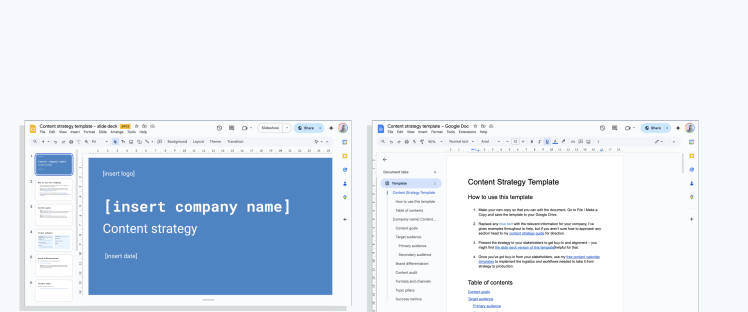
1. Content goals
One or two goals that define what your content is actually trying to achieve – specific and measurable enough that you can tell whether what you’re creating is working.
In B2B, content goals typically sit somewhere on the spectrum between demand creation (building brand authority and audience) and demand capture (generating leads and supporting sales).
Most companies need both, but in different proportions depending on where they are. Getting clear on that balance upfront means every future content decision has a reference point.
2. Target audience analysis
A detailed picture of who you’re creating content for – job title and company size, yes, but also the channels they actually use, the formats they genuinely engage with, and the pain points they’re actively trying to solve.
Don’t rely on assumptions here, talk to your audience, and find out where they get their information and what’s keeping them up at night – it’s the difference between flat content and content that really resonates.
B2B audiences are often multiple people: the champion who finds and shares your content, and the decision-makers who need to be convinced – so include all the audiences you need to engage with content to meet your content goals.
3. Content principles
Three to five non-negotiables that define how you approach content creation – the quality bar you hold everything to, your stance on things like AI use or expert voices, how you think about differentiation. The kind of decisions that should be made once and then just applied, rather than relitigated every time a new piece gets briefed in.
For B2B startups, this tends to be the section that most directly relates to brand voice –– because principles like “every piece should include an expert perspective” or “we lead with audience problems, not product features” are what make content feel consistent even when different people are creating it.
4. Core narratives
The foundational beliefs that should run through everything you create – your B2B company’s view on the market you operate in, and what you want your audience to do or feel differently because of your content.
Most B2B content strategies skip this entirely and go straight to topics.
That’s why so much B2B content feels like it could’ve been written by anyone – there’s no coherent perspective holding it together. Core narratives are what turns random acts of content into a recognisable brand voice.
5. Content production plan
Your topic pillars, formats, channels, and cadence. This is where the strategy connects to actual output in your content calendar.
For B2B startups, picking two or three pillars, formats, and channels where you can build depth beats covering ten topics shallowly.
The format of this B2B content marketing strategy template forces that prioritisation: if you can’t explain which goal a format serves and why it fits your audience, it probably shouldn’t be in the plan.
6. Success metrics
The specific things you’ll measure to know whether the strategy is working, tied directly back to the goals you set in section one.
This B2B content marketing strategy template prompts you to pick a small number of metrics that directly connect to your goals – fewer things tracked well, rather than a dashboard full of numbers that make you feel busy without telling you anything useful.
How to use this template to build your B2B content marketing strategy
Start with customer research, not the template
The most common mistake with content strategy templates is filling them in with assumptions – audience analysis built from stereotypes, content principles that sound good but don’t reflect what your buyers actually care about.
So before you open the template, spend time getting actual insight.
Sit in on sales calls. Listen to recordings of customer conversations. Lurk in the LinkedIn communities, Slack groups, and forums where your audience talks about their work. Read the questions that come up in demos.
Fill in goals and principles before channels
The most useful thing a content strategy template can do is force you to answer the harder questions before you get to the easier ones.
If you start with “we should do LinkedIn and a blog and maybe a newsletter,” you’ll end up with a calendar before you have a strategy.
Goals and principles come first, channels and formats come later.
When you’re clear on what you’re trying to achieve and what your non-negotiables are, the channel decisions become more obvious – and more defensible.
Be honest about capacity
The production planning section asks you to commit to a cadence. My advice is: be conservative.
Two truly valuable, creative pieces per month consistently beats eight mediocre ones. B2B buyers have plenty of content to read – what’s in short supply is content that actually helps them with something specific.
Overcommitting to output is how you end up on the content hamster wheel, creating things just to keep the calendar moving rather than building something that compounds.
Start with the minimum viable cadence you can maintain at a high quality level. You can always scale up once you know what’s working.
Use the core narratives section to find your POV
This section takes the most work, and it’s the one teams most often skip or fill in with vague aspiration rather than perspective.
Your core narratives should be things your company actually believes about your market, including positions you’re willing to take even if they alienate some people.
If you’re not sure what your core narratives are, look at what drove the founding of the company. Look at what makes your product different. Look at the things your sales team says that get the strongest reactions on calls. The POV is usually already there — it just hasn’t been written down and given to content yet.
Treat your content strategy as a living document, not a box to tick
A content strategy that sits in Google Drive without being touched isn’t doing anything for anyone.
Plan to revisit it every quarter. After each quarter of content production, do a quick audit of what performed, what didn’t, and what changed in your understanding of the audience or the market. Then update the strategy accordingly – cut what isn’t working, double down on what is, and keep it useful as a reference point for everyday decisions.
Go to the B2B content marketing strategy templates (ppt & word) →
FAQs
What is a B2B content marketing strategy?
A B2B content marketing strategy is a documented plan that defines how a company will use content to achieve its business goals – covering what to create, for who, why, and how to measure whether it’s working.
The main difference from B2C is that B2B buying decisions typically involve longer sales cycles, multiple stakeholders, and more emphasis on trust and expertise over emotional appeal. B2B content tends to do its best work educating buyers, building credibility over time, and helping sales teams handle objections – rather than trying to drive instant conversions.
For a detailed walkthrough of how to build one, see Tabitha Whiting’s content strategy guide.
How do you create a B2B content marketing strategy?
Start with goals and audience research, define the principles that will guide what you say yes and no to, identify three to five topic pillars where you can build genuine depth, and pick the formats and channels that actually fit how your audience consumes content.
Most strategies fail because they start with formats and channels instead of goals and principles. Get the foundational layer right first, and the tactical decisions become much easier.
Tabitha Whitings’s content strategy guide covers each step in detail, with examples from real B2B startup content strategies.
What makes a successful B2B content marketing strategy?
A few things tend to separate content strategies that work from the ones that gather dust:
- Ruthless focus on audience. A generic persona based on job title and company size will produce generic content. The strategies that work are built on specific, research-backed understanding of what your buyers are actually struggling with and how they prefer to consume content.
- A clear point of view. B2B content that could’ve been written by anyone doesn’t build brand authority. The strategies that work have perspective – core narratives that run through everything and make the brand recognisable.
- Fewer, better bets. The best B2B content strategies commit to a small number of formats and do them well – one consistently excellent newsletter will build more over time than five erratic channels.
How does content marketing fit into a B2B SEO strategy?
Content marketing and SEO work best when they’re planned together rather than treated as separate workstreams. Your SEO content strategy shapes which topics and formats you prioritise for search; your broader content strategy shapes the point of view and editorial quality that makes those pieces worth ranking. Without the strategy layer, SEO content tends to become generic – optimised for queries but not differentiated enough to build authority or convert.
What’s an example of B2B content marketing?
A few standout B2B content marketing examples from Tabitha Whiting’s Content Ideas newsletter – which shares a new B2B content marketing example to learn from each edition – are:
- Agorapulse’s Social Trends dashboard turns their product data into an always-on, monthly-updated benchmark resource.
- Storyarb’s The Standard newsletter is designed to read like an independent industry publication, building brand authority for a content agency without ever feeling like it’s promoting their services.
- Sequel’s Game Changers webinar series has run consistently since 2022 as a single, focused content bet – rather than trying to be everywhere at once.
What these have in common: a clear point of view, a commitment to one format done well, and content that serves the audience genuinely rather than just supporting the funnel.

