
The topic cluster model is an approach used in content marketing to improve SEO performance, as well as to ensure a well-organised content library.
In brief, a topic cluster is a group of webpages (typically blogs or articles) that share the same overarching topic.
There is always one pillar page at the core of the topic cluster which gives a broad overview of the topic, and several pieces of cluster content which discuss one aspect of the topic in more detail. The pillar page hyperlinks to each piece of cluster content, and the cluster content links back to the pillar page, so that the whole topic cluster becomes connected.
In the rest of this article we’ll dive a little deeper into the topic cluster model – how exactly it works, why it’s great for SEO performance, and how to create your own topic clusters.
Here’s exactly what we’ll cover:
- What is a topic cluster?
- What is a pillar page?
- What is cluster content?
- Why is the topic cluster model good for SEO?
- How to create topic clusters
What is a topic cluster?
A topic cluster refers to a ‘cluster’ of web pages or articles built on a brand’s website, which all explore aspects of the same overarching ‘topic’.
The overarching topic is one which is highly relevant to the brand’s target audience and their product, and so is a topic area that the brand wants to be seen as an expert in through the content that they provide on that topic – typically those topics will be decided as part of the overarching content strategy, often as a set of 3-5 core content pillars.
Using a topic cluster model is a highly effective way to demonstrate expertise on that topic to both users and search engines – building topical authority and improving SEO performance.
There are two key elements to a topic cluster:
- Pillar page. The pillar page gives an overview of the overarching topic – often in the form of a blog titled something like ‘a complete guide to X’ or ‘an introduction to X’. It will introduce and touch on several sub-topics or related questions.
- Cluster content. The rest of the topic cluster is made up of web pages or blogs which cover one of those smaller sub-topics or related questions in much more detail.
All of these pieces of content are connected by internal links: the pillar page includes hyperlinks out to each of the pieces of cluster content, and the cluster content includes hyperlinks back to the pillar page.
This ensures a clear structure which tells search engines like Google that all of this content is connected, demonstrating the brand’s topical authority.

Here’s a quick topic cluster example to bring this to life.
Ravio is a compensation benchmarking tool. In 2023 Ravio launched equity benchmarks, and as part of the launch wanted to show their expertise on the topic of equity compensation. I used the topic cluster model to create an equity compensation cluster.
The pillar page for the topic cluster is a blog article titled: The complete guide to equity compensation for startups.
This article broadly covers all the basics on how to structure an equity compensation package for employees, as well as a whole host of FAQs on the topic.
The pillar page then links out to several blog posts that cover specific aspects of the topic of equity compensation:
- How to use equity refresh grants for employee loyalty and retention
- Should you grant equity compensation to all employees?
- What is the most common vesting schedule in European tech?
- How Ravio calculates equity benchmarks using the Black-Scholes Model
Together, the equity compensation pillar page and cluster content creates a group of strategically linked content which demonstrates Ravio’s deep expertise on the topic of equity and introduces potential customers to their equity benchmarking tool.

🎁 Explore more topic cluster examples
I personally always find that looking at examples of how other companies are doing content helps me to understand different approaches and get inspired. So, I’ve put together a set of content cluster examples to help you do just that for the topic cluster model.
Read more ➡️
What is a pillar page?
A pillar page (sometimes also called an anchor page) is a long-form article or blog post that gives a broad overview of a chosen topic and targets a parent keyword.
Pillar pages are at the core of the topic cluster model – the pillar page then links to several other pieces of content (blogs, guides, free tools, etc) which give a detailed exploration of one specific sub-topic or question within the broad topic area introduced by the pillar page.
Pillar pages tend to have headlines like:
- The ultimate guide to [topic]
- [Topic]: The complete guide
- Everything you need to know about [topic]
- A step-by-step guide to [topic]
- An introduction to [topic]
- A beginner’s guide to [topic]
- Best practice approaches to [topic]
Example: The Complete Guide to Equity Compensation for Startups by Ravio
What is cluster content?
Cluster content refers to a group of content (blog posts, guides, free tools, etc) that all share the same overarching topic.
Each piece of cluster content links back to the pillar page which lies at the core of the topic cluster (see above) to create an interconnected group of content which together provides in-depth coverage on a topic area.
The cluster content each covers one specific aspect or question related to the overarching topic area, typically targeting a long-tail or question keyword.
Example: How to use equity refresh grants for employee loyalty and retention by Ravio
Why is the topic cluster model good for SEO?
The topic cluster model is primarily used to improve SEO performance and, therefore, to increase organic traffic to a website.
So why are topic clusters good for SEO?
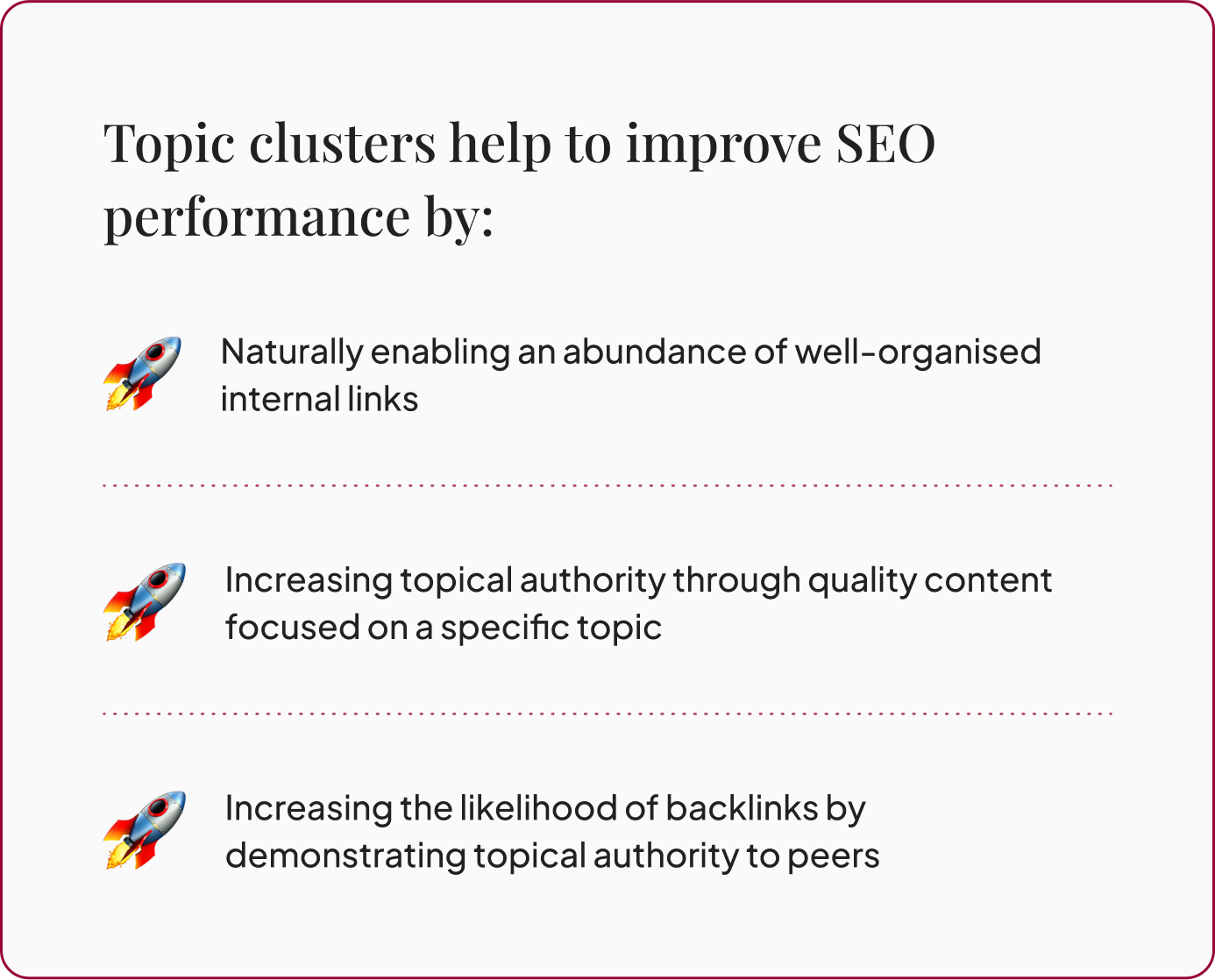
There are three key ways that topic clusters positively influence SEO performance and rankings:
- Internal links
- Topical authority
- Backlinks
Let’s take a look at each.
Topic clusters enable a clear internal link structure
Internal links are hyperlinks that link from one webpage to a different page on the same website – as opposed to ‘external links’ which link to a webpage on a different website.

Internal links are important in SEO because they give search engines vital contextual information on your site structure, showing which web pages are related to other web pages. If search engines can easily understand your website and the value that you offer to users, you’re more likely to rank highly.
Search engines also use internal links to crawl (discover) and index (make discoverable to search engine users) new content – the search engine sees that new internal link on a page that it already knows, and follows the link to find the new page. So, a strong internal linking structure can help you to rank more quickly for keywords too.
A topic cluster model naturally creates a clear and structured internal linking approach, because you’re creating a group of content which is all interconnected in an organised manner. The pillar page has internal links to several pieces of related cluster content, and all of that cluster content has internal links back to the pillar page.
Topic clusters increase topical authority
In SEO, topical authority is a measure of a website’s expertise on a particular subject area.
Increased topical authority gives search engines trust (and your website users too) that your website is the place to go for valuable insights on a subject – and you’re rewarded for this by better keyword rankings for terms related to that subject.
Demonstrating topical authority means that you need to demonstrate that you are an expert in that subject. That means developing content which covers all aspects of that subject in detail – and a topic cluster model helps you to do exactly that.
Topic clusters increase the likelihood of backlinks
A backlink in SEO refers to a link from a website that is not yours to a page on your website.

Backlinks are important because search engines use them as one of the (many) factors which influences where a web page deserves to be ranked within search results. If other websites see a page as valuable or insightful enough to link to it from their own content, then the search engine sees this as a signal that the page is worth showing to search users.
Topic clusters are good for building backlinks because through demonstrating your subject expertise and starting to rank more highly, you’re also more likely to be linked to by external websites as a valuable resource.
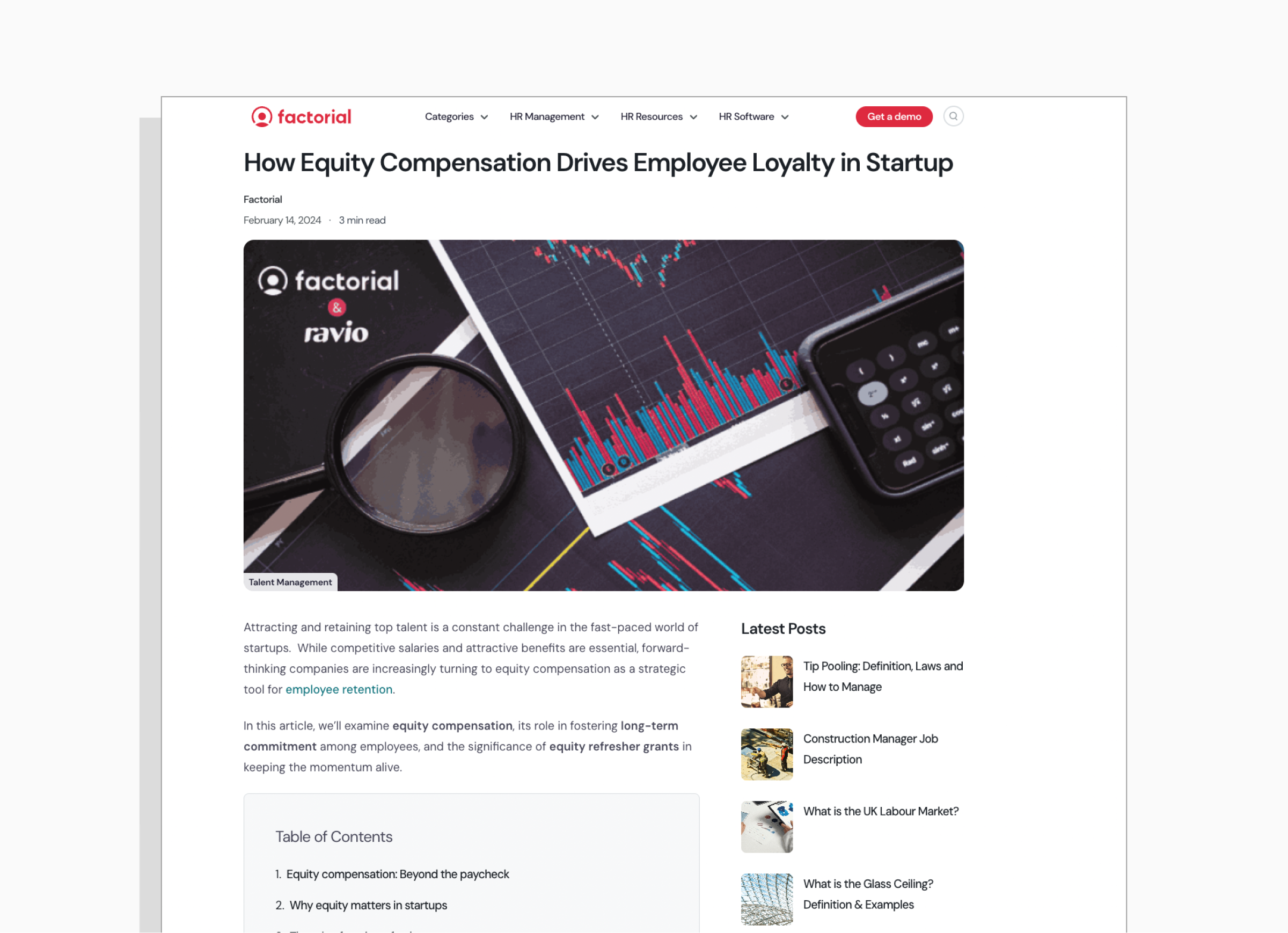
Plus, backlink building can be included strategically within your topic cluster model through guest posts or co-marketing with other individuals or brands who share the same subject area as you. For Ravio’s equity compensation cluster, for instance, I also developed two partner content pieces which each link back to Ravio content:
- Factorial: How Equity Compensation Drives Employee Loyalty in Startups
- Equity People: How to reduce the impact of a volatile stock market on employee equity as a public company.
How to create topic clusters
There are six key steps to take to create an effective topic cluster:
- Decide the overarching topic for the cluster
- Plan subtopics for the cluster content
- Create the pillar page
- Create top priority cluster content
- Add internal links
- Analyse performance and add to the cluster
Let’s take a closer look at each step.

Decide the overarching topic for the cluster
Choosing the right topic is key to a successful topic cluster.
Most companies will already have a good idea of the big topics that you want to demonstrate deep subject expertise in – determining these ‘pillar topics’ (usually 3-5) is typically an important part of your foundational content marketing strategy.
Essentially, those pillar topics should be the topics that your target audience are most interested in, that relate to your product or service, that you can offer real value and expertise in, and that have strong SEO potential for keyword ranking.
If you aren’t immediately sure the right pillar topics are for your brand, consider the following questions to figure it out:
- What pain points do we regularly hear from our customers and prospects?
- What problems do we solve for our target audience – which topics closely align to our product?
- Which keywords hold potential for us – have the right balance of keyword volume, keyword difficulty, and search intent?
When it comes to planning topics for your topic cluster model, those pillar topics will be your guide.
You’ll definitely want to create a cluster for each big pillar topic.
But, there might also be smaller sub-topics or niches within the pillar topics that are worth their own topic cluster.
Let’s take Ravio as an example since I’ve already mentioned them a few times in this article.
Ravio is a compensation management and benchmarking data tool with a target audience of People or Reward Leaders at fast-growing startups in Europe.
They might have a content strategy guided by three big pillar topics:
- Compensation management
- Fair pay
- Compensation market trends
But each of those pillar topics can be broken down into smaller topics for a topic cluster each.
Compensation management, for instance, could include the topics:
- Total compensation benchmarking – which can be further broken down into salary benchmarking, equity compensation, variable pay, employee benefits
- Compensation reviews
- Salary bands
And so on.
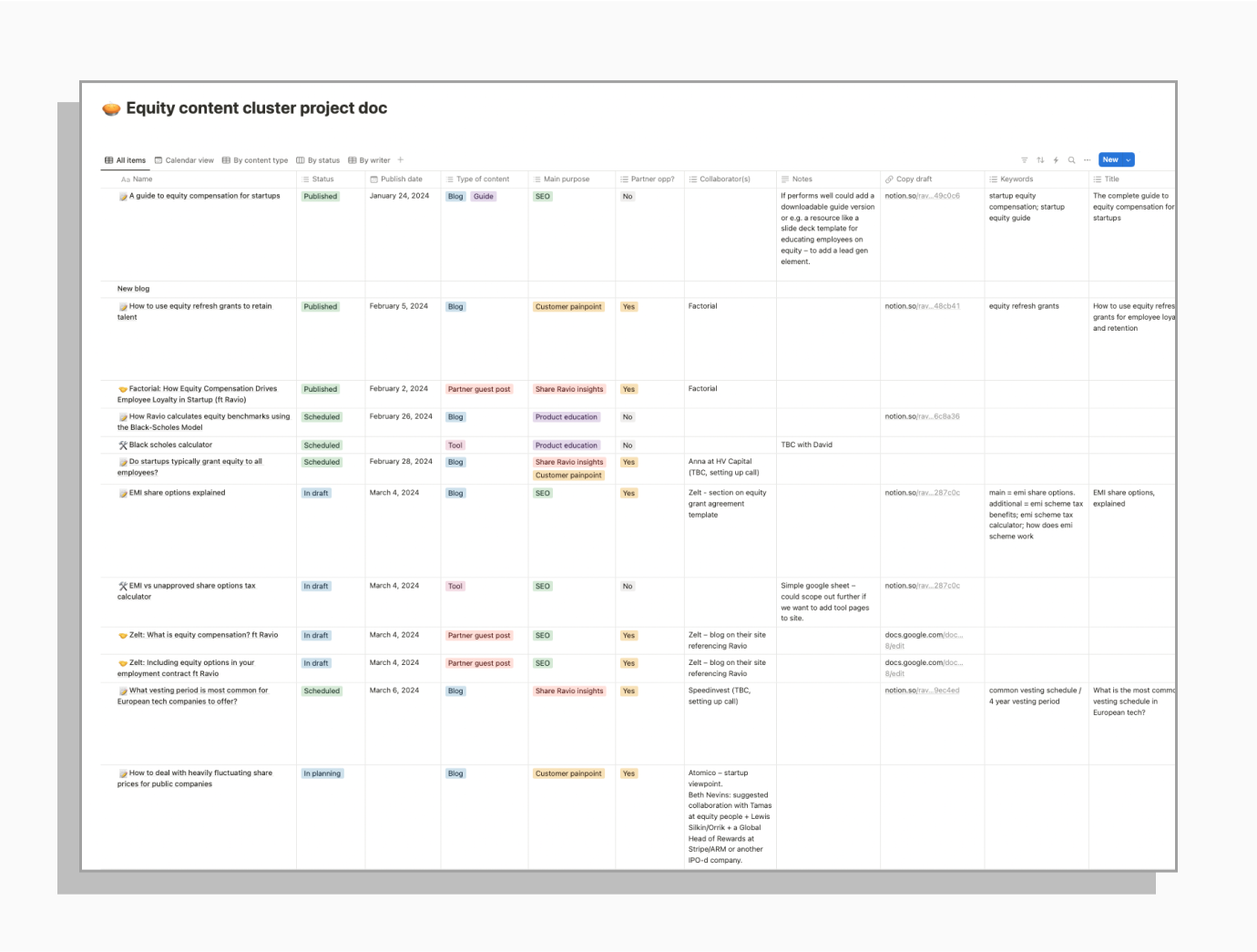
If you want to adopt a topic cluster model, I’d recommend first creating a topic cluster planning document which lists all of the topics you want to go after in order of priority – prioritising based on keyword potential and relevance to your target audience and your brand. This can then easily be turned into your content calendar for the next 12 months (or more).
Plan subtopics for the cluster content
With the overarching topic for your topic cluster decided, you now need to plot out all of the content that will make up the cluster.
The pillar page is simple: it’s always a broad overview of the whole topic.
The cluster content is slightly trickier.
Essentially, you want to cover all possible aspects of the topic that your target audience are looking for information on. But you also want to make sure each individual piece of cluster content addresses one specific subtopic or problem area to avoid competing content and keyword cannibalisation – so the cluster needs to be organised and well-structured.
To decide what to include in your cluster content, keyword research is the place to start (I’d recommend using one of these topic cluster tools).
Keyword research enables us to find out what related searches and questions are being commonly put into search engines. Keywords which are topically relevant, have a decent search volume, and have a keyword difficulty that isn’t impossibly high, are great bets to target as part of the topic cluster – if you create quality content targeting that keyword, you’re likely to rank for it.
If we stick with the Ravio example and we plug ‘equity compensation’ into a keyword research tool like Moz as our overall target keyword for the topic cluster, we’ll get a list of common searches:

This immediately gives us ideas of keywords that we can target within the overarching subject area – a term like ‘startup equity tax implications’ could become a blog titled ‘The tax implications of offering equity as a startup’, for example.
I’d also recommend looking at the question keywords too:
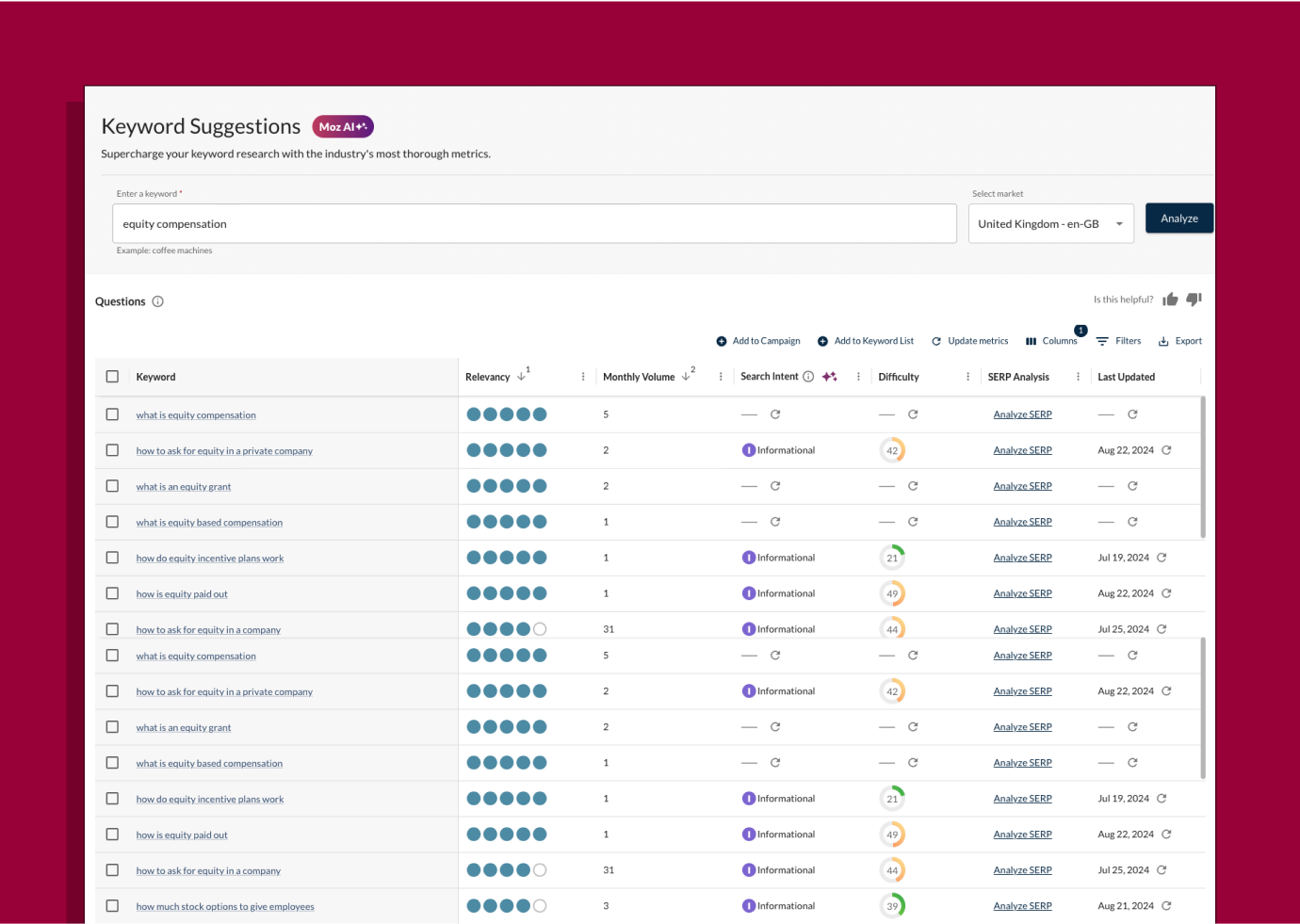
These question keywords are the perfect headlines for top of funnel informational and educational content that answers the questions that users are already asking – questions like ‘what is an equity grant?’ or ‘how many stock options should you give employees?’
There are also lots of topic cluster tools out there which will help you to find keywords and group them into an effective plan for your topic cluster – which might help make the process feel a little less overwhelming.
Once you’ve done the keyword research and you have an initial list of cluster content ideas, I’d recommend adding to this by also considering:
- Customer pain points. What problems do you regularly hear from our specific customers and prospects with relation to this topic that could be addressed through content as part of the topic cluster?
- BOFU conversion-focused content. How does the topic relate to your product? Ravio, for instance, offers equity benchmarks as part of their platform, to enable start ups to understand how other startups offer equity to their employees. As part of the equity compensation topic cluster, then, Ravio might want to target keywords with commercial intent, such as ‘equity benchmarking tools’, or content that addresses common objections during the sales process, such as ‘how do you calculate your equity benchmarks?’
- Existing content. Do you already have content on this topic area? If so, include it in the topic cluster plan – it might need to be refreshed to ensure it’s up-to-date and includes internal links to the other cluster content, or it might need to be consolidated into a new cluster page to avoid overlapping content.
From this, you’ll end up with a big list of ideas for cluster content on subtopics and questions relating to the overarching topic – all you need to do now is rank the list in order of priority so you have a topic cluster plan ready to start producing.
Create the pillar page
I always like to start with building the pillar page first.
That’s just personal preference, but I find that it helps to ensure a well-structured topic cluster because researching and writing the pillar page helps to inform the plan for the cluster content, and makes it clear where each internal link will fit in.
If you aren’t sure where to start with your pillar page it can help to explore pillar page examples from some of the websites out there that are using topic clusters successfully – like Zapier or Semrush, for instance.
Create top priority cluster content
Once you have your pillar page, you need to create the surrounding cluster content to link to and from.
Unfortunately, there’s no simple answer to the question of ‘how many blogs should be in my topic cluster’. It all depends on how competitive your topic area and keywords are and how much authority your website already has in the eyes of the search engines.
I’d recommend starting off by producing five pieces of top priority cluster content – these should be targeting high potential keywords and be closely related to the real pain points of your specific target audience.
Add internal links
With your pillar page and first few pieces of cluster content published, you need to connect them all together via internal links so that the search engines (and your website users) can tell that these pieces of content are all related to one another.
Make sure that the pillar page links to each individual piece of cluster content, and that each piece of cluster content links to the pillar page.
If one piece of cluster content has a natural connection to another piece of cluster content, make sure they have internal links to one another too.
Analyse performance and add to the cluster
Monitor Google Search Console to see how the topic cluster is performing, keeping a particular eye on the number of impressions and the number of clicks that each piece of content in the topic cluster is getting – you should see this grow over time if the cluster is effective.
I’d also recommend using an SEO tool like Ahrefs or Semrush to analyse performance alongside Search Console. These tools enable you to track the overall topic keyword (e.g. equity compensation) and the specific keywords that you’re targeting with each piece of cluster content (e.g. startup equity tax implications) so that you can clearly see whether you’re starting to climb the search engine ranks for those search terms.
Use the performance data to inform the ongoing plan for the topic cluster:
- Expand the topic cluster within additional content to continue building topical authority and boost rankings
- Improve low-performing content that isn’t ranking
- Identify additional keywords that you’re starting to gain impressions for to close gaps within your topic cluster plan.
Your content shouldn’t sound like every one of your competitors’.
With my Content Strategy Audit you’ll identify the creative content opportunities that competitors can’t replicate, and that will truly build brand authority.
 Tabitha Whiting: High-impact content for high-impact startups
2 thoughts on “The topic cluster model, explained”
Comments are closed.