
Doric. Ionic. Corinthian.
That covers all the classic types of pillars, right?
Wrong.
The missing piece: content pillars.
Done right, content pillars are a fundamental part of any strong content strategy.
They ensure focus stays hyper-dialled in on the problem areas that your brand actually has expertise in solving and that that actually interest your niche target audience.
So how do you effectively introduce content pillars to your content marketing approach?
That’s what we’ll explore in this article, covering:
- What is a content pillar?
- Why are content pillars important?
- Do content pillars actually work?
- How do you decide your content pillars?
- How many content pillars should you have?
- Are content pillars the same as pillar pages?
Looking for content inspiration?
Subscribe to This Month In Content – one creative content marketing example every edition to keep your ideas flowing.
What is a content pillar?
Content pillars (or ‘topic pillars’) are a set of foundational topics or themes that a brand’s content will cover.
The content pillars are determined as part of developing a content strategy, and should be focused on the niche interests and pain points of your specific target audience that your product or services specialise in solving.

Why are content pillars important?
Content pillars are important for four key reasons:
- Content pillars ensure content always resonates with the target audience
- Content pillars help to build a strong brand voice
- Content pillars build topical authority for SEO
- Content pillars bring organisation and focus to content marketing efforts.
Let’s take a closer look at each.

Content pillars ensure content always resonates with the target audience
The biggest reason that I see content marketing fail is that the content produced does not resonate with the target audience.
Effective content marketing requires a deep understanding of the niche target audience or ICP that you want to interact with your brand. If you don’t have that, then frankly there’s no point in bothering to build a content engine.
Content pillars are a great foundational approach to ensure that content does resonate with your target audience, because you’re doing the work first to understand what problems your niche audience have that you have enough expertise (either internally or through collaboration with subject matter experts) to address through content.
Head to the section ‘how do you decide your content pillars?’ below for more on this.
Content pillars help to build a strong brand voice
If you’re consistently producing content around a set of strategic content pillars then your audience will quickly learn to associate your brand with those subject areas.
This becomes what your brand is known for and how your audience explains your brand to others – which is why it’s so important that the content pillars align with the problems that your product or service can solve for your target audience.
Content pillars build topical authority for SEO
Content pillars give focus to the topics and themes that your brand wants to ‘own’ in the market. This is great for improving SEO performance, because consistently publishing content on a given subject area shows search engines that you are an expert in that subject, which naturally builds topical authority for your brand and website.
In SEO, topical authority is a measure of a website’s expertise on a particular subject area.
Increased topical authority gives search engines trust (and your website users too) that your website is the place to go for valuable insights on a subject – and you’re rewarded for this by better keyword rankings for terms related to that subject.
Content pillars bring organisation and focus to content marketing efforts
Because content pillars bring focus to content planning, giving a core set of themes and topics that you’re always listening to and planning new ideas around.
This creates a more organised and well-structured content calendar because ideas naturally link to one another and you’re always seeking balance between the core pillars.
And a more organised content calendar also means more organised and well-structured content hubs and channels too, making it easier for users to understand your brand and find relevant content.
🌟7 content pillar examples
It’s always helpful to see how other brands are implementing approaches, including content pillars – so I’ve put together a list of examples to help.
Read more >
Do content pillars actually work?
Content pillars seem to get a fair amount of stick on the wonderful world of the internet.
The main arguments against content pillars are:
- Content pillars are too rigid – content needs to be able to flex outside of a given set of topic areas.
- Content pillars lead to lazy content – brands will end up generating any old content that relates to the chosen topic areas to ‘fill the feed’, rather than thinking strategically about which content pieces will move the needle towards business goals.
The first may be somewhat true, but common sense tells you that if there’s a question that keeps coming up that feels important to cover through content but doesn’t perfectly fit within one of your content pillars, then that’s fine. They’re there to be a framework or guide to maintain focus and propel growth, but the world won’t end if you occasionally share content that goes outside of them. In fact, sometimes this can be an important experiment to inform the next iteration of your content strategy.
The second objection bottles down to using content pillars incorrectly: using the topics as a crutch, without the right thinking behind them. The whole point of content pillars is to ensure that the content you create is always hyper-focused on the problems that you can use your brand’s expertise to explore and address. The content pillars act as guidance on this, but each individual piece of content still needs to adhere to that.
Ultimately a lot of the posts and articles that I see talking about ‘the problems with content pillars’ seem to be largely for clickbait purposes – people trying to have an opinion for the sake of having an opinion, finding problems where there are none, or completely misunderstanding how to use content pillars effectively.
Here’s a couple of examples to show what I mean.
The blog ‘content pillars don’t work’ by The Two Lauras explains content pillars as follows: “If managing a photographer’s social media, the pillars might include studio shots, behind-the-scenes photos, final photo reveals, booking information, and highlighting the gear used.”
Those are not content pillars. They’re content formats or types. They’re also all very brand-centric content ideas, so it’s no wonder they don’t work well.
It’s the same with this one by Sydney Delucchi – she uses ‘quotes’ as an example of a content pillar. Again, not a content pillar.
Both of these examples focus on content pillars for social media, but the principles should be the same no matter what marketing channel is your primary focus.
So, do content pillars actually work?
Yes, content pillars do work. They have several benefits, as explored in the section above ‘why are content pillars important’. But they only work if you implement them effectively.
Which is kinda true for most approaches and strategies really – it’s ultimately up to you to decide which approach best fits your goals and target audience. And if you’re not sure, I’d recommend working with a content strategist to help you figure it out.
How do you decide your content pillars?
There are three key factors to consider when deciding content pillars:
- Target audience pain points. What are the problems that customers and prospects are regularly mentioning in conversation with your team? Content that explores and addresses these pain points will resonate with your ideal buyers.
- Brand expertise. What problems does our product or service solve for our target audience? What subject areas does our team and network have a higher-than-average level of expertise in? Topics that closely align with your brand and product will ensure that you’re building a warm audience of potential buyers.
- SEO potential. Which parent keywords hold the most potential (relevant search intent, and a good balance of keyword volume and keyword difficulty) for strong SEO performance? Some topics are typically underserved with content, and others are heavily saturated – deliberately aiming to ‘own’ underserved topics can help to quickly build relevant organic search traffic.
Themes that stand out across each of these three factors are perfect candidates for content pillars – they should be the topics that your target audience are looking for support in, that relate to your product or service, that you can offer real value and expertise in, and that can drive organic traffic to your website.

It’s then also worth considering what the key subtopics are for each content pillar you come up with. The content pillars will typically be big subject areas that contain lots of smaller themes and topics – so this will help your content planning and organisation later.
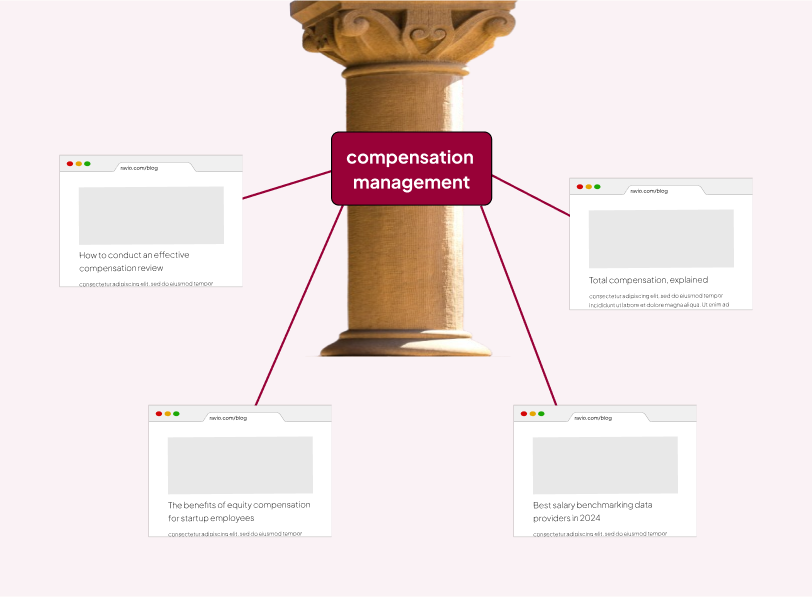
As one content pillar example, one of the SaaS brands I work with is Ravio, a compensation management and benchmarking data tool with a target audience of People or Reward Leaders at fast-growing startups in Europe.
Given their product and audience, let’s say they have a content strategy guided by three core content pillars:
- Compensation management
- Fair pay
- Compensation market trends
Each of those pillar topics contains many smaller topics.
Compensation management, for instance, could include topics like:
- Total compensation benchmarking – which can be further broken down into salary benchmarking, equity compensation, variable pay, employee benefits
- Compensation reviews
- Salary bands
And so on.
How many content pillars should you have?
3-5 content pillars is the right kind of range to aim for.
This might sound like a low amount, but that’s deliberate because having too many content pillars reduces focus.
With a lot of content pillars, your content efforts are spread thinly across all of those topic areas. That means you’re less likely to build brand credibility and topical authority in any of them. It makes it more difficult for your audience to understand your brand and the problems you can help them to solve. And it also leads to messy and confusing content hubs or channels – I’m sure we’ve all seen company blogs with a huge list of topics or categories to choose from, and felt overwhelmed with where to start!
If you feel that there are more than five content pillars that are important for your brand to build content around, then I’d suggest two things.
Firstly, clearly define each content pillar you want to include in your content strategy. Document a few ideas for individual pieces of content within that content pillar which address real pain points for your ideal customers. Think about what you would name the corresponding category on the blog page of your website.
It’s worth doing this because often when we think we need more than five content pillars, we actually just need to refine the ideas we have a bit further – I typically find that there’s a lot of overlap or lack of clarity within the planned content pillars.
Secondly, if you really do have more than five content pillars that make sense for your brand, I’d recommend ranking them in order of priority and then start with the top three as your content pillars for the year ahead. When you refresh your content strategy next year, you can then focus on the next three content pillars, until you have a solid foundation for each content pillar that can be built on effectively.
Realistically, you aren’t going to ‘own’ every topic you want to until you’re a giant with decades in the content game (like the Hubspots of the world), so it’s still better to start with a few topics and go deep on them.
Plus, focusing on select topics really does make for better content – you’ll find yourself listening more closely to new ideas and problems in that topic area, and all the research you (and any other writers you work with) conduct on that topic area will make each piece of content you publish even richer. This is what builds that brand expertise and topical authority, so it’s very important.
Are content pillars the same as pillar pages?
No, content pillars aren’t the same as pillar pages.
‘Content pillars’ are sometimes confused with ‘pillar pages’ – which is understandable given their lexical similarity, but they are actually slightly different.
Here’s the difference.
As we’ve seen, content pillars are the set of foundational topics or themes that a brand’s content will cover, determined as part of a brand’s core content strategy.
Pillar pages are a feature of the topic cluster model, a long-form page or blog which gives a broad overview of a topic – often with a headline like ‘the complete guide to [topic]’ or ‘[topic]: a step-by-step guide’ or ‘an introduction to [topic]’.
The topic cluster model is a specific approach sometimes used in content marketing and SEO. For topic clusters a group of webpages (typically blogs or articles) is produced, which all share the same overarching topic. Each cluster always has one pillar page at the core of the topic cluster which gives a broad overview of the topic, and several pieces of cluster content which discuss one aspect of the topic in more detail. The pillar page hyperlinks to each piece of cluster content, and the cluster content links back to the pillar page, so that the whole topic cluster becomes connected.

So they’re slightly different.
But combining content pillars and pillar pages is incredibly powerful for building brand recognition and improving SEO performance.
Combining the two would look like this:
- First determine the content pillars that will be foundational to your brand’s content.
- Then use the topic cluster model to plan and produce a topic cluster for each content pillar – and potentially also for any important subtopics within the overarching content pillar topic.
 Tabitha Whiting: High-impact content for high-impact startups