
Content marketing 101: have a foundational content strategy in place before you start creating content.
When there’s no content strategy in place, it’s all too common to see early-stage companies performing what I like to call ‘random acts of content’.
One of the sales team suggests writing a blog to answer a question that a prospect brought up on a demo call one time. The founder thinks ‘state of’ style industry reports are the best way to grow the brand. The content marketer has a topic that they’d love to cover to add to their portfolio.
All of these content pieces could perform well.
But if they did, it would be through pure luck.
We don’t want lucky wins. We want replicable success – a targeted approach so that we can get a clear understanding of what works, and build from there.
So if your startup is just about to commence its marketing journey, or if the journey so far has been something like the scenario outlined above, then you need a content strategy.
And this article will teach you how to go about creating one.
📖 Table of contents
Here’s what we’ll cover:
How to create an effective content strategy: a step-by-step guide
There are lots of content strategy guides out there that all claim to be the definitive way to create a content strategy, from the likes of Hubspot, MailChimp, and Semrush.
None of them are that revolutionary definitive guide.
They’re all just variations on a theme.
Which is what I’m going to give you too.
But, unlike most of those guides, I actually have first-hand experience of developing effective content strategies for startups like Lune, Ravio, and Kamma.
And I’m sharing my own personal approach with you.
Think of it like this: if you hired me as a content strategist to help you figure out how your company should do content (which, by the way, you can), this is the process that I would follow for that project.
To kick things off, here’s every step in my content strategy process in brief:
Step 1: Content goals – what business impact are we aiming for?
Step 2: Audience analysis – who are they? how do they engage with content? what problems are they looking for support with?
Step 3: Brand differentiation – who are we? what unique angles, insights, or opinions do we have? what does a great piece of content look like for us?
Step 4: Content audit – what existing content do we have? is it performing well?
Step 5: Content channels and formats – what type of content should we create, and how should we share it?
Step 6: Content pillars – what topics should we create content about?
Step 7: Content cadence – how often will we share new content for each chosen format and channel?
Step 8: Success metrics – what will we measure to understand what’s working well for our content goals?
Now let’s take a detailed look at each step.

Step 1: Content goals
Defining the aims, objectives, goals for your content is a vital starting point for any content strategy – giving the purpose behind the plan and ensuring that the content strategy is designed for business impact.
So how do you figure out the right content goals?
Well, content goals should always be informed by the priorities of the business as a whole, answering the question: how will content marketing support progress towards the company’s goals?
So, for example, if the north star objective for the overall company is to increase MRR by 20%, then you might want to build a content strategy which prioritises conversion and supporting the Customer Success team with upselling.
The ideal scenario looks like this:
- Business goals defined by leadership team
- Marketing goals (overall) informed by business goals and defined by marketing lead
- Content goals informed by marketing goals and defined by content lead.

If you aren’t quite sure where to start, these are some of the most common content marketing goals to consider:
- Increase brand awareness
- Increase organic search traffic
- Build brand credibility and trust in the market
- Demonstrate topic expertise
- Increase lead generation
- Increase conversion rates
- Build loyalty with existing customers to increase retention
- Build an owned audience (e.g. newsletter subscribers).
Of course, if you use any of these goals you’ll need to turn them into SMART goals to make sure they have a specific purpose in the context of your business. Increasing lead generation, for instance, might become ‘30% increase in inbound deals in the next year.’
Step 2: Audience analysis
Next up: audience.
Who your audience is makes a big difference to how you approach content.
The big questions to ponder are:
- Who are we talking to when we create content?
- What kind of content do they typically engage with?
- What channels do they hang out in?
- What specific pain points do we know that they have, that are relevant to our brand, and that we could address through content?
If your ICP is a sales executive struggling to close deals, who spends 2 hours a day on TikTok and never reads written content, then a company blog isn’t going to have the impact you want it to.
It’s also pretty likely that there will be multiple personas involved in the sales cycle for your brand, so you need to understand how each of those differs in terms of content needs.
For this reason it’s really important to get into the details here, to really get to know your niche target audience as well as you possibly can so that you can create content that will actually resonate with them and provide value.
The absolute best way to do this is to speak to customers – or people who fit the ideal buyer persona(s) for your company. If you can, set aside time early in the content strategy process to conduct a handful of interviews designed to find out the information above.
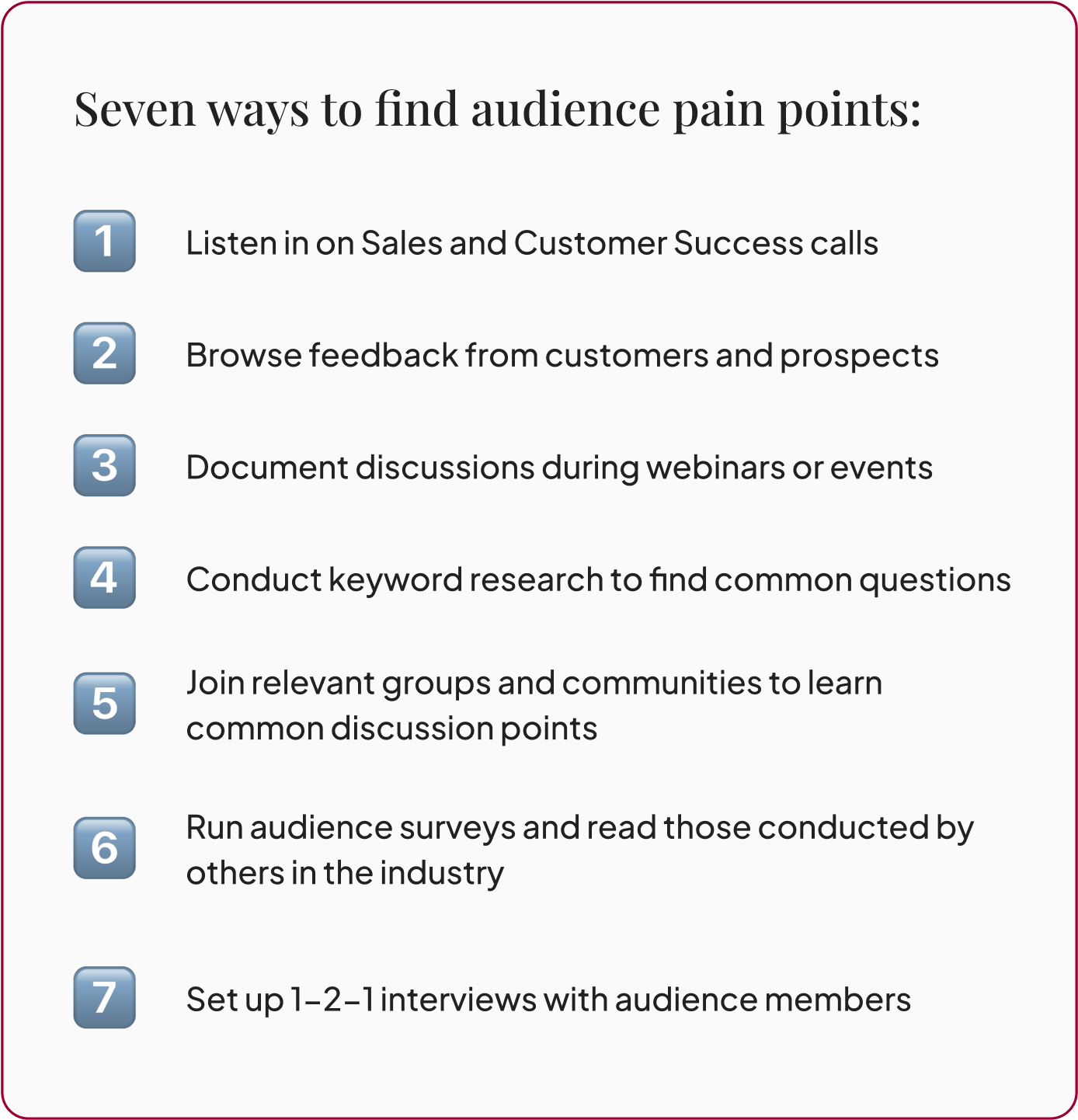
If that’s not possible, then go detective and seek out all the information that already exists about your target audience:
- Sales and Customer Success calls – sit in on upcoming calls or listen to previous calls via a call recording tool like Gong or Grain (if your company doesn’t already record sales calls, I highly recommend it, they’re an absolute goldmine for feedback, pain points, and ideas).
- Feedback gathered from prospects and customers – find all the common feedback, objections, topics raised, etc that the sales and customer success teams have noted down in Slack or Notion.
- Questions or discussion points raised at previous webinars or events
- Social listening – find the LinkedIn channels, Slack communities, Reddit threads, industry influencers, etc that your target audience are using, and see what kind of discussions arise
- Keyword research to identify common search queries in your space
- Industry research – find existing industry research in your space e.g. recent data reports or surveys run with your target audience, to understand current trends and concerns.
Step 3: Brand differentiation
There’s a lot of content out there today that all covers the same topics in the same ways.
That’s true in every industry, and the chances are that all your competitors are using content as part of their marketing strategy too.
If your content does the same, it isn’t going to cut through.
Bland, tickbox content used to work for SEO purposes. Create a blog structured around a target keyword, with subheadings optimised for longtail or question keywords, and it didn’t matter too much how useful that content actually was.
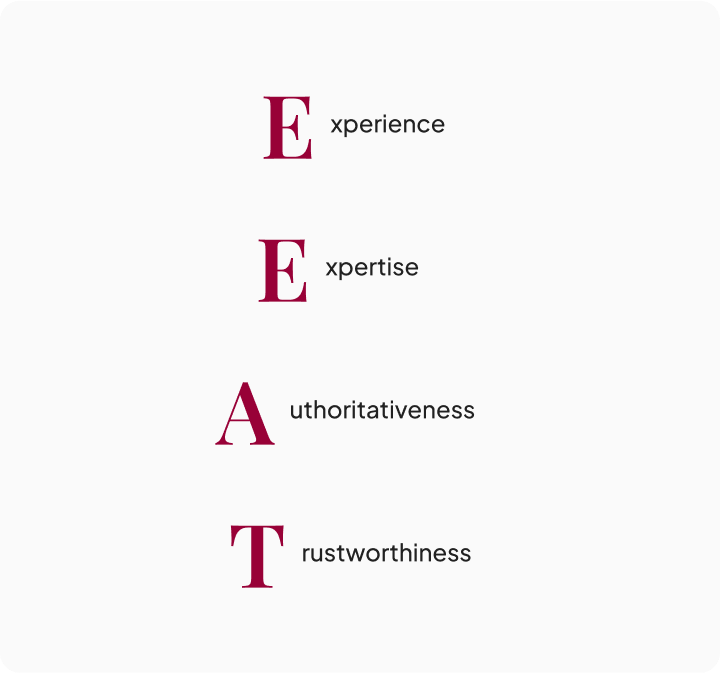
That isn’t true anymore. Google’s SEO algorithm prioritises relevant and valuable content over everything else – especially since the EEAT update.
You want your content to stand out (for the right reasons).
And that means figuring out how you will differentiate your brand’s content from the noise, and provide genuine value for the target audience. This could include:
- Brand voice. What kind of personality and language will resonate with your target audience? Could we create a slightly different brand voice to our competitors? Brands in the consumer space have done this really well – the likes of Innocent, Monzo, and Aldi, for instance, who are all well known for their chatty and humorous voices on social media. It’s less well done in the B2B world, but even a subtly different brand voice can stand out from the bland business blogs.
- POVs. What strong opinions does the company have about the sector it operates in? This often comes from the founding team and might even be the story behind why the company was founded to begin with. It could also be key principles, beliefs, or best practices that informed how the product has been developed.
- Data insights. Many tech startups will have proprietary data that can be harnessed for content through identifying trends and stories to tell, and sharing that data within your content gives you unique angles and insights. It could be that the company owns a database as part of the product (like Ravio’s salary benchmarking database, for instance) or it might be that proprietary data exists in the form of how users engage with your product (like the Gong labs series, for instance).
- Expert insights. Collaborating with subject matter experts will always strengthen your content, bringing insights and first-hand experiences from people who have a deep understanding of your sector and the problems of your target audience. You might have internal experts or existing relationships with external experts, or you might need a plan for how to build that.
- Pain point content. We touched on this in the audience section, but understanding the pain points of your target audience means that you can create content which resonates – either through validating the pain or through providing expertise to overcome it. It’s way more valuable than yet another ‘What is X’ blog.
- Content authors. Most company content is in the voice of the brand. Trusted messengers are important for brand credibility, so consider who else could author content for your company. That might look like ghost-writing blog content for those subject matter experts in your network – like this blog for Ravio, authored by Rewards expert Rob Green. Or it might look like a founder or CEO who builds the company in public via LinkedIn posts or a Substack newsletter (like Buffer’s radical pay transparency content, or the Wrap Text newsletter by Equals). Or it might look like expert panel events that are turned into short video clips for social media. And so on.
The key outcome of this thinking is to create a set of content principles to include in your content strategy – a simple list of a few non-negotiables that every piece of branded content should adhere to, to ensure it meets the level of quality that you want to put out there.
For instance, you might decide that every piece of content you publish should target a niche pain point for your specific target audience, and should include either proprietary data or expert advice that informs how to overcome that pain point (which is exactly what Ravio’s content principles look like).
Step 4: Content audit
Unless you’re starting completely from scratch, it’s highly likely that the company you’re building a content strategy for already has existing content.
Conduct an audit of that existing content with two things in mind:
- Content to refresh or repurpose. Some content is probably still relevant to the topics and pain points you plan to address for your audience, but it may be outdated or out of line with the goals that you’re putting in place. It’s well worth marking these pieces for a content refresh or to repurpose the messages into new content.
- Impactful content. Analysing which content is driving progress towards key goals – whether that be specific content formats, topics, or channels – can help to inform which to prioritise in the content strategy.
Your content shouldn’t sound like every one of your competitors’.
With my Content Strategy Audit you’ll identify the creative content opportunities that competitors can’t replicate, and that will truly build brand authority.
Step 5: Content channels and formats
Steps 1-4 are the foundational pieces of the content strategy. You’ll then use the information from those steps to determine steps 5-8.
Unless you have a huge content marketing team at your disposal, you can’t create content in all formats and distribute it via all channels.
And even if you could do that, you shouldn’t – it would be a waste of time.
Instead, you want to focus on the content channels and formats that fit your target audience.
So, there are two key questions to explore:
- What channels does your target audience hang out? As an example, LinkedIn is likely a great shout for a B2B audience, but isn’t your best bet for B2C. There are also likely niche communities that your audience are engaged with or voices in the space that they trust – think Superpath or the Content Marketing Institute for content marketers, for instance.
- What formats does your audience like to engage with? Do they prefer to watch short-form video clips, listen to podcasts, read long-form articles, and so on.
Pick 1-2 formats and channels that have the most potential for your target audience, and focus on them. Don’t try to do them all at once – you can always add to and build on these initial foundations later.
As an example, let’s assume you’re a B2B company whose number one goal with content marketing is to drive inbound revenue.
You might opt for the following content formats as a priority:
- Bottom-of-funnel blogs targeting high intent keywords
- Case studies
- Sales enablement content – blogs answering top objections and questions that prospects and customers have.
And prioritise the following channels for distribution:
- SEO
- Sales and CS team conversations
- LinkedIn – company page and employee advocacy.
Whereas if your goal was to prove brand expertise you might focus on original research content, subject matter expert collaborations, expert panel webinars, and so on.
Step 6: Content pillars
Content pillars are 2-3 core topics or themes that your content will focus on – with the aim of demonstrating deep brand expertise in the topics that are most important for your audience.

They’re important to give focus to the content strategy as well as to ensure content resonates with the target audience. They also help you build topical authority (especially when coupled with a topic cluster approach) which is important for keeping your company top of mind for audience members, as well as to enhance SEO performance.
There are 3 things to consider when determining what the right content pillars are:
- Pain points – the most urgent pain points of your target audience.
- Brand expertise – topics that align most with the solutions that your product or service offers, and that the team internally have deep knowledge of.
- SEO potential – the parent keywords with potential to bring organic traffic to the website i.e. those with relevant search intent and a good balance of keyword volume and keyword difficulty.

Step 7: Content cadence
How often will you produce content for each format and channel that you’ve chosen to prioritise (see step 5)?
Planning a realistic content cadence starts to bridge the gap between content strategy and content production – preparing you to put a content calendar in place.
The answer will come down to internal capacity and budget. Who is creating content? Can you work with external freelance content writers to increase capacity?
I’d highly recommend considering how you could use a content repurposing workflow to make a more efficient cadence here too.
For instance, if original research reports are a key format for you, then that’s going to be a lot of work to produce. Content repurposing can help you make the most of the time spent – by taking that research report and turning it into additional formats and pieces e.g. blogs for each key finding, webinars sharing key insights, YouTube videos sharing the webinar recording, LinkedIn posts for each data graphic or expert contribution, etc.
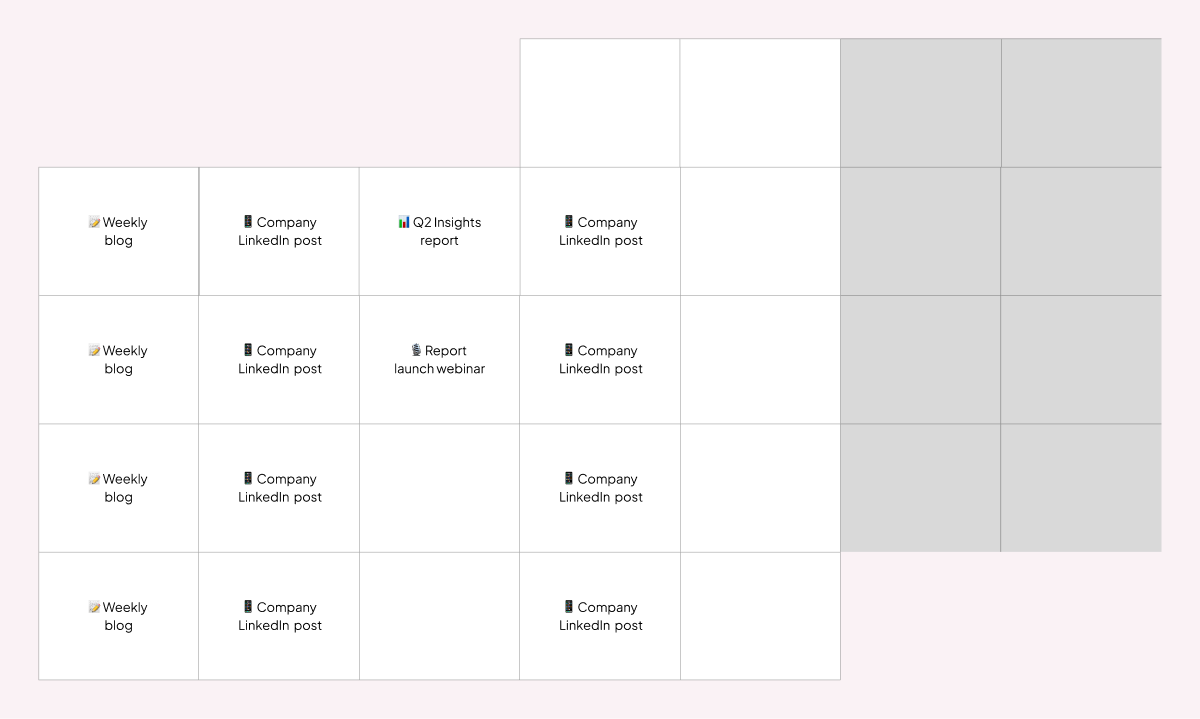
In that scenario your content cadence might be something like:
- 1 original research report per quarter which includes proprietary data analysis and subject matter expert (SME) interviews
- 1 blog per week – with 6 per quarter repurposed from the report findings and SME interviews
- 1 webinar series per quarter (live and on demand via YouTube) – on the report topic and findings
- 2 LinkedIn posts per week via company page – with 1 per week sharing data insights from the report and 1 per week sharing SME insights.
You get the gist.
Also consider how content refreshing will fit into the cadence to ensure that content will stay up-to-date and relevant over time – it’s easy to get into production mode and forget about older content, but it’s an important part of the process.
Step 8: Success metrics
What does success look like for your content marketing?
The right metrics to track will depend on the content goals you set back in step 1.
If driving revenue is the top priority then you might track lead: conversions from content, pipeline produced by content conversions, pipeline influenced by sales enablement content, the number of ICPs engaging with content.
If brand awareness is more important currently, then you might focus on traffic, impressions, and engagement for each key channel – as well as organic shares of your content in key communities for your target audience (user generated content).
My advice is always to pick a limited number of metrics to track. Tracking everything under the sun is tempting, but it’s also time-consuming and often doesn’t help to move the needle. Stick to a few key metrics that directly relate to your content goals, and all is well.
🧠 The most important things to remember when developing your content strategy
If there’s anything I want you to take away from this content strategy guide, it’s these points:
- Start simple, learn what works, and build from there
- Make differentiation a priority – bland content that mirrors your competitors won’t have the impact you want, find what’s unique about your brand and the unique value that you can offer your audience through content
- Less is truly more – produce less content but make sure every single piece is super high quality and holds true value for your audienceLean on subject matter expert content and original research content to demonstrate expertise and differentiate from bland AI content
- Be efficient – make content repurposing and content refreshes a priority from the word go.
Ta da!
That’s it. There’s your content strategy.
Plug the findings for each of those eight steps into a document (word doc, slide deck, notion page – whatever you fancy, whatever you’ll actually use day-to-day).
Then use that strategy to plan the content calendar for the next quarter, avoiding those random acts of content and instead producing content informed by a deep understanding of your target audience and company goals.
All that’s left then is to get cracking on production.
If you work with freelance writers, send them the content strategy so that they understand the foundations of content marketing at your company.
Then, at the end of the quarter, do another content audit to see what’s working, what isn’t, and adjust, build on, or double down on the strategy from there – it should be a living, iterative document that helps you to keep testing and learn what works.
Example startup content strategy
Back in early 2023 I joined the team at Ravio as their first content marketing hire, to build the foundations of a content engine that would build brand awareness and demonstrate the depth of Ravio’s insights and expertise in the compensation management space.
I spent the early weeks absorbing as much customer insight as possible – reading feedback, listening to sales and customer success calls recorded via Grain, researching compensation leader communities, and so on.
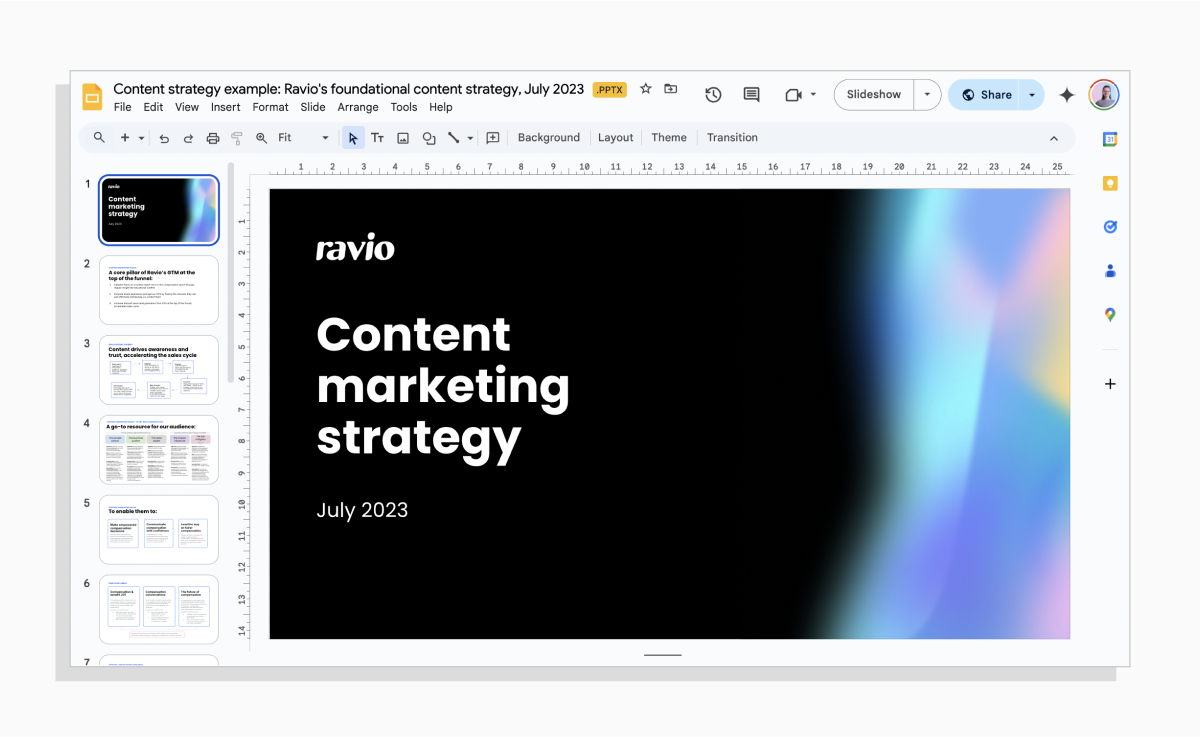
I then used that information to develop a first version content strategy to inform content production at Ravio from then on. The resulting document is a first pass that has already been iterated and improved upon from learnings and refinement along the way, but it gave the initial structure and focus that was much needed.
Explore Ravio’s content strategy ➡️
It covers each of the key steps that I outlined earlier in this article:
- Content goals – slides 2-5
- Audience analysis – slide 4
- Brand differentiation – slide 7
- Content audit – slide 13 (kind of, this one is a bit of a gap as there was very little pre-existing content)
- Content channels and formats – slides 8-11
- Content pillars – slide 6
- Content cadence – slide 9
- Success metrics – slide 12
📣 Free content strategy templates for Powerpoint and Google Docs
Over the years I’ve refined my own content strategy templates, and now I’m sharing them for other marketers to use – no email or payment involved.
How a content strategist can help with your content strategy
Implementing a strong content strategy is not a quick or easy task.
From customer research to pillar planning, there’s a lot of time and effort that goes into producing a content strategy that will actually guide the direction of your company’s content marketing.
Some teams struggle to find the time to focus on strategy alongside all the tactical work going on. Others don’t have internal content marketing expertise to lean on.
In these scenarios, working with an external content strategist to build the content strategy can be a huge help. Having it in place means the team can produce well-informed content, instead of random acts of content.
Content strategy FAQs
What is a content strategy?
A content strategy is a document that defines a company’s approach to content marketing – the objectives for content marketing, the types of content that will be created, the distribution channels used, the topics focused on, and so on.
The core question that a content strategy answers is: ‘how will the content that we create and distribute under our brand’s name contribute towards our business goals and priorities’.
A content strategy is not the same as a content plan or calendar. Whereas the content strategy is a strategic document that forms the guiding principles and approach to content, the content plan or calendar is a tactical document that outlines exactly what pieces of content will be produced over a period of time e.g. the next quarter.
Why is content strategy important?
A content strategy is important because it gives structure, focus, and purpose to content creation and distribution, ensuring that every piece of content produced is working towards a defined goal and will resonate with a specific target audience.
Without a content strategy it’s common for companies to fall into a routine of producing what I like to call ‘random acts of content’ – content ideas that come up through internal conversations, mimicking topics seen on competitor or industry websites, and so on – which vastly reduces the likelihood of content having the desired impact on brand awareness or revenue pipeline.
What should my content strategy include?
A content strategy should include the following elements:
- Content goals – what business impact are we aiming for?
- Audience analysis – who are they? how do they engage with content? what problems are they looking for support with?
- Brand differentiation – who are we? what unique angles, insights, or opinions do we have? what does a great piece of content look like for us?
- Content audit – what existing content do we have? is it performing well?
- Content channels and formats – what type of content should we create, and how should we share it?
- Content pillars – what topics should we create content about?
- Content cadence – how often will we share new content for each chosen format and channel?
- Success metrics – what will we measure to understand what’s working well for our content goals?
For a more detailed exploration of each of these, head to the ‘step-by-step guide’ section above.
What makes a good content strategy?
There are a few things that I see as clear markers for a great content strategy:
- Enables focus and structure. The point of the content strategy is to bring clarity to content plans ensuring that every piece of content is making progress towards defined goals, and will resonate with the intended target audience through seeking to understand them deeply and find the overlap between their needs and the expertise that branded content can offer.
- Prioritises brand differentiation and content quality. There’s a lot of content out there today, and that’s only growing with AI content generation. Differentiation is vital, finding the unique value and insights that your brand can offer through content to solve the real pain points of your target audience. Original research and expert-led content are both great to emphasise.
- Starts simple and iterates. A content strategy doesn’t need to be pages and pages long to be effective. The best content strategies start simple to create clear focus. It’s then much easier to learn what works, and build on the strategy over time to increase impact efficiently.
- Informs content creation, every time. Ultimately a content strategy should be a set of guiding principles that inform the content that you choose to create for a brand. If you’re not sure what to prioritise, the content strategy should be the document that you turn to to decide. If it isn’t serving that purpose, it isn’t a good content strategy.
Can I use your content strategy template?
Yes! Go to the content strategy templates (ppt and google doc) >
 Tabitha Whiting: High-impact content for high-impact startups