
You hit ‘publish’.
A wave of relief immediately washes over you – another stellar piece of content ticked off the to do list and out there in the world.
Job well done 🍻.
Or not…
That ‘publish’ button is often seen as the finish line in content marketing.
But it shouldn’t be.
Days of work on audience listening, research, interviews, writing, editing, design, set up, likely went into creating a piece of content that imparts an important message that will resonate with your target audience.
That message deserves to be heard.
Content distribution (i.e. disseminating the new content across all channels) and content repurposing (i.e. reusing the content over time) are key to that.
In this blog post we’ll explore all things content repurposing:
- What does content repurposing mean?
- Content repurposing vs content distribution vs content refresh
- The benefits of content repurposing
- Content repurposing strategy: how to implement repurposing effectively
- Is it worth engaging a content repurposing agency?
Your content shouldn’t sound like every one of your competitors’.
With my Content Strategy Audit you’ll identify the creative content opportunities that competitors can’t replicate, and that will truly build brand authority.
What does content repurposing mean?
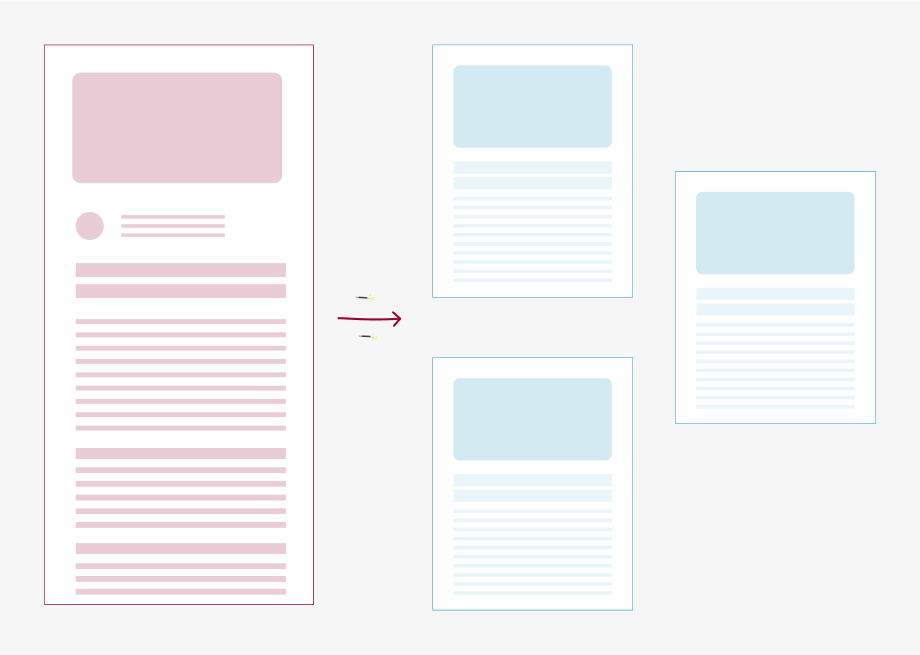
Content repurposing is the practice of reusing a piece of existing content in new ways to expand its lifespan and increase its reach amongst the target audience.
That might be recycling the content from one format into another – a blog post turned into a YouTube video, a research report turned into infographics for LinkedIn posts, a video turned into a podcast, and so on.

Or it might be taking one key message or particular elements of a story and transforming that into new pieces of content. For instance, if you’ve put time and effort into an original research report, you might turn each key finding from the research into a standalone blog post.
Content repurposing vs content distribution vs content refresh
I often see definitions and uses of ‘content repurposing’ that seem to be confusing it with content distribution – so let’s take a quick look at the differences before we move on.
Content distribution is the practice of disseminating a piece of content across all marketing channels that your brand uses. So, if you’ve just published a new blog post on your website, content distribution would be shouting about that blog in a LinkedIn post, including it in your next subscriber newsletter, sharing it in any community slack channels you’re part of, and so on.
Content repurposing is the practice of turning that new piece of content into additional pieces of content, either as new formats (e.g. blog to video) or by taking one message or element turning that into its own piece of content.
They’re interlinked because repurposing content should be part of your content distribution workflow: transforming content into different formats means that it can now be distributed across additional channels.
For example, turning a ‘how-to’ blog into a video explainer means that you can now distribute it on Youtube. Using short clips from that video explainer for LinkedIn posts gives you new ways to highlight the content in a platform-friendly way.
In the world of content the phrase ‘create once, distribute forever’ is a common once (thanks Ross Simmonds) – and content repurposing is key to that.
🤔 Is repurposing content the same as refreshing content?
This is another mix up I’ve seen.
Optimizely’s content repurposing guide (one of the top ranking articles for content repurposing search terms), for instance, includes the sentence: “The possibilities for repurposing content are almost endless. You can simply update an existing asset with the latest facts and figures…”
Updating a blog with the latest facts and figures is not content repurposing.
It’s content refreshing (or simply updating), which is a super important part of content marketing – ensuring that key pieces of content remain relevant and avoiding SEO performance dropping over time – but isn’t the same as content repurposing.
The benefits of content repurposing
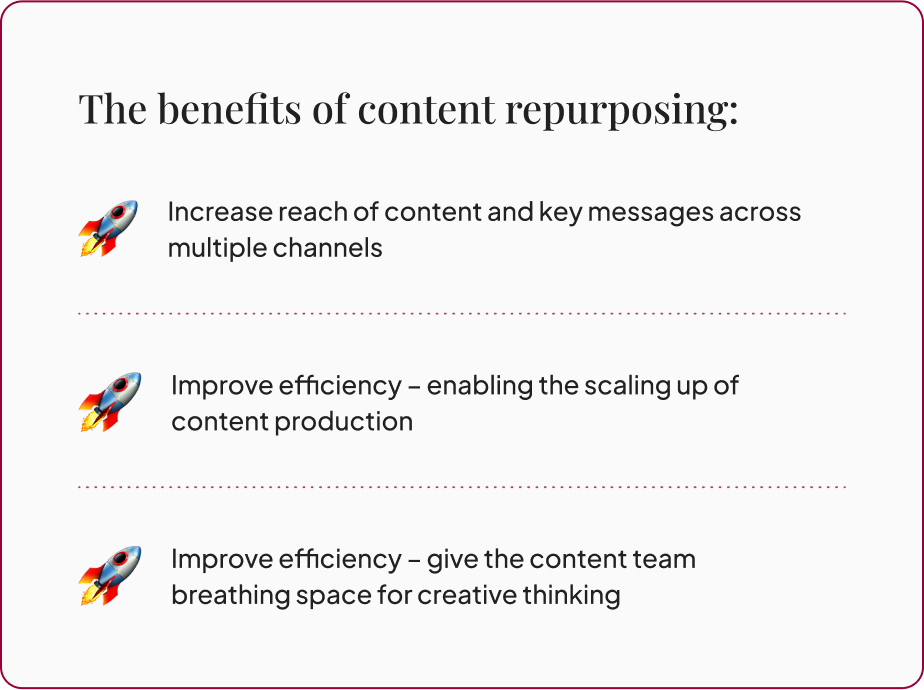
The key benefits of content repurposing are:
- Increase reach of key messages across channels
- Improve efficiency – enabling the scaling up of content production
- Breathing space for creative thinking.
Content repurposing increases the reach of key messages
Every piece of content you create is full of nuggets of wisdom – topic education, expert advice, best practice viewpoints, inspirational stories, and much more.
If those nuggets exist only in one format, designed for one channel, they’re destined to reach only a small subset of audience members who like to engage with that specific format and channel.
Take a company blog, for instance. Some users will find it through browsing your website. Some users will find it through search engines (if it’s SEO friendly). But many users will rarely visit your website. Others don’t have the attention span to read a blog, or simply prefer to engage with video content over written content. So it only ever reaches a tiny portion of the total potential audience.
If that piece of content is repurposed into new formats or tailored for new channels, the potential audience significantly expands – which means your key messages and nuggets of wisdom can reach further, raising brand awareness.
Content repurposing enables content production to scale
If every piece of content is a one and done, then your content team is constantly having to plan and create brand new content and tell brand new stories across all core channels.
That takes a lot of time and effort – it’s not very efficient.
When content is systematically repurposed via a systematised workflow, the team no longer needs to create every new piece of content from scratch.
Instead, the core ideas and research is already there, and it’s about making the most of that message by using it as a basis and then repurposing it in creative ways over a longer period of time.
A blog stops being just a blog, and becomes instead a blog + video version + short video clips for LinkedIn posts + a newsletter topic + several LinkedIn carousel posts + a webinar topic + the basis for three more blogs, and so on.
Those different formats can all be spread out in your content calendar across a period of time e.g. a month.
It’s a way more efficient way to disseminate a message across multiple channels, which means it’s way easier to scale content production and impact.
Content repurposing gives content teams breathing space for creative thinking
Constantly planning, researching, and creating new content ideas to keep a regular cadence across all core channels is all-consuming.
It leaves a content team that has no time for creative thinking – because it’s always onto the next piece of content.
A more efficient and streamlined workflow (which, as we’ve seen, content repurposing enables) gives content teams breathing space. That breathing space is absolutely vital, because it’s the time when we’re able to reflect on what’s actually moving the needle for the brand, and think creatively about how best to increase impact moving forward.
Plus, thinking up ways to repurpose content into different formats or new pieces is inherently a creative act – it’s bound to spark new ideas on how to (efficiently) increase the reach of a message.
Content repurposing strategy: how to implement repurposing effectively
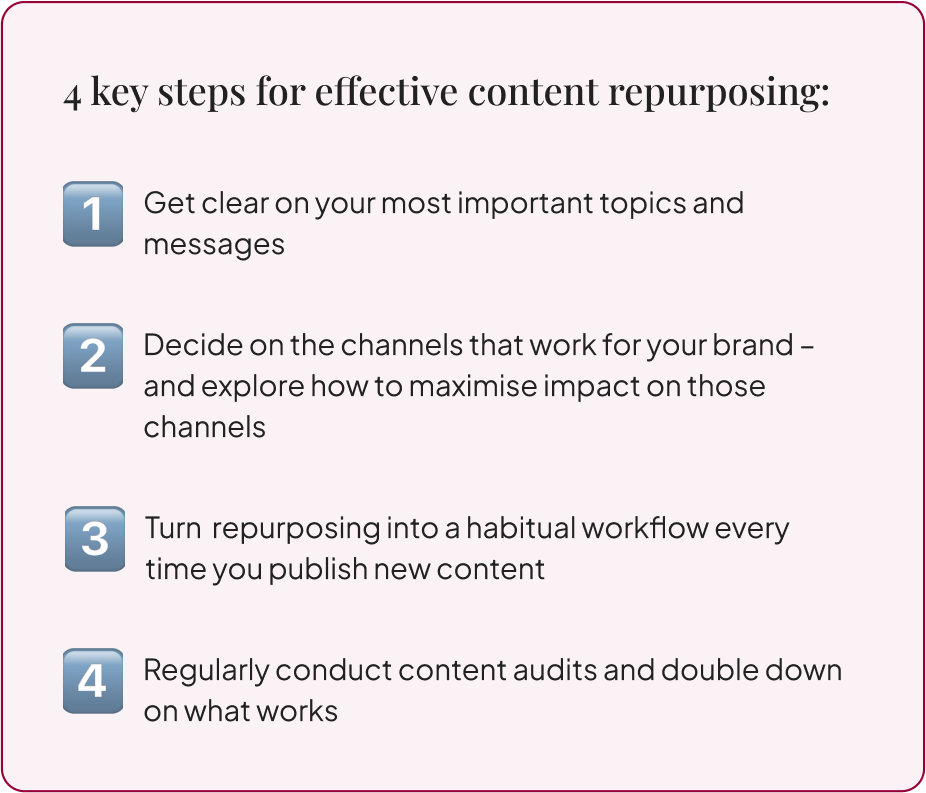
There are 4 key steps for an effective content repurposing strategy:
- Get clear on your most important topics and messages
- Get clear on the channels that work for your brand – and how to maximise impact on those channels
- Make content repurposing a habitual workflow
- Regularly conduct content audits and double down on what works.
Get clear on your most important topics and messages
Not every piece of content is worth repurposing.
The content that is worth repurposing is the content that:
- Makes effective arguments that back up your brand’s worldview
- Addresses real pain points for your target audience
- Demonstrates brand expertise
- Provides evergreen education on relevant topic areas.
Because those are the messages that you want to disseminate far and wide to build brand awareness and authority.
For content repurposing to be effective, therefore, you first have to be crystal clear about the most important messages, topics, and viewpoints for your brand and your target audience so that you can make strategic decisions on which pieces of content are worth taking the time to repurpose over and over.
Get clear on the channels that work for your brand – and how to maximise impact on those channels
It can be tempting to repurpose content into all possible formats for all possible channels – but beware of this, because spreading yourself (or your content team) too thinly is a recipe for disaster.
To combat this, it’s important to have clarity on which channels and formats actually make sense for your company before you start repurposing.
This should be led by understanding the channels and formats that members of your target audience use and engage with on a day-to-day basis. It’s also worth considering internal capabilities and resourcing – if no one on the team has experience with podcast production (or is keen to learn by doing), then turning your blogs into podcast topics might not be a viable option right now.
Then do the research to understand how to maximise impact for each channel or format that you plan to use in content repurposing.
Let’s say, for instance, that blog posts have been the primary content format for your company, and that they’ve primarily been distributed via SEO and through LinkedIn posts that use text or image only.
Now you want to use repurposing as a way to start using video content, turning high-performing ‘how to’ blog posts into video explainers to post on Youtube – and then using short clips from those for video LinkedIn posts.
To maximise impact of the repurposed content, you need to understand what makes an engaging explainer video on YouTube for a B2B audience. You need to understand how YouTube SEO works to maximise reach. You need to understand what improves video performance on LinkedIn. And so on.
Make content repurposing a habitual workflow
The simplest way to implement content repurposing is to make it a workflow.
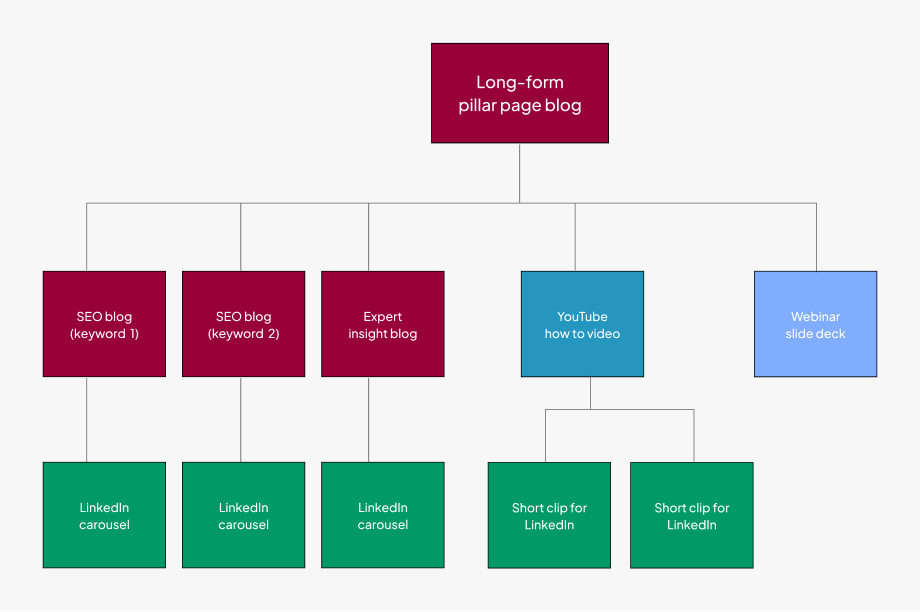
By ‘workflow’ I essentially just mean that every time you publish a core piece of content it sparks a standardised process (Atomic Habits habit-stacking style) to repurpose that core piece of content across all other relevant formats.
So if you publish a new long-form ‘complete guide’ style blog on an important topic, that might spark a workflow to turn that blog into:
- Additional short-form blog posts on specific topics within the guide
- A LinkedIn carousel for each section or message
- An explainer video for Youtube – which is then repurposed further into short clips for LinkedIn posts
- A webinar slide deck.
🛠️ The best content repurposing tools
There are loads of tools on the market today to help make setting up these content repurposing workflows easy – here’s a comparison of 11 of the most well-known.
Read more >
Regularly conduct content audits to understand what works
Content audits should always be a regular process for any content team.
They ensure that you understand what content is performing well and identify any content that needs refreshing to stay up-to-date and avoid performance falling.
The former is vital for effective content repurposing. High-performing content is content that is resonating with your target audience, building brand awareness and authority and driving revenue growth.
This high-performing content is the content that you should be focusing repurposing efforts on to increase its reach and impact even further.
💡 Content repurposing examples
Looking for examples of content repurposing workflows that actually work in the real-world? Here are 11 examples of brands that have content repurposing down to an art.
Read more
Is it worth engaging a content repurposing agency?
Whilst content repurposing can make for a more efficient content plan, it does take time and effort to implement repurposing effectively.
If you want to try out content repurposing but you can’t spare the time internally to do so, then working with a content repurposing agency could be a good option.
Content repurposing agencies are particularly beneficial if you think that a certain content format or distribution channel could be impactful for your brand, but you don’t have the internal expertise to try it out. For instance, if you want to introduce video content to the mix, but your internal team is focused on quality written content, then engaging a content repurposing agency with video expertise could enable you to test video out more easily.
Remember that you know your target audience, brand voice, and content strategy best, and any decent content repurposing agency will always make it their first job to understand that, before getting started.
From there, the process of working with a content repurposing agency typically starts with the agency’s team analysing your brand’s current content library to identify opportunities for repurposing content. Once agreed, the agency will then create the repurposed content, optimised for each format and channel required.
🚀 Outsource your content repurposing
We’ve seen throughout this article that creating high-quality original research content is no easy task.
Working with a freelance content marketer who has experience with content repurposing can help you to get those workflows in place, without adding extra pressure to the team – and at a lower cost than working with a content repurposing agency.
Get in touch
 Tabitha Whiting: High-impact content for high-impact startups
3 thoughts on “Content repurposing guide: get more from existing content”
Comments are closed.