
Solve your audience’s problems.
It’s what your product should stem from.
And the same is true for your content – we want customer-centric content, not brand-centric content.
Content that empathises with a target audience’s pain point is engaging in an authentic way, showing the audience that your brand understands the unique challenges they face.
Content that educates on solutions to those pain points demonstrates brand knowledge and expertise, sowing seeds of trust, reputation, and memorability.
Content that showcases how your product can solve the pain points in a way no other solution can (or how it has already solved this pain for others like them), helps to convert audience members into customers.
But how can you effectively bring audience pain points to the core of your content marketing efforts?
That’s what we’ll explore in this article, covering:
- What is an audience pain point?
- How to identify audience pain points
- How to effectively address pain points in content marketing
- What is pain point SEO?
What is an audience pain point?
Pain points are the problems or challenges or things that cause pain in the day-to-day life of your specific target audience – that your product or service can help them overcome.
Lots of things can be pain points, but you want to go deep and find real pain – the specific problems that audience members are actively trying to fix, and would be willing to put time, money, and effort into solving.
Finding out the most pressing audience pain points should be at the top of the list for any start up, because understanding those pain points is vital to creating a product that provides real value and to commercialising it in a way that will deeply resonate with the desired audience (messaging, marketing, sales, etc).
Most articles (like this one, for example) on pain points deem that there are four main types of pain points:
- Financial pain points i.e. spending too much on existing solutions or a lack of budget for a solution
- Productivity pain points i.e. spending too much time solving the problem that could be used more valuably elsewhere
- Process pain points i.e. an overly-complex task or process
- Support pain points i.e. limited support to solve a problem or complete a task.
I personally think this is too rigid.
Pain doesn’t fit neatly into boxes, it has a thousand different variations for a thousand different people. To use pain points effectively means committing to the detective work needed to seek out exactly what pain the real-life people we want to buy our product have. The nuance and the detail is important. So feel free to use these four boxes if it’s useful for you, but do so with caution.
How to identify audience pain points
The first step in identifying audience pain points is to know the niche target audience you want to attract most.
Most startups neglect audience development. They dive right in to creating a broad range of product features based on their assumptions of a very general target audience, with little evidence of that audience’s real pains and needs. This brings with it a huge risk of building a product that nobody needs. The same is true with content.
Narrow the target audience down to bring focus and effective targeting.
If your leadership team can’t (or won’t) do this overall, then do it within the content strategy that you own: define the niche target audience that your content will aim to build trust with. It might be that you have multiple segments of different personas or buyer profiles – that’s all good, they’ll just have different pain points so will require different content.
Once you know your audience, identifying their pain points comes down to one simple thing: listen to your audience.
I truly believe that one of the most important things you can do to improve the quality, differentiation, and just overall success of your content engine is to get better at listening to your target audience.
And it really doesn’t take much to be better at listening to your audience than your competitors are, because the vast majority of content marketers are not conducting audience research ‘nearly enough’ – according to Tommy Walker’s 2024 ‘State of (Dis)Content’ report.
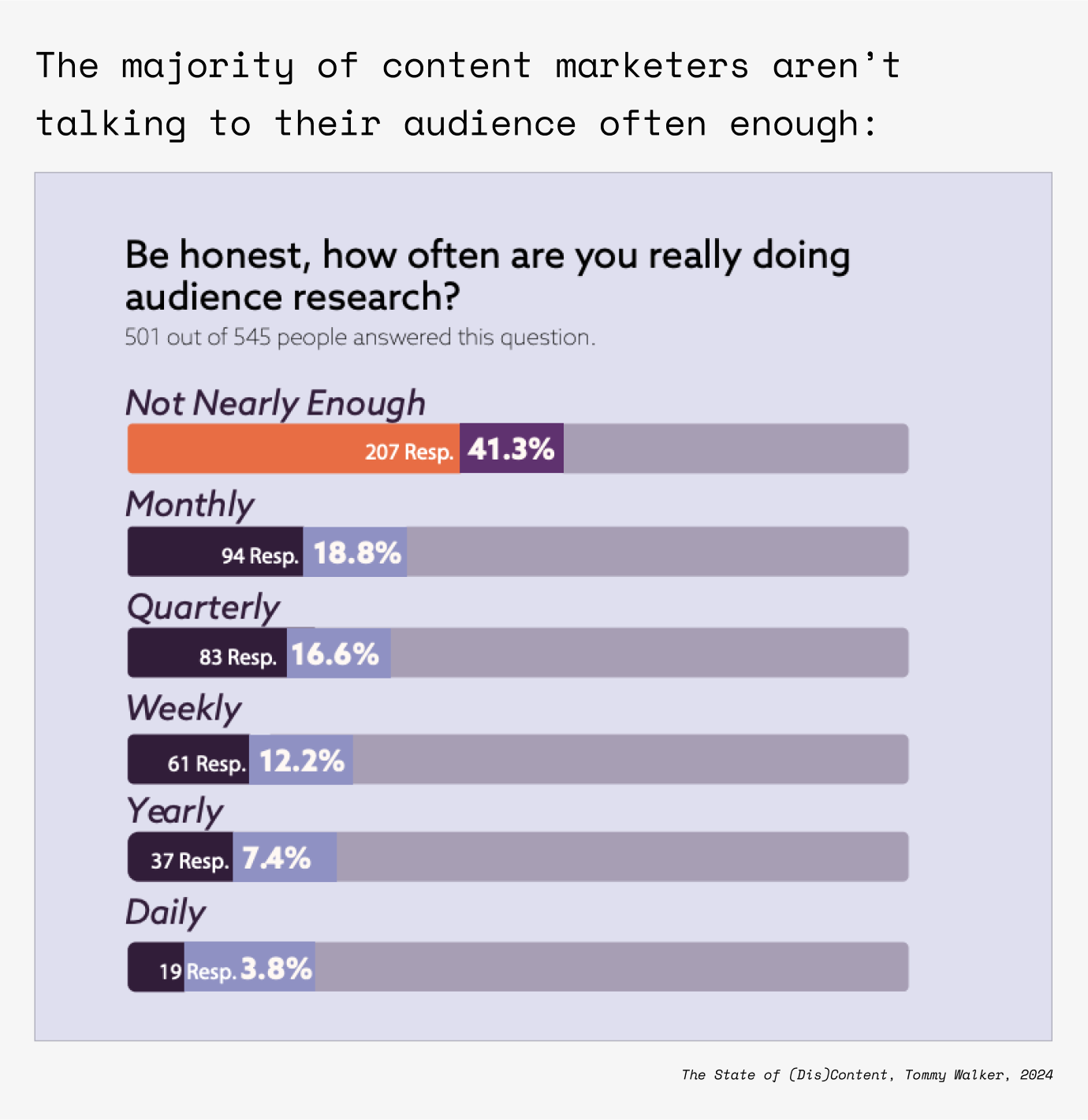
So what are the best ways to listen to your audience and gather insights on their pain points?
Here’s the main ways to go about this:
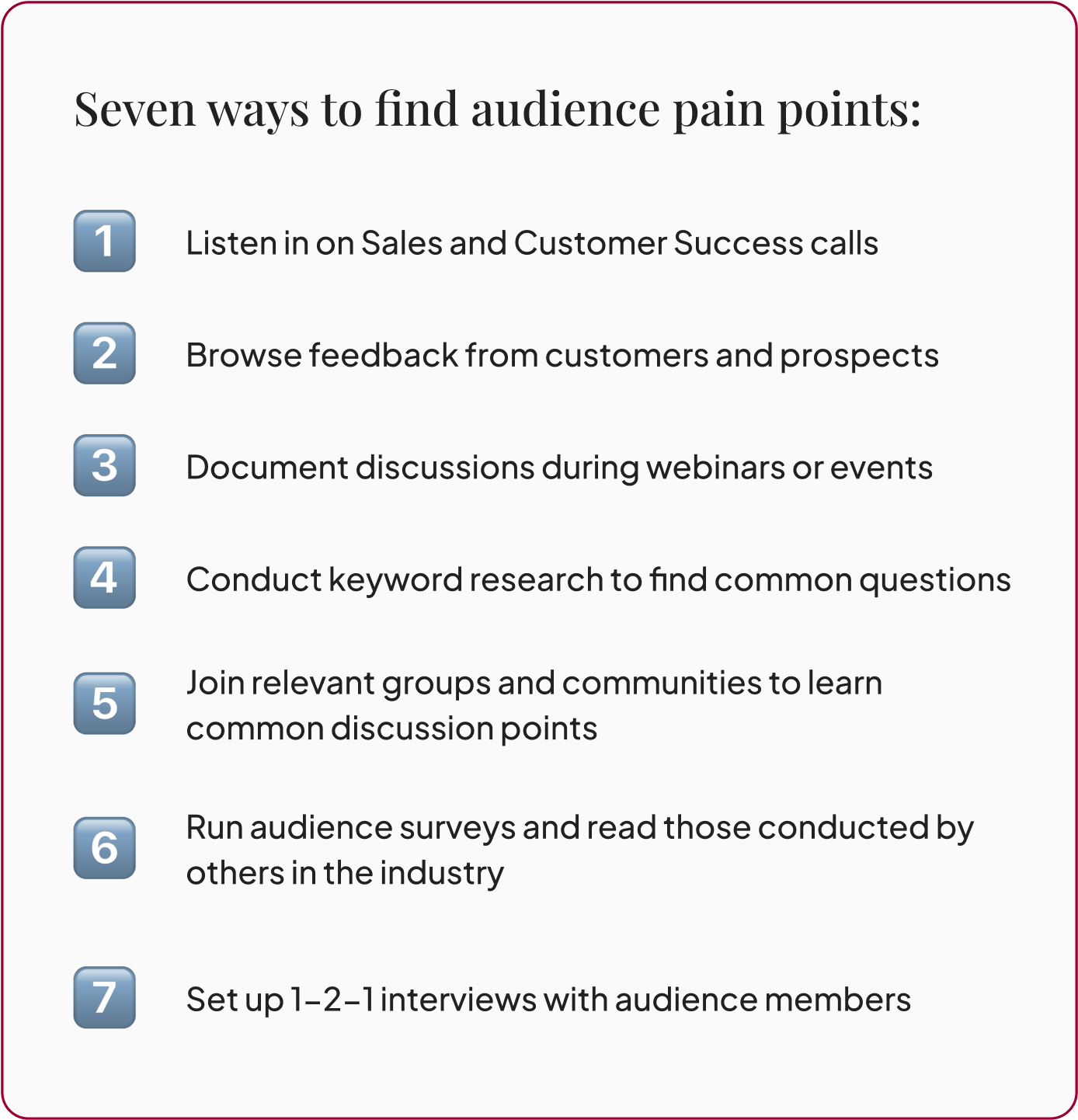
- Sales and Customer Success calls. The best case scenario is that your commercial team already record all of their calls with prospects and customers. Even better if they use a tool like Gong which automatically creates call transcripts and groups snippets of conversations together based on common themes. If this isn’t the case for your team, ask if you can join a call once a week – just to sit quietly in the background and make notes, nothing more.
- Prospect and customer feedback. Regularly gathering customer and prospect feedback and ideas is incredibly valuable for all teams – sales teams need to find the most common objections and come up with ways to handle them, product teams need to understand the most requested bugs to fix or features to build, and so on. Because of this it’s highly likely that your company is already documenting customer feedback somewhere – be it in a slack channel, notion document, google drive file. Having access to that feedback is pain point gold.
- Webinars or events. The questions or discussions that come about during webinars or events with your target audience can unveil things that are concerning them.
- SEO research. Conducting keyword research on relevant topic areas via an SEO tool like Ahrefs or Answer The Public will help you to identify the common search queries of your target audience – many of which will be problems they’re looking for help to solve.
- Social listening. Be active in the channels and communities that your target audience hangs out in (join Slack communities, follow industry influencers on LinkedIn, browse relevant forums or Reddit threads, etc) and see the kind of questions or discussions that commonly arise.
- Industry research. Run surveys with your target audience (which can double as an opportunity to gather data for original research content too) or regularly search for new industry insights from other brands that contains data or surveys about your target audience – industry reports like Tommy Walker’s ‘State of (Dis)Content’ or Ravio’s ‘Compensation Trends reports’ typically include a survey element, and the answers given may well give you valuable information about the mindset of the audience answering them.
- 1-2-1 audience interviews. If it’s possible to set up calls regularly with people who fit the niche target audience, then this is the absolute best way to delve into their pain points, because you can ask specific questions tailored to the insights you want to gain. It’s also typically the hardest way to listen to your audience. Other stakeholders within the company already need access to prospects and customers, and you never want to demand too much of someone’s time. It can work when there’s an existing relationship with marketing e.g. if you’re already working on a case study with them or a collaborative piece of content like a webinar. Equally, you could also go outside of customers and prospects, and even offer an incentive like a voucher to set up a 30 minute chat with you.
💡 What should you be asking during audience interviews to find real pain points?
I’ve learnt a lot about deducing customer pain and value from working alongside Alicia Carney (a brilliant Product Marketer and friend), and one of her pieces of advice is to skip the surface level chat and ask the questions that feel vulnerable – you’re aiming to ‘avoid them serving up canned responses of what they think I want to hear.’
Here’s a few of the questions Alicia recommends for identifying customer pain points:
– Who owns [problem] in your business?
– When you’ve had an awful day and you want to close your laptop and rage quit, what has happened?
– When you have an amazing day and you’re buzzing with excitement about your job, what has happened?
– How does this challenge impact your goals and daily work?
– If you had a solution, how would it change things for you?
– How are you currently solving this problem, and what frustrates you about it?
How to effectively address pain points in content marketing
Once you’ve identified the most common and pressing pain points amongst your target audience, it’s time to address those pain points through content.
There are lots of different ways you could approach this.
Here’s a few ideas that work well:
- Educational content that validates the pain point e.g. a blog or video titled ‘The problem with X’ which explores the pain point at hand.
- Entertaining content that validates the pain point e.g. social media posts using meme formats that enable you to highlight the shared misery you’ve heard from your audience – like this one or this one from Ramp’s LinkedIn.
- Community content that validates the pain point through personal stories of others who share the same problem e.g. include as a discussion in an event, start a thread in community Slack channel, share quotes from real people in a blog, use it as the topic for a podcast episode etc.
- Share advice on overcoming the pain point from internal experts or industry influencers who you interview as subject matter experts (SME) – like this example of a blog I wrote for Ravio sharing expert advice on the key pain points in the compensation review process
- Share best practice approaches for overcoming the pain point
- Share resources e.g. tools, templates that can help to overcome the pain point
- Conversion-focused content that highlights how your product can help to overcome the pain point
- Case studies demonstrating how other users have overcome the problem with the help of your product.
💡 Explore real-world examples of customer pain points
I always find it helpful to understand how other brands are approaching content marketing, and that includes how they use customer pain points to inform the content produced – so I’ve put together a few examples to help put things into context.
Go to the examples >
And then all you need to do is build these ideas into your existing content plan for production and distribution.
Using a framework like an empathy map can be a helpful way to distil the information gathered from listening to the target audience into a more concrete set of common themes.
Personally I find it useful to have a ‘content ideas dump’ for any ideas for future content, including if a new pain point comes up that might be worth including, or I think of an idea for a piece of content to address an existing pain point. It just helps to make life much easier when it comes to planning your next batch of content. I typically have my ‘idea dump’ as a separate tab on my content calendar because I like to have all my planning together, but you could equally have a separate document where you jot down ideas to come back to later.
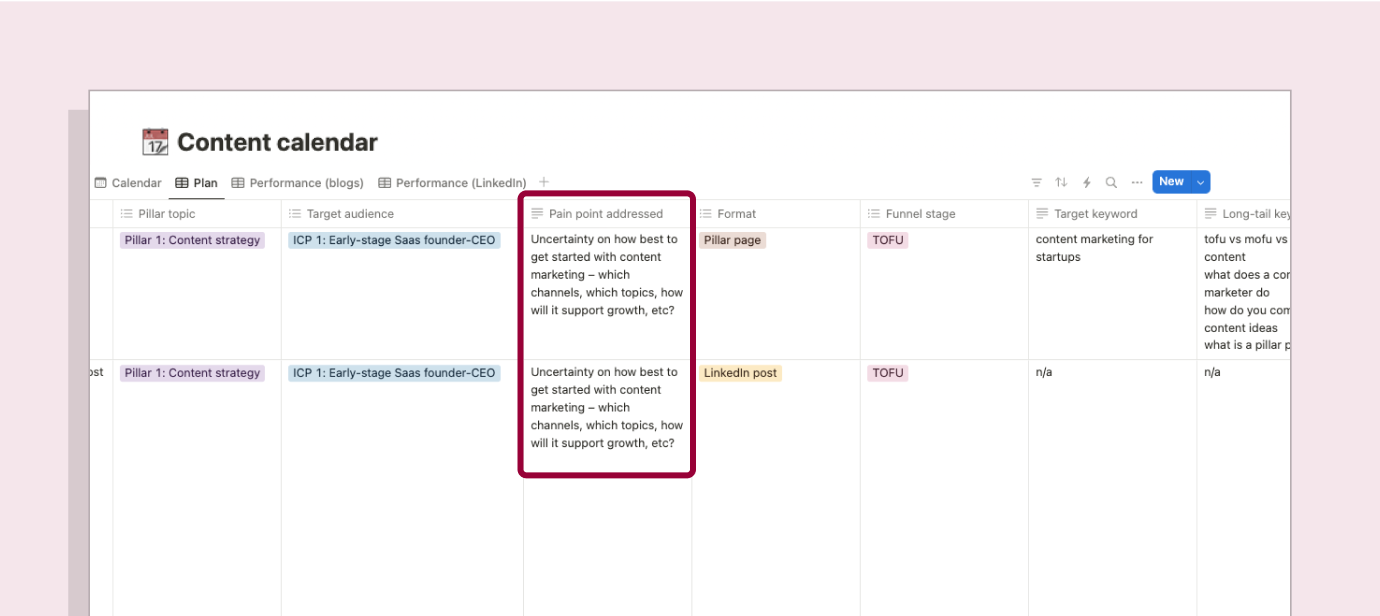
I’d also highly recommend including pain points as an input on your content calendar – so that every piece of content created is deliberately associated with a validated pain point for the audience being targeted with that content. This helps to keep the focus on addressing pain points once you move from strategic thinking mode into delivery mode.
💡 Tip: lean on your sales team to distribute pain point content
Content that addresses common pain points is perfect fodder for your Sales and Customer Success colleagues to use in customer conversations – building the relationship by helping them solve real problems they’re facing, and showing them how your product can get there more quickly.
So, make sure that they’re aware of the content when it publishes and that they add it to their arsenal of content to share during outreach or ABM campaigns.
What is pain point SEO?
Pain point SEO is an approach which aims to increase lead generation from organic search (Google, Bing, etc) by targeting high-intent keywords that align with the real pain points of your target audience.
Search intent in SEO simply refers to the main goal or purpose that a user has when they type a query into a search engine. Content that aligns with search intent is more likely to rank because it actually gives the user what they were looking for, providing real value.
That’s common sense.
Search intent often aligns with pain points, because it’s common for users to make searches based on a pain that they want to solve.
Most searches starting ‘How to …’ will be aiming to overcome a pain point.
Bottom-of-funnel SEO content formats like competitor alternatives or ‘best [category] software’ also typically align search intent with overcoming pain points, because these users are actively looking for a solution that will solve their problem, and they’re probably happy to invest money in that solution.
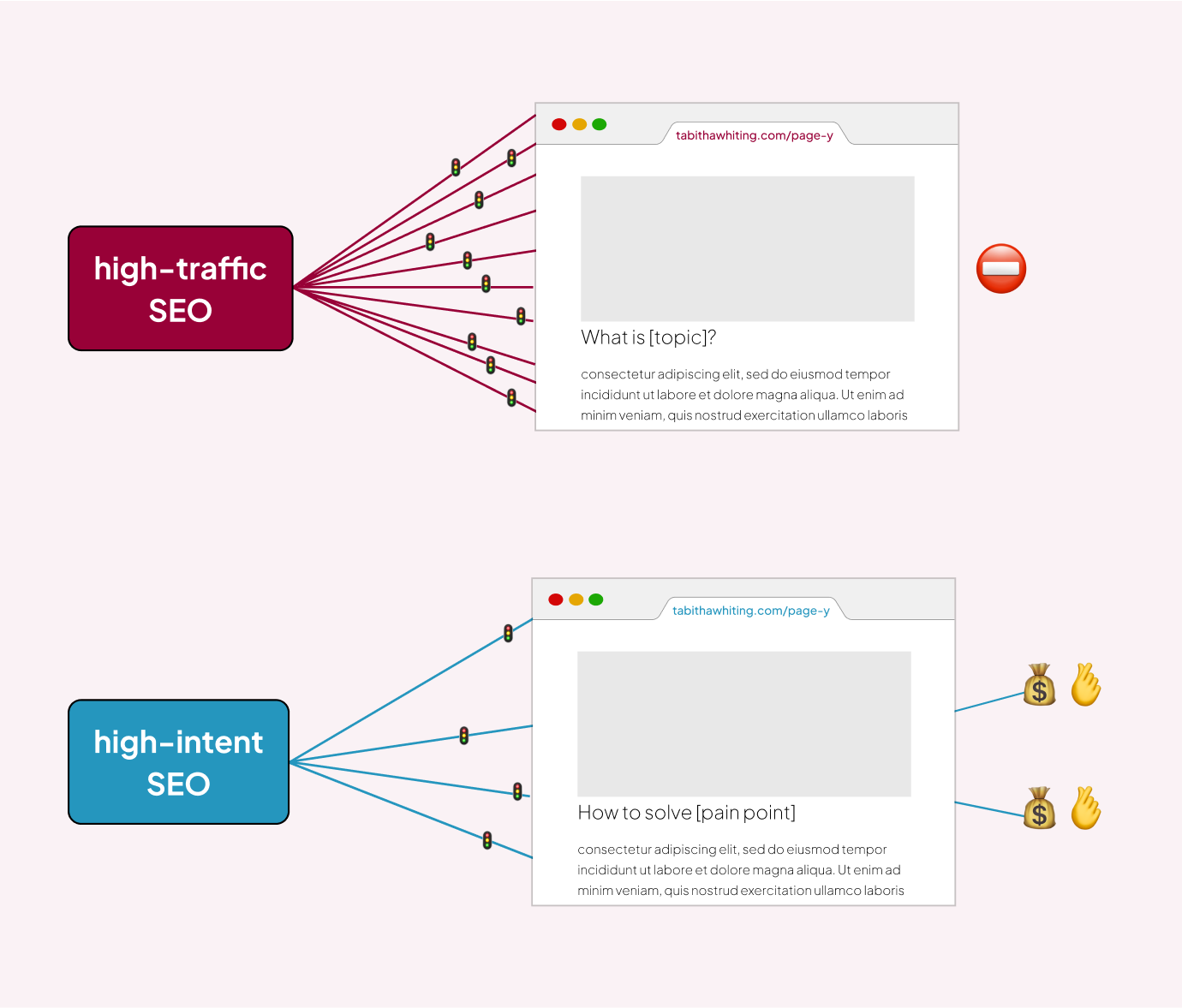
So, with pain point SEO, the idea is to identify the pain points (and therefore intent) of the target audience you want to bring to your website, and then conduct keyword research to find high-intent keywords that relate to that problem.
It’s basically everything we’ve already talked about in this article in terms of using pain points as the foundation for effective content that resonates with your audience – but applying that to SEO-driven content too, so that instead of blindly producing content based on keywords that seem high potential, you’re producing content targeting the search intent associated with known pain points for your specific audience. It’s lower volume, but higher likelihood of converting to customers.
This isn’t revolutionary by any means, but it is different to the high-traffic approach that many companies have typically taken to SEO. Targeting high-traffic keywords will bring more visitors to your website, but those visitors are likely to be less-ready to convert to a customer than those coming from high-intent keyword searches.
So, pain point SEO (and pain point content in general) is all about finding the people who actually have a real need for the solution you offer, and showing them that your brand is the one to trust to help them solve that need.
Your content shouldn’t sound like every one of your competitors’.
With my Content Strategy Audit you’ll identify the creative content opportunities that competitors can’t replicate, and that will truly build brand authority.
 Tabitha Whiting: High-impact content for high-impact startups
8 thoughts on “How to address audience pain points through content ”
Comments are closed.