
Every piece of content that your brand publishes should be addressing a customer pain point for your target audience.
Addressing customer pain points through content demonstrates empathy and understanding with your audience, and if you can support them to overcome those pain points you set your brand apart as an expert in the field.
But they have to be genuine pain points for your specific target audience, or it won’t resonate.
It can be difficult to know if you’ve hit on a real customer pain point.
To help, here’s a few examples of real-world customer pain points, developed from my own experience working with different audiences as a content marketer.
Love learning from real examples?
Subscribe to This Month In Content for creative content marketing examples that’ll inspire your next campaign, in every edition.
Customer pain point examples
To give examples of audience pain points that are actually useful we first need to have a specific audience in mind.
So, let’s take a couple of scenarios:
- Example 1: Customer pain points for a Head of Sustainability persona
- Example 2: Customer pain points for a HR or People Team leader persona
Example 1: Customer pain points for a Head of Sustainability persona
Let’s say you’re a climate tech company with a product focused on automating emissions calculations.
The niche audience you’re targeting is a Head of Sustainability who leads on climate impact as a single-person team for a supply chain management organisation such as a logistics or procurement company – because these companies act as suppliers for a myriad of other companies who all have to report on their carbon emissions, so emissions calculations are a major need.
Pain points for that Head of Sustainability could include:
- The complexity of manually sourcing data from several different people and places internally for carbon accounting and legal reporting requirements – and staying on top of all of those different sources
- Feeling held back by a constant need to persuade leadership stakeholders (CEO, CFO) of the business value of implementing climate programmes.
- Personal frustration due to a disconnect between their deep caring about solutions to climate change and the rest of the team’s.
- Anxiety at being a team-of-one with a lot of responsibility, making big decisions and implementing new processes, all whilst complying with sustainability laws and avoiding accidental greenwashing – without any colleagues to bounce ideas back and forth with.

These are real pain points I experienced when working with Sustainability Leads as an audience, during my time at Lune.
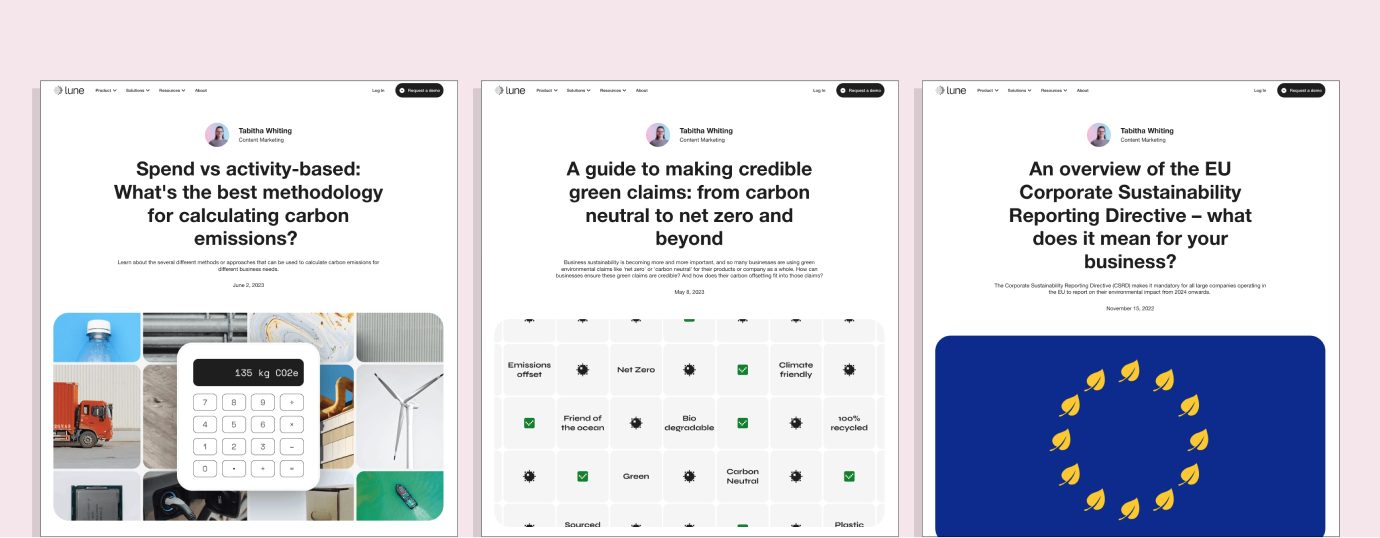
And here’s a couple of examples of content I produced to address those pain points:
- Spend-based vs activity-based: what’s the best approach for emissions calculations? – sharing industry best practices to help with the burden of decision-making
- What does the EU CSRD mean for your business? – helping Sustainability Leads stay on top of ever-changing corporate sustainability reporting laws
- A guide to making credible green claims – expert advice on avoiding accidental greenwashing in marketing language.
💡 A tip: time and cost aren’t strong enough pain points
Wasting too much time and spending too much money are two pain points that you’ll see come up all the time.
It’s easy to see why: they’re applicable to many people, in many situations. It’s fair to say that most of us would love a bit more time and a bit more money!
But that means they’re also pretty useless as audience pain points to build content on – you’ll end up with basic, generic, surface-level content that your competitors have probably already written.
Get more specific and find out what lies underneath the surface. Why are they wasting time? Why are they spending too much?
Example 2: Customer pain points for a HR or People Team leader persona
What if you were an HR tech company with a platform focused on compensation management.
The niche audience you’re targeting is a Chief People Officer or Head of People at an early-stage startup, who is responsible for setting the foundational processes, bringing on board top talent to grow the company, and retaining that talent.
Pain points for that Chief People Officer could include:
- Staying on top of all the changes in employment law and being the in-house expert on these laws – especially new pay transparency laws like the EU Pay Transparency Directive which will have major impacts on hiring and pay processes.
- Difficulties getting stakeholder alignment (founders never agree!) on the goals for hiring and growing a team to enable compensation processes to put in place.
- Frustration with hiring managers not sticking to the processes e.g. guidelines for running compensation reviews in a way that minimises bias and discrimination
- Losing a great candidate for the same reason as the last great candidate was lost, when the problem should have been solved – a lack of flexibility in hiring salary ranges, for instance.

Again, these are real pain points I’ve experienced through working with People Leaders at Ravio. A couple of examples of content I produced to address those pain points are:
- EU Pay Transparency Directive: legislation guide and FAQs – helping People Leaders understand the implications of new employment law
- How do I know what to pay a new hire? – expert advice and best practices on how to benchmark new hire salaries, including proprietary data analysis from Ravio’s compensation data platform
- Expert insights on compensation reviews – interview write ups with 3 experienced People Leaders, exploring the most common pain points associated with annual pay reviews.

💡 How do you identify customer pain points like these?
In short: it’s all about getting time to speak to your target customers – and, more importantly, listening to them.
I’ve together all my best advice in this blog: How to address audience pain points through content >
 Tabitha Whiting: High-impact content for high-impact startups
One thought on “Real-life examples of customer pain points (+ content ideas to solve them)”
Comments are closed.