
Subject matter experts are known as ‘SMEs’.
That had me confused for a hot minute, because SME stands for Small or Medium-sized business, right?
Turns out that, yes, it does.
But it also stands for subject matter expert in the world of content marketing.
That puts subject matter experts firmly in my bad books alongside other confusing acronyms with double meanings – like MVP (minimum viable product or most valuable player), ATM (at the moment or automated teller machine), and PTO (paid time off or please turn over).
Anyway, enough of the inner ramblings of my mind, and back to the point of this article.
Subject matter experts are a must-have in content marketing. Content led by expert input is always much higher quality, offering real value to a target audience and elevating a brand’s reputation.
But how do you find subject matter experts? And how do you work with them effectively?
Lucky you’re here, because that’s exactly what this article covers:
- What is a subject matter expert in content marketing?
- Why are subject matter experts important in content marketing?
- How to leverage subject matter experts for quality content
- How to find subject matter experts
- How to persuade subject matter experts to work with you
- Interview tips: how to get the most out of your subject matter experts
What is a subject matter expert in content marketing?
A subject matter expert (SME) is someone who has extensive professional knowledge of the subject area that your brand is creating content about.
They will have clocked up several years working in that field, giving them lots of personal experience and learning to draw upon.
They may be a well-known figure in the industry, regularly called upon as an expert by others – a panel speaker during events or conferences, a featured expert in news articles, a podcast interviewee – though this isn’t a necessity: you don’t have to be visible to be an expert in a topic area.
Let’s take HR tech as an example. Content writers in HR tech might call upon employment lawyers, compensation consultants, or experienced Chief People Officers as subject matter experts.
Or, content writers in climate tech might speak with climate scientists, experienced Heads of Sustainability, or climate startup founders as subject matter experts.
💡10 real-world examples of subject matter expert content
Examples of how other brands are putting a content concept into action are always helpful, so I’ve put together a few great examples of content that harnesses subject matter experts for high-quality, valuable content.
Go to the examples >
Why are subject matter experts important in content marketing?
Subject matter experts elevate content. They offer deep knowledge and lived experience in the topics which makes for more useful and trustworthy content – increasing your brand’s reputation as a source for valuable insights.
In particular, working with subject matter experts leads to:
- Higher content quality
- Unique angles and POVs
- Brand trust and credibility
- Increased reach and engagement
- Improved SEO performance.
Let’s take a closer look at each of these.

Subject matter experts lead to higher content quality
Quality content addresses genuine problems and pain points of your specific target audience.
That can be difficult to get right, which is in large part because content writers are rarely experts in the problems that they’re writing about.
They can get pretty close, because great content writers are quick learners who are highly skilled at research.
But no amount of research compares to lived experience of the pain point at hand.
This is especially true if your audience is a higher level, expert audience with years of experience in their field. The pain points that they have will rarely be solved even by the most excellent desk research by a writer.
It’s painfully obvious to readers when content is too surface-level to meet their needs, and that prevents an audience from seeing your brand as a go-to resource.
Subject matter experts will have the deep understanding of the problem that you need to ensure your content is truly valuable to the audience. They’ll be able to share their experience, and their learnings and approaches to mitigating that problem.
Your content shouldn’t sound like every one of your competitors’.
With my Content Strategy Audit you’ll identify the creative content opportunities that competitors can’t replicate, and that will truly build brand authority.
Subject matter experts bring unique angles and POVs
The experience that subject matter experts have means that they’ll think of ideas and connections that you can’t as a content writer.
They’ll bring up anecdotes and examples that add colour to the content you’re creating, showing your audience that your brand has a close understanding of their experience.
Plus, every time I speak to a subject matter expert about one topic or pain point, I come away with a whole host of new ideas to explore.
Their knowledge of a broad subject means that they will naturally connect dots during a conversation that you might not otherwise think of – so it’s a great way to find new angles and ideas for future content plans too.
Those unique angles, anecdotes, and perspectives are incredibly valuable for successful content, because they’re what differentiates your content and your brand from everyone else out there.
And according to Tommy Walker’s 2024 ‘State of (Dis)Content’ report, differentiation is what content marketers are struggling with the most:

Subject matter experts enhance brand trust and credibility
High quality content with unique angles and points of view is always going to be great for brand reputation.
It positions the brand as a one that leads with expertise, and a brand that real industry experts are willing to work with to share their expertise.
In turn, this means that audience members are more likely to place trust in your brand, and turn to your content as a credible source of insights.
Plus, we naturally trust people that we recognise have first-hand experience with a topic or problem – we want to learn about their experiences and approaches, so that we can apply that to our day-to-day work as inspiration.
Subject matter experts increase reach and engagement
If more members of your target audience trust the content that your brand produces, then you’ll naturally see an increase in reach and engagement.
Plus, partnering with subject matter experts can be almost like partnering with influencers.
If you collaborate with subject matter experts that already have a strong personal brand and following, then you’ll reap the benefits of that following when you share that you’ve worked with them on a piece of content. Members of their audience that didn’t know about your brand before (or didn’t trust it) will now be more likely to engage with your content and brand.
Even more so if the subject matter expert is willing to share the content themselves to their audience!
Subject matter experts mean improved SEO performance
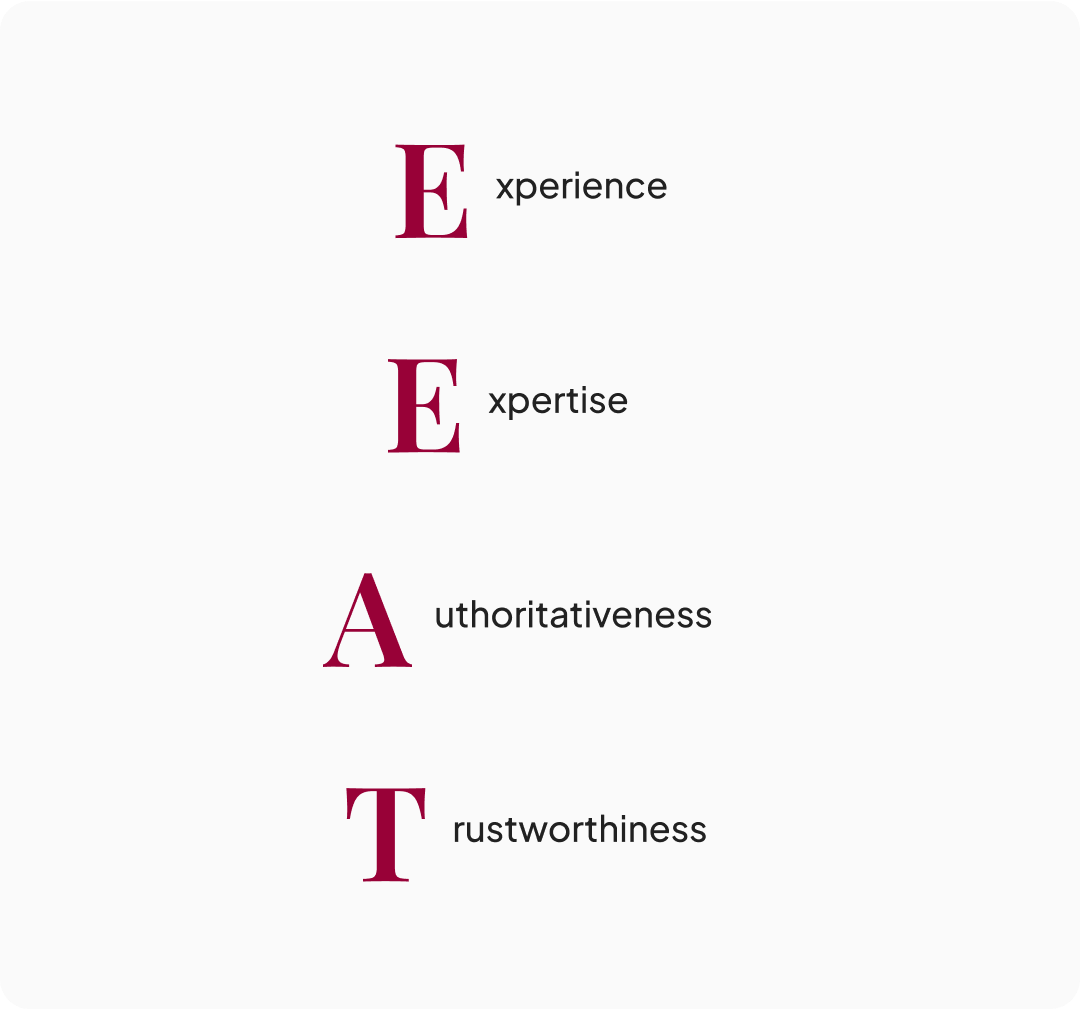
In late 2022 Google introduced ‘E-E-A-T’ to their guidelines for how content is ranked within their search engine.
E-E-A-T stands for: experience, expertise, authoritativeness, and trustworthiness.
It means that the quality of content is now crucial for SEO performance. The content needs to demonstrate deep understanding of the subject matter and real-world experience with it, in order to build that authority and trustworthiness.
All of this is helped by working with subject matters and including their voice within your content – we’ve already seen how they increase the quality of content through bringing that experience and expertise into play.
The ‘authority’ element also relates to how much coverage an author or brand has on the broad topic area. If your brand has lots of helpful, quality content on a topic area, you’re more likely to rank for it – which is where a model like topic clusters can be incredibly valuable.
How to leverage subject matter experts for quality content
There are lots of ways that insights from subject matter experts can be leveraged.
Generally speaking, use of those insights fall into two buckets: direct and indirect.
Direct use of subject matter experts means using their insights verbatim.
That could look like:
- Interview-style article – a write up of your discussion with the subject matter expert
- Interview section – the subject matter expert discussion might be used as one section of a broader article
- Quotes – weave quotes from the discussion with the subject matter expert throughout an article
- Video interview – release the footage of the discussion in video format
- Podcast interview
- Webinar or event
- Ghostwritten article authored by the subject matter expert, as a guest post for your company’s blog.
Indirect use of subject matter experts means using their insights to inform the argument of a piece of content, but without quoting them within it.
How to find subject matter experts
So you’re sold on the idea of leveraging subject matter experts for higher quality content. But how do you actually find subject matter experts?
Here’s the most common ways to find subject matter experts:
- Internal experts. This could be founders or senior leaders who have a strong opinion about an industry or topic area. It could be job roles internally that fit the profile of your target audience. If you’re an HR tech company, maybe your Chief People Officer would make a great subject matter expert, for instance.
- Partners and advisors. Many companies today have a partnerships function, which focuses entirely on building relationships and collaborations between your company and other people or brands in the space. Those existing partnerships are likely full of subject matter experts who are already bought into your brand’s mission. Beyond that, the company’s wider network might include advisors who have relevant experience. For startups, that could include your VC investors.
- Customers. Contacts at existing customers can fit the subject matter expert profile you’re looking for. It also gives you a great chance to build the relationship with customers by helping to raise their profile through collaborative content.
- LinkedIn searches. Use LinkedIn to find people who fit the profile you’re looking for based on their job title and experience, and reach out to them by DM with a specific question or an interview request. If those people are regularly posting on LinkedIn, they’re more likely to be up for content collaborations that might further raise their own personal profile.
- Industry communities. Today there are a whole host of Slack channels and LinkedIn groups for every single niche you can think of – and they’ll be full of industry experts.
- SME tools. Tools like Help a B2B Writer, Featured, and Leaps can help you to find subject matter experts who can share advice and experiences on a particular topic, or answer a specific question for you.
- Survey tools. Survey tools like SurveyMonkey or PollFish enable you to pay for audience participation. This can be a way to find experts to answer specific questions via a survey – but be wary, because the audiences used are often very broad.
- Paid collaborations. There are influencers in all industries today, including B2B. You could pay for a content collaboration with an influencer and use this to leverage their expertise for the content.
💡Tip: look for subject matter experts with an existing personal brand and following
The best case scenario is that you interview a subject matter expert, leverage their insights to create a great piece of content that solves a real pain point for your target audience, and they then share that content with their own audience, increasing reach and impact.
That only works if they’re already active on a channel like LinkedIn, and have an engaged following that fits your target audience – so seek that out.
How to persuade subject matter experts to work with you
Once you’ve found subject matter experts, you still need to persuade them to collaborate with you.
A few tips on this from my own experience:
- Give a brief introduction first. Send them a brief overview of the topic or the piece of content you’re hoping to create, and ask them if it resonates with them first. It won’t always be a good fit – it might just not be a problem they’ve experienced themselves – and this avoids wasted time. Plus, if it isn’t the topic for them, they almost always come back with an intro to someone in their network who is a good fit!
- Be clear about the ask. A vague ask is likely to be ignored. Explain the process – how will you gather their insights, and how long will it take? Explain exactly what you want their contribution for – how will their insights be included in the content. I’d always recommend sharing an example of a previous piece in a similar style to give context.
- Make it easy. When you work with subject matter experts, you’re always asking for a piece of their valuable time. And they’re always busy people with lots going on. So make it as easy as possible for them to contribute. If they’re struggling to find the time for an interview, send them the questions by email and ask them to send bullet point note answers. Never expect them to write the content for you.
- Make it valuable. Whenever I work with subject matter experts, I always feel overly bad about asking for their time and expertise for my content needs. But I forget that most of these experts are trying to build their own personal brand and increase their own exposure. They’re often excited about the idea, because content collaborations help them get their name out there in an expert capacity. So make it valuable, explain how it will help them gain brand exposure in a way that supports their own goals. If they’re a LinkedIn user, I highly recommend drafting a couple of LinkedIn posts for them using the insights shared – it’s hard to keep on top of posting on LinkedIn, so it’s always appreciated, and it supports your content distribution too.
- Build in plenty of time. I’ve made the mistake before of having a piece of content drafted, and thinking ‘this section could really do with an expert comment’. You’re ready to wrap it up and get it published, so you want to interview them to get their input ASAP. They’re busy, and they didn’t know this piece of content even existed until today. Try to think through expert input for every new piece of content whilst you’re in the planning phases, and reach out to experts then. Then build in more time than you think you need to – finding a slot in their busy calendar to chat isn’t always easy, and they’ll normally take a few days to review the content once it’s drafted.
- Aim to develop an ongoing relationship. If you find a subject matter expert who is keen to contribute, make it a priority to cultivate that relationship. It makes collaborations so much easier in the future if you have an existing list of friendly subject matter experts who are happy for you to shoot them a quick question every so often, and who will always say yes to working together.
Interview tips: how to get the most out of your subject matter experts
If you’re anything like me (read: a huge introvert who is better at writing than talking), it can be pretty nerve-wracking to interview a subject matter expert.
There are four things that make SME interviews easier for me personally:
- Remember that you’re doing something for them too. In my early subject matter interviews I would find myself repeatedly apologising for asking them to spare their time to talk to me. I’d always feel that I was asking too much of them, getting them to do me a massive favour. SMEs wouldn’t agree to collaborate with you on a piece of content if there wasn’t something in it for them. Usually it’s that they want to build their own brand and be seen as an expert – many of them even offer consultancy services, so it’s free marketing for them. It’s a positive thing for both sides. I still thank SMEs for their time, that’s just politeness, but I no longer start SME calls feeling guilty for taking up their precious time.
- Go to the interview well prepared. This is a basic piece of advice for any kind of interview, but it’s a good one. Before you get to the interview, make sure you’ve read up on both the topic and the subject matter expert. You don’t want to ask your SME basic questions because that’s a waste of everyone’s time, you want to get to the expertise quickly. If they’ve written on the topic before (website, LinkedIn posts, PR opinion pieces, etc) then get to know their point of view. Then use this information to prepare questions that will unearth a new angle or insight.
- Let the interview be open ended. Prepare those questions, but leave room for improvisation and additional questions during the conversation. Subject matter experts are knowledgeable people. I find they almost always go off on tangents outside of the questions I’ve prepared, because they make connections between that question and other topics or problem areas. Those tangents are your friend: they’re often where those unique angles, insights, and anecdotes arise.
- If you didn’t catch it, ask them to repeat it. Subject matter experts know their topics inside out, in a professional capacity. They’ll often use technical language and they might mention concepts that you haven’t come across yet. It’s also easy to simply mishear – especially if you’re holding an interview virtually. Sometimes it feels like you’re being a nuisance if you ask them to repeat themselves, but you aren’t, and it avoids you trying to decipher missing notes during the drafting process. This is especially important for technical language or concepts, because making those things easy to understand for the audience is an important part of your role as a content writer.
 Tabitha Whiting: High-impact content for high-impact startups
4 thoughts on “How to harness subject matter experts for higher quality content ”
Comments are closed.