
Scientific reports filled with inaccessible jargon. Greenwashing from fossil fuel giants. Media headlines that swing between “glorious sunny weather” and “fiery apocalypse.”
This is the climate communication that most people receive day to day.
We’re told climate change isn’t real, or isn’t that bad. We’re told it’s all our fault. We’re told it’s just about polar bears and melting ice caps. We’re told it’s too late to act, or that someone else will sort it out.
The result? A murky narrative where understanding what climate change actually means for us and what actions we should be taking feels utterly impossible.
Climate change communication has been, on the whole, pretty abysmal.
But effective climate communication is vital to influence change, because we need a mass of hyper-engaged citizens with clear demands for a different future.
If we want people to care about climate change and act on it (including climate tech buyers), we need to completely rethink how we talk about it.
The climate crisis desperately needs the best communications team we can muster.
So I’ve dived into all the research on climate and science communication, and come up with 5 essential principles for climate communication that actually works:
- Find messengers people actually trust
- Know your audience inside out (and tailor the message to that understanding)
- Share human stories, not abstract statistics
- Balance fear with hope
- Start conversations, not lectures.
When you apply these principles together, you create climate communication that cuts through the noise, builds genuine trust, and inspires people to act.
Let’s take a closer look at each.
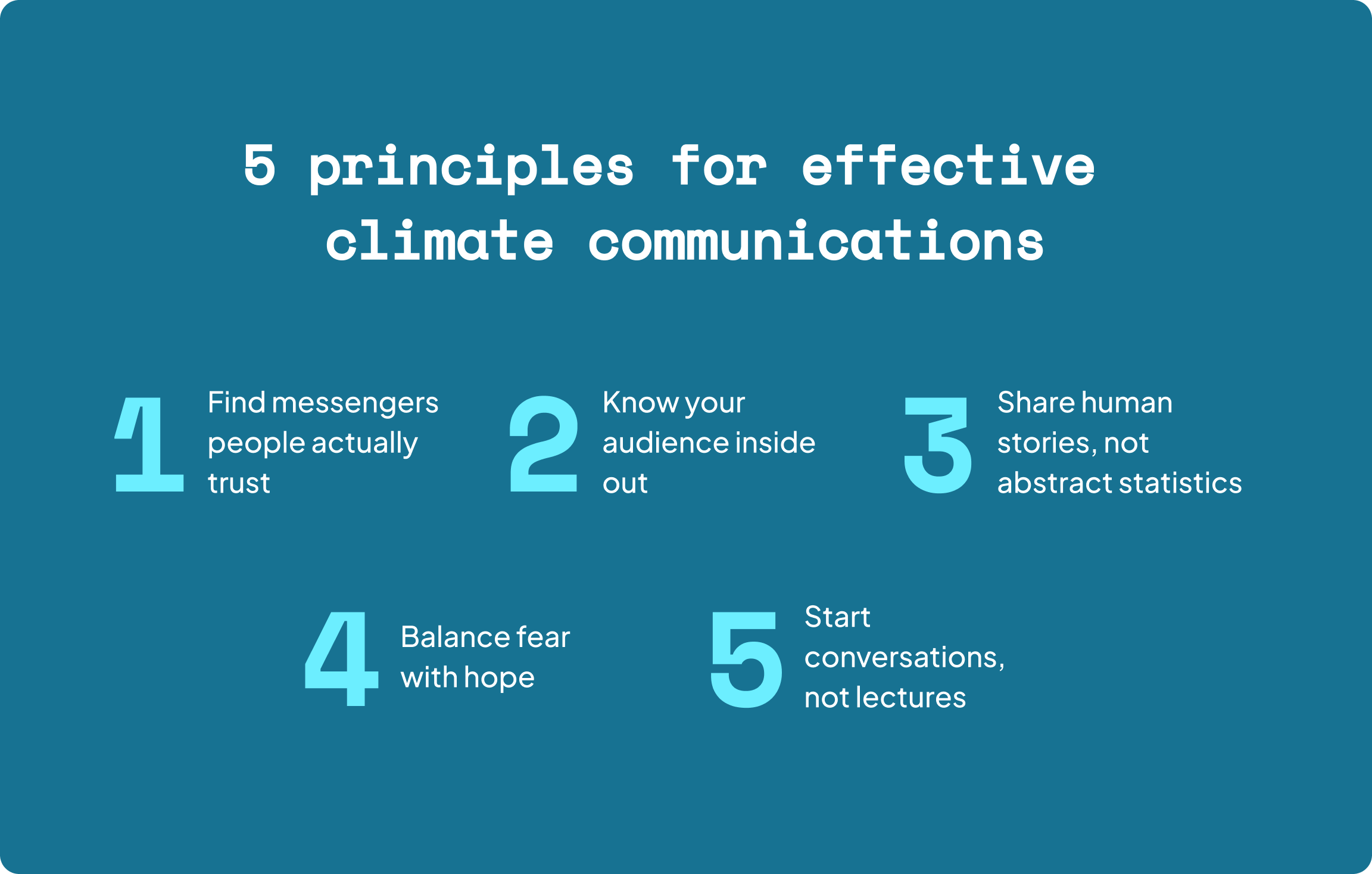
The 5 principles for effective climate communication
Principle 1: Find messengers people actually trust
When it comes to climate campaigns, who delivers the message matters just as much as what’s being said.
For decades, the climate crisis narrative has been dominated by voices that many people simply don’t trust – from politicians who make empty promises to economists with competing agendas. These messengers have muddied the waters, transforming what is truly accepted science into something that feels like an ongoing debate.
Climate scientists have also played a big role in sharing messages about climate impacts and action. But, interestingly, the public generally has lower trust in scientists than we might expect, often due to their use of technical jargon, unwillingness to speak in certain terms, and focus on statistics rather than storytelling.
Our receptiveness to climate messages often has less to do with the facts presented and more to do with who’s presenting them.
A trusted messenger is someone the audience already trusts – and who that is varies dramatically depending on your target audience. It might be local community leaders, religious figures, respected professionals, friends and family members, or social media influencers relevant to specific communities.
Read more about finding trusted messengers for climate campaigns →
The key takeaway: Identify who your specific audience already trusts, and ensure your climate message comes from those voices rather than defaulting to experts or authority figures.
Principle 2: Know your audience inside out (and tailor the message to that understanding)
Climate change means completely different things to different people – and I mean completely different.
A conservative farmer in rural America will interpret the exact same climate message in a totally different way than a progressive student in London. That’s not because one is right and one is wrong – it’s because humans filter everything through their existing beliefs and values.
It’s easy to assume that everyone should care about climate change for the same reasons we do. But people have different priorities, different fears, different dreams for the future.
The magic happens when you take the time to truly understand what your specific audience already cares about, then show them how climate change connects to those things.
Want to reach conservatives? Talk about energy independence and economic opportunity. Speaking to parents? Focus on protecting their children’s future. Addressing a business audience? Highlight the financial risks of inaction.
It’s not about changing your message to tell people what they want to hear – it’s about finding the authentic connection between climate action and what they already value most deeply.
Read more about tailoring climate communications to your target audience →
The key takeaway: Stop broadcasting generic climate messages. Start with deep audience research, then frame your message around what they already care about.
Principle 3: Tell human stories, not abstract statistics
Most people think climate change is happening to someone else, somewhere else, sometime else. Not to them, not here, not now.
We’ve spent decades showing people melting ice caps and polar bears on shrinking ice floes. We’ve bombarded them with statistics about parts per million and global temperature averages. And it hasn’t worked.
Why? Because these messages have made climate change feel abstract and distant.
In reality, we care most about protecting the places we’re emotionally connected to – our hometown, our local park, the beach where we had our first kiss. And we prioritise immediate concerns over future consequences.
The moment you put a human story (tailored to your audience) within climate communications – when you share the story of a local farmer whose crops are failing, a coastal community dealing with flooding, a family struggling with extreme heat – everything changes. Suddenly it’s not about polar bears or statistics. It’s about people just like us facing real challenges.
Read more about the power of climate change stories →
The key takeaway: Use the graphs and statistics sparingly. In their place, find the human stories that make climate change feel personal, local, and solvable.
Principle 4: Balance fear with hope
Most climate communication is absolutely miserable.
We get a constant stream of disasters, extinctions, and corporate greed. Heat domes, wildfires, floods. “We have 12 years to save the planet” headlines that make you want to crawl back into bed and hide.
The problem with that approach is that fear only motivates people when they believe they can actually do something about the threat. When all you hear is doom and gloom, you don’t think “I must act immediately” – you think “this is hopeless, what’s the point?”
People get so overwhelmed by the scale of the climate crisis that they shut down completely. They stop engaging. They turn away.
Yes, it’s important to be honest about the severity of what we’re facing. But then show people the solutions that are already working. The communities that are adapting and thriving. The technologies that are scaling. The policies that are making a difference.
People need to feel both the urgency of the crisis AND their own power to be part of the solution.
Read more about the importance of climate hope in communications →
The key takeaway: Stop with the doom and gloom and despair narratives. Balance honest portrayals of climate impacts with concrete examples of progress and pathways forward.
Principle 5: Start conversations, not lectures
You know that feeling when someone talks at you rather than with you? That’s exactly how most climate communication feels.
We get scientists lecturing us with technical jargon. We get activists shaming us for our every wrong move. We get politicians making grand speeches about what needs to happen. Everyone’s talking, but nobody’s listening.
We treat climate communication like it’s about transferring information from expert brains into empty public heads. As if people are just waiting around to be educated about climate change, and once they know the facts, they’ll obviously start caring.
That’s not how humans work.
Real persuasion happens in conversation. It happens when you genuinely listen to someone’s concerns, acknowledge their perspective, and find common ground. It happens when people feel heard and respected, not lectured and judged.
The most powerful climate communications I’ve seen aren’t presentations – they’re discussions. They’re spaces where people can ask questions, share their own experiences, and explore how climate change connects to their own lives.
When you create genuine dialogue, people don’t just receive your message, they help shape it. And messages that people help create are the ones they actually care about and act on.
Read more about building climate conversations not lectures →
The key takeaway: Stop broadcasting at people. Start genuine conversations where you listen as much as you speak.
 Tabitha Whiting: High-impact content for high-impact startups