
Implementing content pillars for more focused and effective content marketing?
I find it’s always easier to understand a new concept or approach once you see how other brands and marketing teams implement it.
So, in this article we’ll take a look at 7 examples of content pillars by brands that are killing the content market game.
Love learning from real examples?
Subscribe to This Month In Content for creative content marketing examples that’ll inspire your next campaign, in every edition.
How to find content pillar examples
It can be difficult to find good content pillar examples – there aren’t many companies out there who openly publish their content strategy.
So here’s a trick for you.
Blog categories are a sure-fire giveaway for a brand’s content pillars (and tags often tell you the subtopics within those pillars too) so you can find content pillar examples by browsing through company blog pages.
And an extra tip: if a blog has a bazillion categories and you’re confused about what their content pillars are, then you can be pretty sure that they don’t have a solid content strategy with a set of content pillars – and I maybe would err away from using that brand as content inspiration.
Like this one I came across recently which very much made my brain hurt trying to figure out their topic focus.
There are SO many topics. And they’re SO broad. Like ‘migration’ – are we an international development brand? They’re also a mix of topics and content formats, switching from ‘webinars’ and ‘templates’ to ‘deliverability’ and ‘monetize’. It’s all a bit confusing.
(sorry to drop you in it if you happen to see this Beehiiv team, I’m loving your brand at the moment, just not so much your blog structure).
7 content pillar examples
So, let’s take a look at a few great content pillar examples from some SaaS companies you may have heard of:
- Buffer content pillar example
- Zapier content pillar example
- Culture Amp content pillar example
- Shopify content pillar example
- Miro content pillar example
- Slack content pillar example
- And a bonus – my own content pillars.
Buffer content pillar example
Buffer’s blog has three main content pillars which are clearly relevant to their product of a social media scheduling tool and their audience of social media managers:
- Small business i.e. advice on building a business
- Social media marketing
- Podcasts
These are the key topics that Buffer is aiming to demonstrate deep expertise within. Each of these content pillars then also has subtopics, as you can tell from the tags used e.g. Facebook and Instagram within the social media marketing pillar.
Alongside these topics you’ll also see a couple of other categories which are not content pillars. ‘Latest updates’ is simply the most recent content published across all categories. ‘News’ is Buffer’s company news or product updates – it’s common for company blogs to separate this content into its own category to keep it apart from educational and topic-focused content. ‘Case studies’ is stories of happy Buffer customers – again, it’s common to use categories to keep case studies separate from other content as it’s much more product and bottom-of-funnel focused.

Zapier content pillar example
Zapier’s blog has four content pillars which are relevant to their workflow automation product and their primary audience of company and team leaders in small and medium-businesses.
- App picks i.e best software tools for different use cases
- Productivity
- Business growth
- Remote work
Alongside these topic-focused content pillars, we again see additional blog categories covering company updates, product updates, and product help articles.

Culture Amp content pillar example
Culture Amp’s blog has five core content pillars, targeting topics that are highly relevant to their employee experience platform product and a target audience of HR and people leaders:
- Diversity and Inclusion (D&I)
- Employee development
- Employee engagement
- Employee experience
- Performance management

Shopify content pillar example
Shopify’s blog has three core content pillars which are highly relevant for their ecommerce website product and audience of small business owners:
- Idea generation i.e. coming up with business ideas
- Starting up i.e. advice on starting an effective business
- Marketing

Miro content pillar example
Miro’s blog has three core content pillars which are relevant to their visual workspace product and primary audience of product teams (designers, product managers, developers):
- Product development
- Agile management
- Experience design

Slack content pillar example
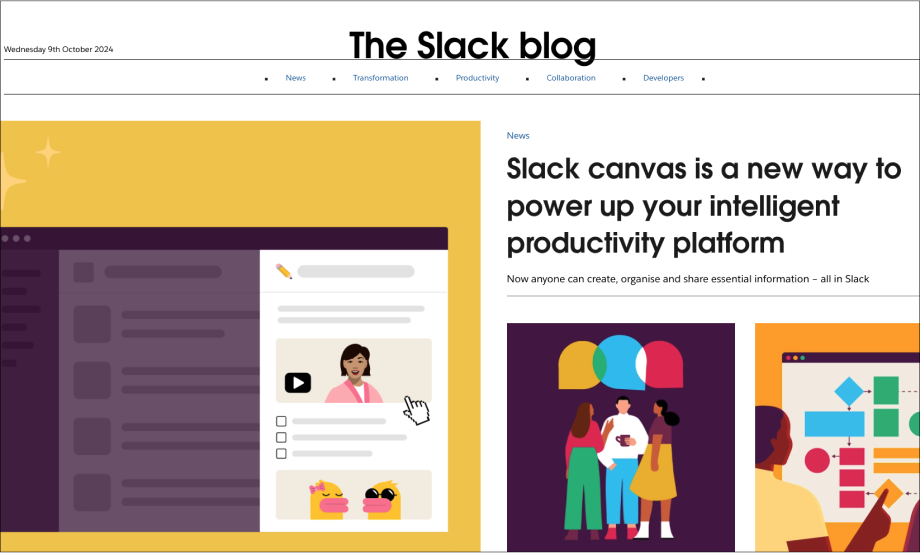
Slack’s blog has four core content pillars which relate to their team communication platform and primary audience of knowledge workers (roles like software engineers, data analysts, researchers, etc).
- Transformation
- Productivity
- Collaboration
- Developers
Bonus: Tabitha Whiting content pillar example 💅
Whilst these content pillar examples from well-known brands are helpful to see how it works in practice, I can’t tell you the thinking behind those content pillar choices.
So, I’ll finish up with one final example of content pillars – my own content pillars for this very website that you find yourself on.
I’m a freelance content writer and strategist who works primarily with B2B SaaS tech start ups.
There are three key personas that make up my target audience:
- The commercial-leaning early-stage startup founder (who is often also the CEO). They know that marketing is important for business growth, but they don’t know how best to approach this or which parts of marketing to focus on.
- The first-hire early-stage startup marketing lead. They’re a marketing expert but they’re a generalist. They’re implementing the foundations of marketing across all channels which includes content, but they’re time-poor and they don’t have specific expertise in content marketing for startups.
- The scale up senior content manager. They’re a content expert who is leading content marketing at their company with a key goal to scale up production and increase revenue impact. They want to continue learning and building their expertise in different content approaches. They want to be part of the current content marketing conversation.
These target audiences and problem areas have led me to the following content pillars for my own content strategy as I’m building my personal brand expertise:
- Content strategy
- Content planning
- SEO
- Content distribution
- Working with freelancers

Each of these content pillars contains content that is specific to the pain points of each target audience.
For instance, for personas 1 and 2 who don’t have content marketing subject knowledge but are exploring content as part of the startup marketing approach, foundational pieces like ‘the complete guide to content marketing for startups’ are valuable.
That piece is way too basic for persona 3 who has been building and executing content strategies for many years – but a blog like ‘the topic cluster model, explained’ might be valuable for them if topic clusters aren’t an approach they’ve come across before.
That’s just a snapshot of the kind of thinking that goes into deciding and developing content pillars, but hopefully it provides a little more context to help inform your own content strategy and creation.
 Tabitha Whiting: High-impact content for high-impact startups