
When it comes to climate campaigns, who delivers the message matters just as much as what’s being said.
For decades, the climate crisis narrative has been dominated by voices that many people simply don’t trust.
From politicians who make empty promises to economists with competing agendas, these messengers have muddied the waters, transforming what is truly accepted science into something that feels like an ongoing debate.
Our receptiveness to climate messages often has less to do with the facts presented and more to do with who’s presenting them.
So who are the trusted messengers that people will actually look up to on climate issues?
And how can we leverage this understanding for more effective climate campaigns?
Table of contents
- Table of contents
- What is a trusted messenger?
- The trusted messenger paradox in climate campaigns
- Who qualifies as a ‘trusted messenger’ on climate change?
- How to find the right trusted messenger for your climate campaign
- Successful examples of trusted messengers in climate campaigns
- In summary
What is a trusted messenger?
Before we dive into the climate campaign side of it, let’s get clear on what we mean by a ‘trusted messenger’.
In communication theory, a trusted messenger is an individual or entity that audiences perceive as credible, authentic, and reliable—someone whose message they’re willing to hear and consider seriously.
Research has consistently shown that when people evaluate information, they place greater weight on the trustworthiness of the messenger than on their expertise alone – it’s something that’s deeply rooted in the way that humans process information and make decisions.
The concept relates closely to the psychological principle of source credibility – wherein the trustworthiness and capability of a person or entity is directly related to how credible they are as a source, and therefore how likely individuals are to believe the information they impart.
It’s a cornerstone of social influence and persuasion theory dating back to Aristotle’s focus on ‘ethos’ in rhetoric to explore the credibility or trustworthiness of a speaker or argument.
Here’s a couple examples of recent research on the topic of trusted messengers to illustrate the importance they hold.
Firstly, a 2022 paper by Loeb et al explored the relative effectiveness of different messengers in communicating public health information and encouraging vaccination during the Covid-19 pandemic.
The key finding was that community-based organisations who already had an established relationship with vulnerable communities were the most effective for these campaigns because pre-existing trust increased their credibility around the highly-debated topic of vaccines.
Interestingly, the study also discovered that trust can be transferred by association – when a primary trusted messenger introduces or endorses a secondary messenger, some of that established trust transfers to the previously unknown entity.
As a second example, a 2023 research paper by Chi-Horng Liao explored how mass media impacts altruistic behaviours. A key insight from the study was that audience trust in the media source is crucial for determining whether information will be perceived as useful and reliable – with trusted sources having far greater influence on attitudes and behaviors.
In the specific context of climate communication, trusted messengers function as individuals who can help “bridge the climate change communication gap” between scientific facts and public understanding.
Communicators like these can transform abstract climate data into climate campaigns that resonate emotionally and culturally with their intended audiences.
The trusted messenger paradox in climate campaigns
When we consider who the most credible messenger for a climate campaign is, the instinct might be to think of climate scientists.
These are the people who have the deepest knowledge of the subject matter, the experts on the matter who audiences will surely respect, right?
Wrong.
The evidence is clear: scientists may be the ones who conduct the research, but they aren’t necessarily the most effective at communicating it – in fact, the public generally has lower trust in scientists than we might expect.
There are several reasons for this trust deficit, with three that research has found to be particularly damning:
- Use of technical jargon
- Unwillingness to speak in ‘certain’ terms
- Too many statistics, a lack of storytelling.
Use of technical jargon forms a communication barrier
Scientific communication relies heavily on specialised terminology that creates significant barriers to public understanding.
Research published in the Journal of Language and Social Psychology found that the mere presence of specialised terminology in science communications triggered negative reactions in audiences, even when definitions were provided (Shulman et al., 2020).
The study demonstrated that jargon doesn’t just make content harder to understand – it actively signals to non-experts that “this message isn’t for them,” creating psychological distance between scientists and public audiences.
Unwillingness to speak in ‘certain’ terms: when scientific caution backfires
Scientists are trained to express appropriate uncertainty and nuance in their findings – the argument being that there is always some level of uncertainty in science, some unknowns that haven’t been factored into a particular piece of research.
It’s a methodological strength that unfortunately becomes a communication weakness in public discourse.
Research published in Nature concluded that uncertainty was found to erode trust in scientists and their research (Howe et al., 2019).
The paper particularly highlighted how the subtle difference between scientific and everyday understandings of “uncertainty” leads to public misinterpretation of normal scientific caution as evidence of disagreement or lack of consensus.
“In scientific discourse, [‘uncertainty’] conveys the degree to which something is known. In the vernacular, the word conveys rather the sense of not knowing”.
The emotional storytelling gap – statistics aren’t enough to persuade
Perhaps most critically, scientific communication often lacks the emotional resonance and narrative structure that research shows is essential for motivating action on climate change.
Scientists typically focus on facts, statistics, and research findings.
In reality, it’s personal stories that make a successful climate campaign.
A study in the journal Climatic Change found that to trigger action on climate change, campaign messages needed to be structured as stories, rather than as analytical presentations of facts. Storytelling facilitates “experiential processing” that heightened emotional engagement and arousal – crucial factors for motivating pro-environmental behavior (Morris et al., 2019).
Research published in Communication Reports provides further evidence that personal stories about climate impacts can shift beliefs and risk perceptions even among political moderates and conservatives – with these effects mediated specifically by emotional reactions like worry and compassion (Gustafson et al., 2020).
Who qualifies as a ‘trusted messenger’ on climate change?
So, if not scientists, who should we be incorporating as trusted messengers for climate campaigns?
A trusted messenger is, quite simply, someone the audience already trusts.
Research from Climate Outreach’s “Britain Talks Climate” study reveals that David Attenborough stands out as the UK’s most universally trusted voice on climate issues.
Described as “a trusted messenger across all seven segments” of British society, Attenborough transcends political and social divides in a way few other public figures can.
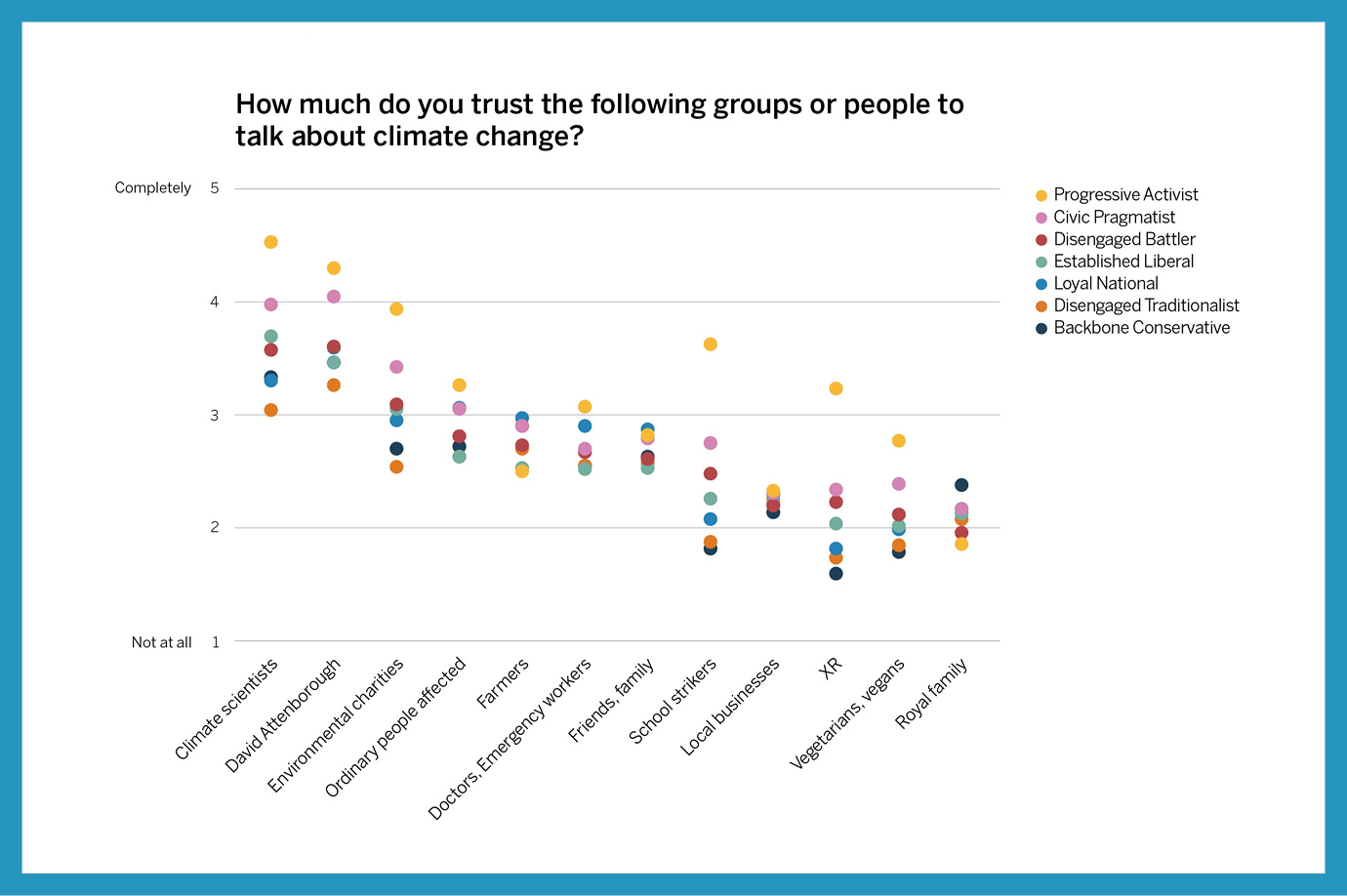
His effectiveness stems not just from his knowledge, but from his authenticity, consistency, and ability to communicate complex ideas in accessible ways.
He connects the scientific reality with the emotional impact in a way that resonates across demographic boundaries – getting that balance between fact and relatable storytelling right, which we’ve seen is vital for success.
But beyond celebrity figures like Attenborough, trusted messengers can come from many places – with different audiences trusting different messengers.
Social identity theory has an important role to play in this, because it’s typically people in our ‘in-group’ who we naturally perceive as trusted figures.
Social identity theory, first proposed by Henri Tajfel in 1979, explains how our sense of self is deeply intertwined with the social groups we belong to. We naturally divide the world into “us” and “them” – those who align with our identity and those who don’t.
With climate change having become an increasingly debated and politically polarising issue, it has, as George Marshall notes in his excellent book Don’t Even Think About It, become “polluted with social meaning.”
It means that we need to be looking to the ‘insiders’ of our audience when we think about the right trusted messengers for climate campaigns, people like:
- Local community leaders
- Religious figures
- Respected professionals (doctors, teachers, etc.)
- Friends and family members
- Social media influencers relevant to specific communities.
The right messenger varies dramatically depending on who you’re trying to reach, so the place to start is always with a deep understanding of your target audience and the people and organisations in their life that they have pre-existing trust with.
How to find the right trusted messenger for your climate campaign
It’s clear that, for those embarking on climate campaigns, getting the messenger and the voice of the campaign right is absolutely crucial for success.
Without the right messenger, the campaign will fall on deaf ears.
With the right messenger, you’ll be able to leverage ‘trust transfer’ – gaining trust from an audience through your organisation’s new association with a voice that they already know and trust. This is especially important for climate campaigns trying to reach skeptical or disengaged audiences.
As we’ve seen, before selecting a messenger for your climate campaign, you need to understand the specific audience you’re trying to reach.
Consider these questions:
- What social circles does your audience belong to? (Professional, religious, cultural, geographic)
- What values and beliefs define these social circles? (Conservative, progressive, traditional, innovation-focused, family-driven)
- Who do these groups typically trust for information? (Both within their immediate social circle and farther afield e.g. social media influencers, media outlets)
- Where do they consume information? (Social platforms, community spaces, traditional media)
- What existing views and knowledge does this audience have about climate issues?
The answers will guide you toward appropriate messengers who can genuinely connect with your target audience.
Successful examples of trusted messengers in climate campaigns
Celebrity messengers: Olivia Colman and Make My Money Matter
One successful example of a trusted messenger in recent climate campaigns is Academy Award-winning actress Olivia Colman’s work with Make My Money Matter.
In late 2023, Colman took on the role of “Oblivia Coalmine,” a villainous fossil fuel CEO in a campaign that exposed how UK pension funds are financing climate damage.

The campaign generated more than 15 million organic YouTube views within just three weeks and led over 70,000 people to visit the organisation’s website to learn more about how their pensions were being invested.
As a widely respected actress with broad appeal across different demographics in the UK, Olivia Colman brought credibility and attention to an issue many people had never considered before.
Campaign director David Hayman noted that having “a well-known and popular spokesperson” helped the campaign go viral, particularly when they can “bring their own personality and humour” to the issue.
By personifying the fossil fuel industry in a darkly comedic way, Colman made a complex financial issue both accessible and emotionally engaging, with a clear story.

Reaching niche audiences through Social media influencers
An increasingly important category of trusted messengers for climate campaigns is social media influencers who have built dedicated followings around specific interests or identities.
Take, for example, Pattie Gonia, a drag queen environmentalist with over 770,000 Instagram followers, who combines LGBTQ+ advocacy with climate activism. By merging these identities, Pattie Gonia (the drag persona of Wyn Wiley) makes climate activism inclusive and accessible to LGBTQ+ communities.
Pattie Gonia has successfully collaborated with major environmental organisations on climate campaigns.
For instance, in 2024, Pattie partnered with The Nature Conservancy on an educational campaign about forest management through controlled forest fires.
The video, which featured Pattie in a fire-inspired dress talking to a firefighter about how indigenous communities have used controlled fires as a forest management tactic for centuries – combatting misunderstanding and promoting greater understanding of environmental and social issues.
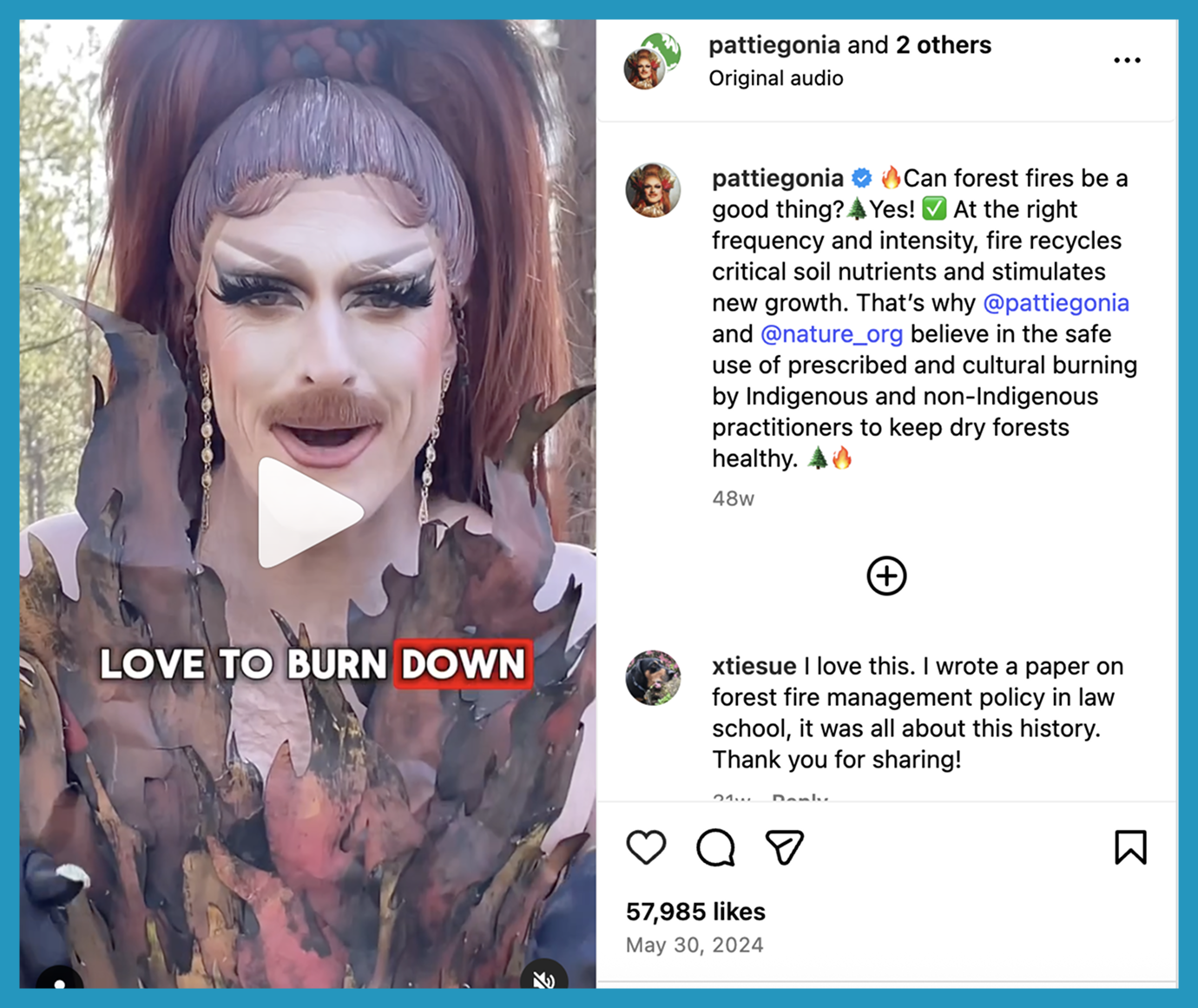
It quickly became The Nature Conservancy’s second-highest performing Instagram reel ever, generating over 210,000 likes and 14,000 shares.
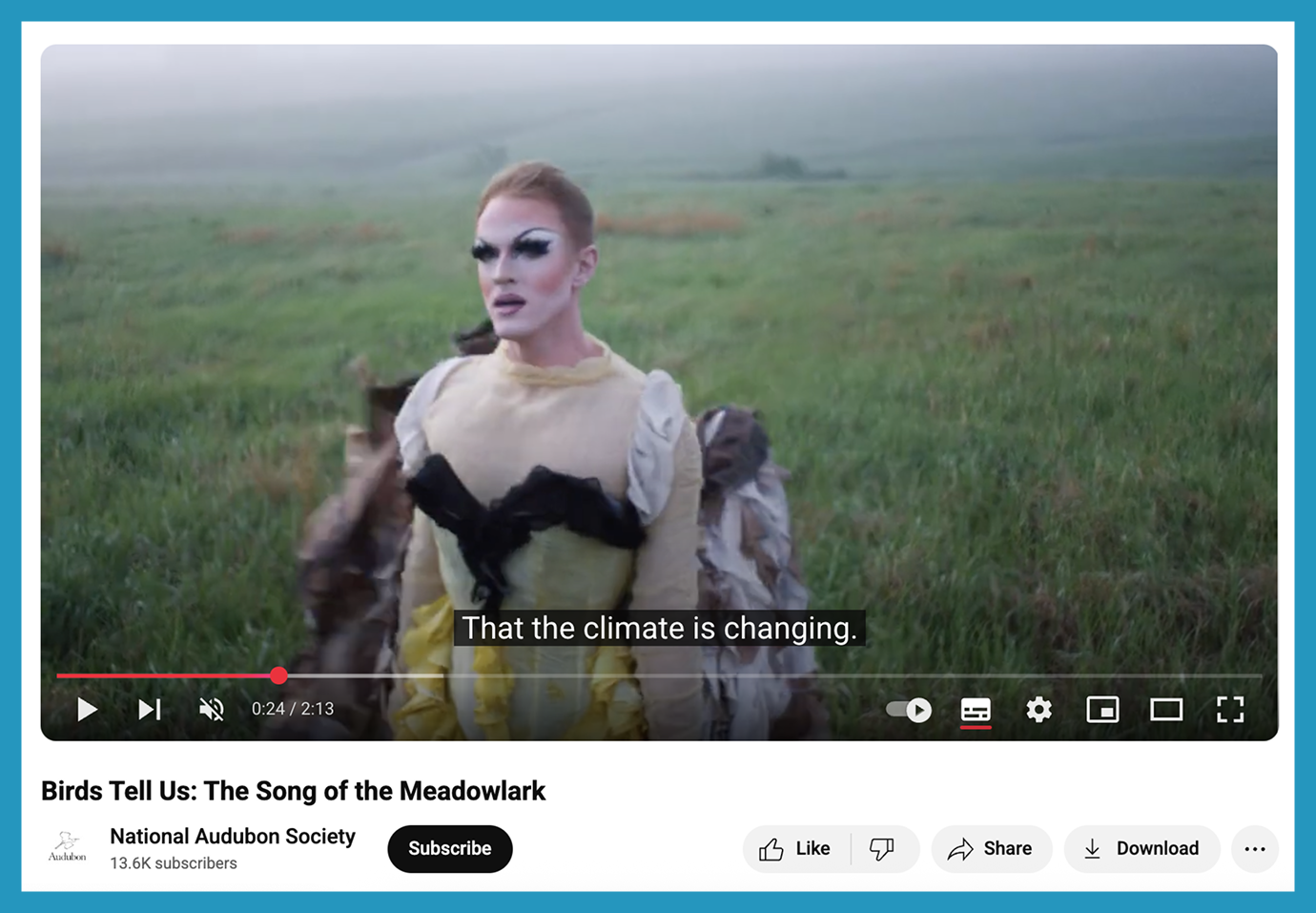
Other campaigns have included a 2023 Pride Month collaboration with the Audubon Society on a YouTube music video ‘The Song of the Meadowlark’ which highlights how climate change is impacting birds – with a hopeful message of ‘let’s go birding together’ aiming to spark action amongst the audience.
The effectiveness of influencers stems from their ability to connect with specific communities through shared identities, interests, and values.
Unlike celebrity messengers who offer broad reach, these influencers provide deep engagement with particular demographic groups who might otherwise be overlooked by mainstream climate campaigns.
Faith leaders as climate messengers: The Islamic Declaration on Climate Change
Faith leaders have emerged as particularly powerful trusted messengers on climate issues, especially in communities where religious identity is central.
Religious leaders shape the attitudes and beliefs of their congregations and are among the most trusted voices in many communities.
The effectiveness of faith leaders as climate messengers stems from their ability to frame climate action in terms of shared religious values.
For example, in 2015 Muslim leaders from 20 countries issued the “Islamic Declaration on Climate Change”, calling for action to phase out greenhouse gas emissions and framing climate protection as a religious duty.

In summary
Finding those trusted messengers who can truly cut through is vital for effective climate campaigns.
In a landscape clouded by denial, fossil fuel industry influence, and greenwashing, the right voices can transform how climate messages are received and acted upon.
The science of climate change is settled. Now, the challenge is ensuring that science is communicated by people your audience is ready to hear.
This article is part of a series on effective climate change communication. Check out the rest of the series:
 Tabitha Whiting: High-impact content for high-impact startups